Rosebud Meets with top level Indian Health Officials

Mary Smith
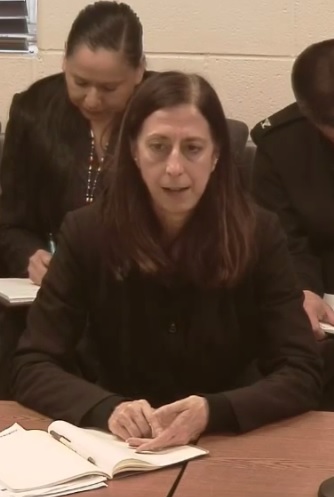
Mary Smith, Principal Deputy Director of the Indian Health Service, was accompanied by a team of federal employees at the April 7 meeting with the Rosebud Sioux Tribe’s Health Board. Photo from YouTube.com

By Vi Waln

ROSEBUD – Members of the Rosebud Sioux Tribal Health Board recently spent over 4 hours discussing the future of the Rosebud Hospital with several officials from the Indian Health Service (IHS).


The Emergency Room at the Rosebud Hospital has been closed since December 5, 2015 after officials from the Centers for Medicaid and Medicare found at least 3 patients had been exposed to unsafe conditions. The 3 cases involved a cardiac patient, an OB patient and trauma on a pediatric patient.


“I want to say at the outset, the conditions at the hospital and what has happened with CMS are unacceptable. We are committed to making change and that’s why we’re here,” stated Mary Smith, Principal Deputy Director of the Indian Health Service. We have been working on the corrective action plan. We do want to open the Emergency Department as soon as possible. It is one of the highest priorities at IHS.”


“We want to open the emergency department when we have a full staff of physicians and nurses, when we are able to meet the CMS requirements and when we will be providing high quality patient care, that is our goal and you deserve no less. That’s why we’re here,” Smith continued.


“We are committed to opening the [Emergency Room] as soon as possible,” Smith told Health Board members. She was unable to give a definite date when the ER would be open. IHS has issued a request for proposals (RFP) to contract out and manage of the Emergency Departments at Rosebud, Pine Ridge and Winnebago. IHS hopes to award the contract in June.


Since the diversion took effect, patients needing care for serious conditions are transferred to off-reservation facilities. Many are taken directly by ambulance to hospitals in Winner, Martin or Valentine. The ER diversion has taken a toll on both the ambulance staff and vehicles.


“We ran 6 ambulances into the ground,” stated Willie Bear Shield, Chairman of the RST Health Board. “We need 2 handicap vans for transport. We still hold your agency for their word that all costs would be taken care of while we were in this immediate jeopardy status.”


The diversion of the emergency room came on the heels of a Notice of Intent to Terminate the Medicare Provider agreement, sent to the Rosebud Hospital from CMS last fall. CMS initially determined that the deficiencies identified in their recent survey were so serious that they constituted an immediate and serious threat to the health and safety of any individual who comes to the hospital to receive emergency services.


CMS subsequently granted at least 2 extensions to the Rosebud Hospital to correct deficiencies. The most recent extension was granted on March 4, 2016. The letter states in part “CMS therefore agrees to extend the termination date of the hospital’s Medicare Provider Agreement from March 16, 2016 to May 16, 2016. However, in the event that IHS and CMS are unable to agree on the terms of an SIA [Systems Improvement Agreement] for the Rosebud IHS Hospital and an SIA has not been signed by the close of business on April 29, 2016, CMS will offer no further extensions, and the Medicare Provider Agreement between CMS and the Rosebud IHS hospital will be terminated at the close of business on May 16, 2016.”
Voting Doesn’t Make You White

Native_Vote_ad_revised

By Vi Waln

Tribal people born in this country weren’t considered American citizens until June 2, 1924. This means we’ve only been recognized as citizens of this country for 92 years. Some of us have grandparents who were granted American citizenship when they were children. Our great-grandparents were not considered American citizens, even though they were born and died on this continent. Consequently, citizens of the United States are granted certain rights and responsibilities. Our lives can definitely improve when we take advantage of all the rights that come with being a US citizen.


Despite our recognition as American citizens, there are many tribal people who would rather not acknowledge their citizenship. In fact, there are tribal people whom actively reject their citizenship. Many tribal people reject American citizenship as a form of protest against the US Government. I understand their position and tend to agree with many of them.


Still, we do live here in this country. Most of us aren’t planning to go anywhere. So, we do have the right to take advantage of certain privileges which are available to us as American citizens. I don’t see my tribal citizenship diminished by my choice to take advantage of the rights granted to American citizens.


One of the privileges we have as American citizens is our right to vote in tribal, county, state and national elections. Voting in elections doesn’t make you “white” or mean you are assimilated. Exercising your right to vote means you are taking an active role in determining who is elected to represent you.


There are many people in our county, state and country who don’t want tribal citizens to vote. It brings them great satisfaction to know tribal citizens won’t get out and vote. They also know that when tribal citizens do decide to take an active role in elections, we will have the collective power to easily elect candidates who will work hard to ensure that many issues facing tribes are improved.


You have the responsibility to decide who is put into office to make decisions for you and your family. Our children need all of us to vote. The quality of our lives, as well as our children’s lives, depends on voting in honest, qualified, ethical leaders who will act with integrity.


All across this country there are people who make a choice NOT to participate in the election process. We are currently in a Presidential Election year. Many of us are tired of the campaigning craziness we are watching in the news. Unfortunately, we still have 8 months to continue being bombarded with the often unscrupulous campaign antics of the current US Presidential hopefuls.


Even though I tend to disagree with the philosophy of political candidates on nearly all levels, I still exercise my right to vote. My vote counts because I am an important citizen with a voice that people need to hear. I vote in all elections I am eligible for – tribal, county, state and federal. My ancestors sacrificed their lives so we could continue to live on this Turtle Island. I am not about to disregard their sacrifice by refusing to vote.


Many of you believe your vote doesn’t make a difference. However, an example of the Native Vote making a difference in a key election was when Tim Johnson beat John Thune in 2002 for the US Senate seat. The voters on the Pine Ridge Reservation exercised their right to cast ballots during that election to put Johnson in office.


The voters living in Todd County have a chance to do the same this summer during the Todd County School Board election. Voters wanting to see change in their student’s classroom would do well to go to the polls and election qualified, educated people to the school board. I believe former educators are highly qualified to serve as school board members, as they have spent time as either teachers or administrators. Who else knows the needs of students better?


You have the power to elect people to the Todd County School Board who will look out for the educational interests of your students. School boards should not be political, but unfortunately they often are. Some school board members will discount the concerns you’ve voiced as mere rumors. When a governing body allows politics to drive their decisions, they will often overlook the people they are supposed to be serving. The students attending the Todd County School District need school board members who care about quality education.


The Rosebud Sioux Tribal Education Department, as well as the Education Committee, encourages all tribal citizens to register to vote today! Cast your vote in the June 2016 School Board Election. Vote for former educators who are familiar with your students.


The power of change is in your hands, don’t let it slip away.


The Power of Change is in Your Hands

real-mission-

By Vi Waln

Many Lakota parents living on the Rosebud Reservation are completely dissatisfied with the public system currently serving our K-12 students. Issues with curriculum, staff, teachers, administrators and school board members are the topics of discussion amongst many local people. Long-term employees are also speaking out about internal problems, as well as political favoritism being practiced, within the Todd County School District (TCSD). In fact, many long-term employees feel they are being targeted for removal by administrators and school board members.


This summer you have the power to effect change in this dismal educational system currently failing the majority of our Lakota students. That is, there are two vacancies on the Todd County School Board and an election will take place in June 2016. Consequently, you will likely see some excellent Lakota educators appearing on the ballot as candidates.


We are responsible for our children’s future. Part of that responsibility is ensuring that qualified people with the proper credentials are put in charge of overseeing the public school system serving our students on the Rosebud Reservation. One way to actively show responsibility for our children’s collective future is by registering to vote today.


The TCSD definitely serves a majority of Lakota students. Our voting power is the only certain way to change the direction of the public school system on the Rosebud Reservation. The district must now move forward to be more proactive to the needs of all students, in order to ensure a successful start in life.


Registering to vote is only the first step. We also have a responsibility to follow through by going to the polls in June to elect qualified Lakota people, who will work hard by speaking out to affect real change to the unresponsive educational system now serving our students. A transition must be made now from a system which is failing our students, to one which approaches contemporary, educational needs from a true Lakota perspective.


Some of the Lakota people who are running for these positions have spent their lives here on the Rosebud Reservation. They have worked as teachers or administrators. As educated Lakota people who have dedicated their lives to our students, they are highly qualified to be elected as school board members. I believe they will work to make changes which will benefit all of our students attending the TCSD.


The power to move these changes into reality lies in your vote. Our Lakota children deserve a school board which is comprised of qualified members who have knowledge of what is needed in the classroom. The only people who could possibly know what is needed in the classrooms are those who actually spent time there.


The time is now to rid our school district of board members who don’t care about tribal values or Lakota students. These are your elected representatives who would rather spend their time playing petty politics with staff and parents. We deserve better!


Many of us are actively listening to complaints about how the TCSD is failing our Lakota students. We have to take action now. There is no time left to discuss the problems. Register to vote today. Go to the polls in June and cast your vote for an educated Lakota candidate who has experience as a classroom teacher and/or administrator.


Many Lakota families with students enrolled in the TCSD believe money spent sending school board members on travel to party at national conferences would be better spent on academic improvement. Your vote is needed to elect experienced Lakota educators who have dedicated their lives to teaching our precious children and teenagers. The power of change is in your hands.


Aske Win: A Lakota Ancestor

12771480_1048143345232443_6724152114318327095_o
“Get up early to greet the Morning Star and Tunkasila will bless you all day.” ~Dinah Crow Dog-Running (Aske Win) 1933-2006. Photo by Vi Waln

By Vi Waln

“Get up early to greet the Morning Star and Tunkasila will bless you all day.” ~Dinah Crow Dog-Running (Aske Win) 1933-2006


March is Women’s History Month. Most of the commemorations related to Women’s History in this country are focused on females of European descent. For instance, Susan B. Anthony is a woman well referenced in American History books. She worked for women to have the right to vote.


Consequently, we rarely read about the contributions of Lakota women during Women’s History Month. There are many tribal women who have contributed a lot to our society. They are rarely spotlighted by the American media; still, it’s important to teach our children about them.


So, this week I want to remember the late Sicangu Lakota elder, Dinah Crow Dog-Running (Aske Win). She was a Tuwin to me, yet the relationship we had was also one of great friendship. So, despite our difference in age, she was one of my beloved Maske. She was my spiritual counselor. She shared many of her teachings with me about our Lakota way of life.


For example, Dinah always stressed the importance of nutrition. She helped me understand how crucial it is for women to take the utmost care in preparing the food we feed our children. She often spoke about the nutrition law of our people. I doubt many of our people truly understand the law of nutrition in the same way our ancestors did.


She helped me understand the importance of food to our body, mind, emotions and spirit. For instance, we put our energy into whatever we create, including meals. I believe that’s the reason for certain cooks we know, like our Ina or Unci, having the ability to create those delicious meals we love to eat. They carry the family love energy and that is what they put into their meals.


The energy we put into creating our meals is the most important ingredient. The food we prepare and feed our children helps them to grow into responsible Lakota adults. In addition, Dinah was asked on a regular basis to prepare spiritual food for different occasions. She was instrumental during times when a local family wanted to honor one of their own, or when a family was spiritually devastated.


I will never forget her taking the time to prepare the wasna for my late Takoja to take on her spiritual journey. The simple ceremony she conducted when feeding my Takoja’s spirit still helps me get through hard times even today. Consequently, Dinah’s interpretation of nutritional law was carried into the next world by those lucky enough to be blessed with the spiritual food she created and shared with their spirit.


Maske Dinah was also an articulate orator. I witnessed her addressing the Governor of South Dakota in his mansion in 2003. She offered him much wisdom to move forward during his term in office, suggesting practical ways to include the Lakota tribes of this state. Of course, he did not take her advice.


During her time here on Earth, she did serve as a representative on the Rosebud Sioux Tribal Council. In her later years, I was privileged to hear Dinah publicly address the tribal council on many occasions when I attended meetings with her. She also offered sound, sensible advice as well as suggestions addressing the needs of our people. However, I don’t ever recall the tribal council incorporating her advice or following through with her suggestions.


I also attended many ceremonies which Dinah was an essential part of. She helped many women in ways that are indescribable. Her prayers were very powerful. The sacred ceremonies she participated in were greatly enhanced by her presence.


She could see the truth inside people. It was often intimidating to those who had something to hide. Yet, the things she saw inside people helped her to understand human nature more clearly. There were times when she could see things in people who were close to me. This would prompt her to offer me advice based on her perceptions. Her intuition about people was never wrong.


Dinah walked on from this life on February 27, 2006. I miss her early morning calls. I miss listening to her talk and laugh as we rode to meetings together. I miss seeing her at wacipis, the sun dance and Native American Church ceremonies. Some days I could really use her wisdom, as well as her humor.


Aske Win is one of our Lakota ancestors. Remember her in your prayers. She and the multitude of Lakota ancestors are there to help us walk this human path.


Meth


effects_of_meth
Courtesy Photo

By Vi Waln

Rumors and gossip are behaviors unbecoming to Lakota people. Yet, I realize a lot of you thrive on adding more distorted tidbits to an outlandish tale another person has told you. Many reporters can tell you about the calls or emails they receive on an issue or event that people ask them to write about. Our reputation as writers only goes as far as our ability to accurately report a chain of events, or address controversial issues.

Over the years, I’ve had many people talk to me about something they would like to see printed in the newspaper. I’ve dealt with honest people who sincerely want the public to read about an important issue, as well as people who want to see dramatic stories in print. It’s unfortunate that many prefer sensationalism, instead of reading an accurate account of what happened.

People are actually addicted to the negativity happening every day in their community. We need to examine why that is, because when we thrive on talking about drama, even when it isn’t true, we miss seeing the areas of our lives which need improving. There are always areas in our lives or family needing attention. Personally, I would rather focus on myself and my immediate family. I make a choice not to waste energy focusing on negative events happening in my community.

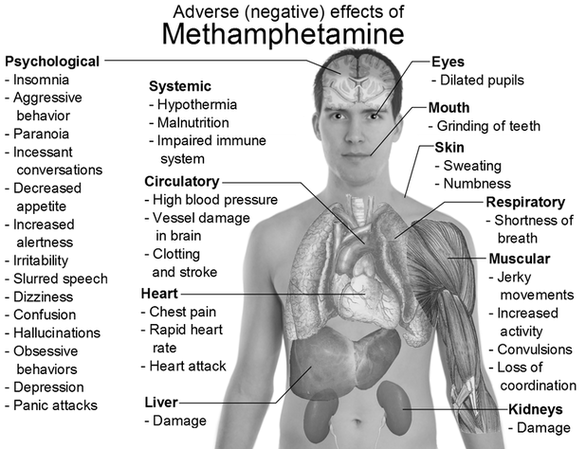
This past week on the Rosebud was a prime example of negativity, gossip and sensationalism. It all started when the Testing-Demo-Cleaning Department (TDC) of Sicangu Wiconi Awayankapi (SWA) gave a demonstration to the Tribal Council at a meeting I didn’t attend or watch. The demonstration entailed a process followed when SWA is faced with testing a house allegedly contaminated by methamphetamine use by a tenant.

Since I didn’t attend that particular meeting, I was later informed by a tribal council representative that there was a set agenda with SWA in attendance to address homeless issues and the prevalence of meth use on Rosebud. SWA did give a presentation on meth testing, due to the number of houses being contaminated. One council representative had questions on the specifics of testing the housing units, so SWA was asked to bring their machine and demonstrate.

Testing was done, and as unofficially reported through an online blog, some of the furniture in the Council Chambers tested positive. Tribal Council then requested impromptu testing of all representatives present, as well as all the employees working in the tribal building. In addition, the tribal building was shut down on Thursday afternoon for further testing and sanitation by SWA employees, as requested by tribal officials. The tribal building was open again on Friday.

There were many stories uttered on the reservation about this incident. I thought it was pretty crazy, as many of the stories sounded extremely far-fetched. But that is the nature of rumors and gossip, the more something is repeated, the more skewed it gets. The fact that some local people I once thought highly of were repeating stories sounding absolutely ridiculous, made me wonder why I thought so highly of them in the first place.

Tribal council set an example by ordering drug tests. Many tribal citizens would like to see all tribal directors and employees tested too. Drug test results are confidential. Still, I believe the mass drug testing of all tribal employees could possibly weed out (no pun intended) substance abusers from our programs. Drug and alcohol addicts bring down overall productivity. Our tribe cannot move forward when the majority of its members are addicted to substances, whether they are legal (vodka, beer, morphine or hydrocodone) or illegal (meth, heroin, etc.).

Drugs are poisons. When we ingest any type of drug, legal or illegal, our bodies tend to work to remove the poison. Our body excrements, such as sweat, urine and feces, contain waste matter. Whatever poison you are using, like vodka or meth, also leaves your body when you sweat or use the restroom. And when you are sweating, the toxins contained in the sweat will be absorbed by your clothing, as well as the surfaces you come into contact with.

The general public does have access to the council chambers, as well as most of the offices in the tribal building. Lots of people sit on the chairs in that building. Lots of people lean on the tables and against the walls. These actions leave behind sweat and body oils, along with whatever substance the person has ingested. So, it was no surprise that certain areas in the tribal building tested positive for drugs. After all, we do have a wide-spread drug problem that is out of control. I’m sure a lot of drug users visit the tribal office on a daily basis for a variety of reasons.

I’m in favor of testing all elected tribal officials, as well as all tribal directors, tribal employees and political appointees. Testing everyone will send a message that our tribe is serious about eradicating drug users on the payroll. But let’s not forget how many of our people who don’t work for the tribe are actively using drugs. People who use drugs also regularly visit the hospital, university and other program buildings. It’s really not fair to place all the blame on the tribal workforce or elected officials.

Alcoholics and drug addicts need prayers. They need help. The families who are dealing with them also need help. Our children are precious and are being exposed to dangerous drugs that people my age knew nothing about while we were growing up. It’s going to take all of us working hard to clean up our tribe.

Does anyone besides me wonder how things would change if people chose to pray instead of repeating wild rumors?

Tribal Students Need Relevant Education

Constitution Picture

Recently, my Takoja came home from school and asked me if George Washington was white. A strange question, but since it is February I figured the class was learning about US Presidents. So I told him, yes George Washington was white. Then I asked my Takoja if he knew who the President of the Rosebud Sioux Tribe was. He couldn’t answer.

Our local schools are failing our children by not including material relevant to their lives as tribal citizens. Students who live on the reservation need to learn about everyday issues that apply to them as tribal citizens, including their own tribal government. If the local public and tribal schools offers lessons on US history, which teaches our children all about US Presidents, they also need to include tribal history.

Many Lakota people who grow up on our homelands often choose to stay here. We might attend an off-reservation college or university, but many of us return to the area where we grew up. We have to know the history of our homelands. We have to learn about our tribal government. We have to learn about our own Lakota culture.

Teaching our students only about the relevance of the US government and their history is an incomplete education. Our Lakota students should know about tribal government when they graduate from high school. Unfortunately, many high school graduates have no idea of what their own tribal government does.

I am sure there are a few local teachers who incorporate tribal government, history and cultural information into their lessons. But they are the exception. Most of the teachers working in our homelands did not grow up here. They do not understand the relevance of including teachings about the Lakota people to Lakota students.

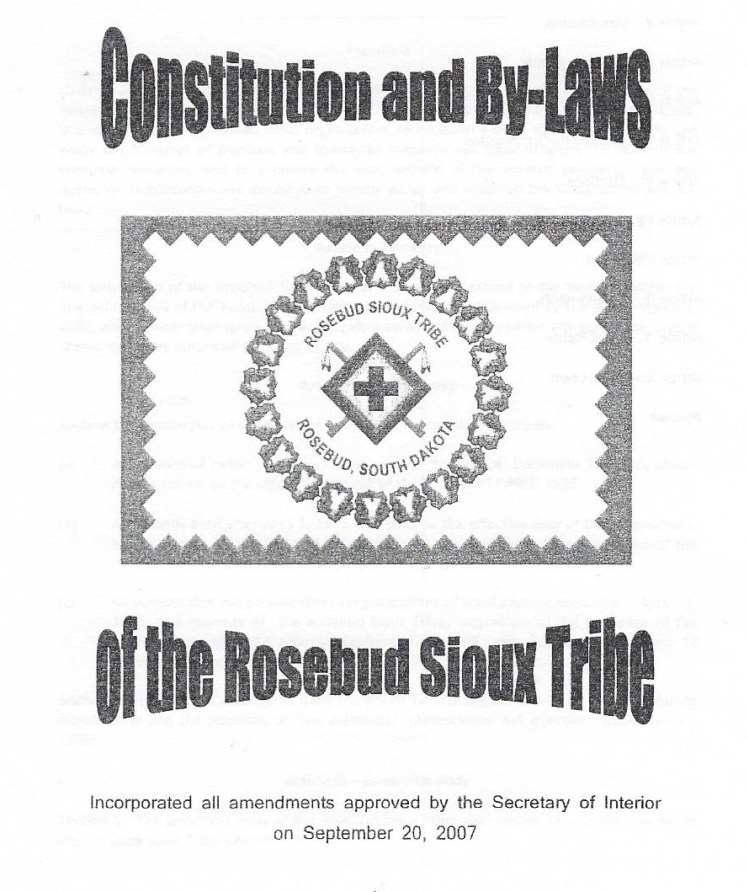
Our students should be exposed to basic lessons about tribal government beginning in Kindergarten. An idea Lakota curriculum would include lessons about the 1924 Indian Citizenship Act. Our elementary, middle and high school students should also be studying the Constitution and By-Laws of the Rosebud Sioux Tribe, which was adopted in 1934; learning about the subsequent amendments to our Constitution and By-Laws is also important.

Additional curriculum should include studying the Corporate Charter of the Rosebud Sioux Tribe, as well as the amendments to this document. The Indian Reorganization Act (IRA) of 1934 is an important piece of legislation that has affected us for the last 82 years. Our students should be learning about the original IRA as well as amendments made to this document.

In addition, the Rosebud Sioux Tribe has established numerous resolutions, ordinances and codes. Again, our local students graduate from high school without knowing much about their own tribal government. Our tribal government could operate much better if our young people were educated about how the system works. Our educational systems have failed us as Lakota people because of the limited curriculum covering the historical and contemporary governance systems which apply to us.

Also, many of our tribal students might have learned about what the stars and stripes represent on the American flag. Yet, many do not have any idea what the symbols on the Rosebud Sioux Tribal Flag represent.

The Rosebud Sioux Tribe has elected 40 Presidents since the IRA was incorporated. Our children know who George Washington was, but the majority of them do not know who the first President of the Rosebud Sioux Tribe was. Many of our Lakota students, like my Takoja, cannot tell you who the current President of the Rosebud Sioux Tribe is.

Our students can succeed when what they learn is meaningful to them. It wouldn’t take much to incorporate lessons surrounding the Rosebud Sioux Tribe into the local schools’ curriculum. I challenge the school board members, administrators and teachers at the St. Francis Indian School and the Todd County School District to provide more curriculum on local tribal government to the K-12 students currently attending our local schools. After all, they are our future leaders.

Our schools are there to educate our children. I believe they have a responsibility to provide our Lakota students with a relevant education about how their own tribal government operates.

AIFRA Amendments of 1994 do not include Marijuana

800px-Cannabis_Plant
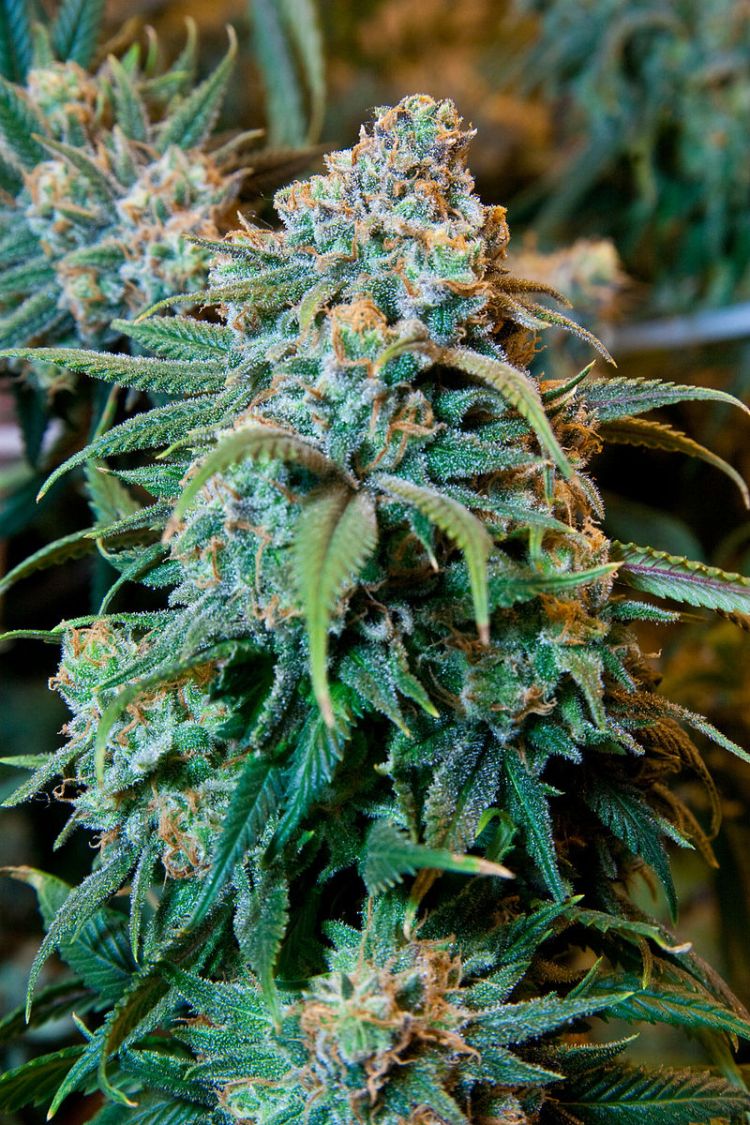
Cannabis Courtesy Photo

By Vi Waln

The American Indian Religious Freedom Act (AIRFA) Amendments of 1994 were established to protect members of federally-recognized Indian tribes who attend Native American Church (NAC) ceremonies and ingest peyote. The AIRFA also allows members of federally recognized tribes to obtain permits to buy, possess and transport peyote for use in bona fide ceremonies.

According to Wikipedia, Section 2 of the Act speaks to the “Traditional Indian Religious Use of the Peyote Sacrament,” and reads in part:

(c) For purposes of this section – (1) the term ‘Indian’ means a member of an Indian tribe; (2) the term ‘Indian tribe’ means any tribe, band, nation, pueblo, or other organized group or community of Indians. . .(3) the term ‘Indian religion’ means any religion – (A) which is practiced by Indians, and (B) the origin and interpretation of which is from within a traditional Indian culture or community; and (4) the term ‘State’ means any State of the United States, and any political subdivision thereof.

People must be enrolled members of federally recognized tribes to either possess peyote or attend NAC services. Consequently, this law applies only to peyote. The AIRFA Acts of 1994 were not created to recognize religious organizations where other controlled substances, such as marijuana or ayahuasca, are used.

James “Flaming Eagle” Mooney, who has been in the news many times over the last several years, made headlines again last month with claims that sacramental marijuana was seized by officials. Mooney, along with Joy Graves, claim to be leaders of the bogus Oklevueha NAC based in Gunnison, Utah. According an article published on January 26, 2016 on the Court House News website, the pair is suing the US government, along with the US Postal Service, in Federal Court for seizing the marijuana.

Consequently, Mooney, along with his wife Linda, were caught with 12,000 peyote buttons, which were seized by law enforcement, in 2000. The non-Indian couple subsequently agreed to stop using peyote as a condition of the dismissal of several charges involving a controlled substance. So, the Oklevueha chapter is not affiliated with any bona fide NAC which considers peyote as a sacrament.

The article also states that “Graves says she mailed 5 ounces of marijuana to a church member in Ohio on Dec. 10 last year, but it never arrived. A week after she mailed it, she says, the Post Office’s tracking website reported that her package had been seized by law enforcement.”

Mooney and Graves claim that their marijuana is considered a sacrament and was seized illegally. Marijuana is legal in Oregon, where Graves heads up a bogus NAC chapter. However, it is illegal to send marijuana through the mail. Again, the AIRFA Amendments of 1994 don’t apply to marijuana.

Consequently, a Brief of Amici Curiae was filed in 2014 with the Ninth Circuit Court by the National Council of Native American Churches, The Native American Church of North America, The Azzee’ Bee Nahaga of Diné Nation and both The Native American Churches of Oklahoma and South Dakota. This brief was filed in Docket No. 14-15143: Oklevueha Native American Church of Hawaii, Inc.; Michael Rex “Raging Bear” Mooney (Plaintiff/Appellants) v. Eric H. Holder, Jr., as US Attorney General, et al. The brief states:

The Amici NAC organizations do not recognize Oklevueha as a chapter, nor does it recognize Mooney as a member. In addition, Amici organizations do not recognize, condone, or allow the religious use of marijuana, or any other substance other than peyote in any of its religious services. To the contrary, the only plant that serves as a sacrament in the NAC is peyote, and without peyote, the NAC services could not take place. The Amici organizations fully reject Appellants’ contention that marijuana serves as a substitute for peyote in services of any Native American Church.

Similarly, the AIRFA Amendments do not apply in this case. The statute expressly and exclusively provides an exemption to federal and state drug laws for members of federally-recognized Indian tribes who use peyote in traditional Indian religious practices. Mr. Mooney, by his own admission, not a member of a federally-recognized tribe, and in this case, neither he nor Oklevueha seeks legal protection for the use of peyote. The AIRFA Amendments do not apply in a case like this one where an individual who is not a member of a federally recognized tribe seeks legal protection for the possession, use, and distribution of marijuana.

Mooney has a website where he claims to have been given a blessing in 1998 by the late Leslie Fool Bull, who served as the Chairman of the Native American Church of South Dakota. Mooney alleges that he was told by the late Fool Bull to “take this medicine to the white man.” He also claims on his website that this “blessing” was witnessed by Kirk Fool Bull, son of the late spiritual leader.

However, in an affidavit dated January 28, 2016, Kirk Fool Bull denies witnessing his late father giving Mooney any kind of blessing to distribute peyote to non-Indians. The late Leslie Fool Bull only wished Mooney safe travels, after the non-Indian paid the late Fool Bull an impromptu visit in the Rapid City Regional Hospital. Kirk also states in his affidavit he only gave Mooney his phone number so the non-Indian could call when he returned home safely.

Mooney is dangerous. He puts our right to use and possess the sacred peyote at risk with his attempt to include the use of marijuana in the AIRFA. Our medicine people fought hard to guarantee our freedom to attend our sacred NAC ceremonies and use peyote as a sacrament. Mooney, as well as countless non-Indians like him, are a threat to that freedom.

Flag flown at half-staff at Fort Laramie in memory of Lakota woman

Mary Miley's avatarHonoring Maynadier & Spotted Tail

This was in the StarHerald on Jan. 31:

54cc06413dc8c.image

In respect for and remembrance of Mary Jane Spotted Tail, the flag flew at half-staff at Fort Laramie National Historic Site on an uncharacteristically calm morning at the Grand Old Fort on Friday. Mary Jane is the direct descendant of Lakota Sioux Chief Spotted Tail and his beloved daughter, Mni Akuwin, who he buried at Fort Laramie in 1866 per her last request.
Mary Jane Spotted Tail was instrumental in having Mni Akuwin re-interred at Fort Laramie NHS in June 2005, and in 2007, with adopting the descendants of Col. Henry Maynadier, commanding officer of the Fort at the time of the original burial, into the Spotted Tail family. A memorial to Mni Akuwin is located on the hill near the hospital ruins, and plans are being made to establish a memorial to Mary Jane at the site by descendents of both…

View original post 18 more words

Sicangu Youth Council Seeks Help with Research


001
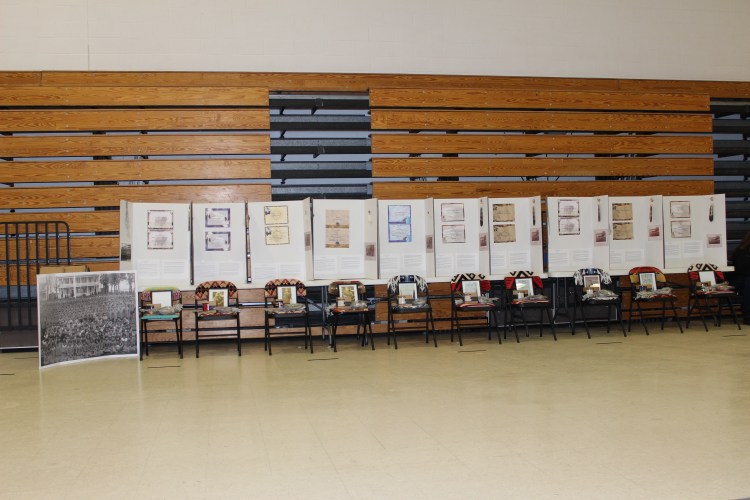
The Sicangu Youth Council put together a display honoring the 10 known students who are buried in a cemetery in Carlisle, Pennsylvania. The traveling display was set up during the Sinte Gleska University Founder’s Day Activities last week. Photo by Vi Waln.

By Vi Waln

ROSEBUD – The Sicangu Youth Council is asking local families to search their family tree to see if they could possibly be related to any of the students who are buried in the cemetery at Carlisle, Pennsylvania.

The youth group has identified at least 10 students with ties to Rosebud who are buried in Carlisle’s cemetery. Other relatives could also be buried there. Several local family surnames can be traced to students who attended the Carlisle Indian Industrial School from 1879-1918. The names are included in the following paragraphs.

Chief White Thunder’s Son and Sister-in-Law: Knocks Off and White Cow.

Children and relatives of Black Crow: Plenty Aunt, Strikes The Enemy, Passes Through The Enemy and Rain Water.

Chief Iron Shell’s children and relatives: Thunder, Short Leg, Runs After The Moon, Her Pipe and Looking Woman.

Children and relatives of Chief Blue Tomahawk: Joe Taylor, Strikes First, Warrior and Ear.

Children and relatives of Good Voice: Bull Man, Kills, Looking Woman and White Woman.

Children and relatives of Whirlwind Soldier: Frog, Kills Without Wounding, Running Horse and Big Boy Earth.

Children and relatives of Big Star: Henry Thigh, Frank Yellow Bird, Young Bird and Little Girl.

Children and relatives of Geese: Behind, White Man, Little Man, Hawk Charging Daylight, Kills Without Wounding, White Whirlwind, Yellow Ear, Shoes and White Horse.

Children and relatives of Coarse Voice: Little Wolf, One That Kills 7 Horses, Wind Blows, White Whirlwind, Negut, Chit-set-suh, Passon, Buckskin Jim, Smoke, Shevano, Piah and Kopesit.

Children and relatives of Fills The Pipe: Makes Trouble in the Front, Runs in the Clouds, Crockery Face and Yellow Lod.

Children and relatives of Chief Quick Bear: Wants To Be Chief, Kills Plenty, Kills The Enemy and Paints Dust.

Interpreter Tackett and children of Spotted Tail: Tackett, Stays At Home, Little Scout, Bugler and Talks With Bears.

Children and relatives of High Bear: High Bear, Yellow Jack, Yellow Hair and Pretty Woman.

Children and relatives of Iron Wings: Red Medicine, Bull Man, Mrs. McKenzie and Looking Woman.

If you have any questions or would like more information on how to research your family tree, please contact Marcida Eagle Bear at (605) 441-5668 or the Tribal Historic Preservation Office (605)747-4255.

Dances With Wolves Star Visits Rosebud


Mary McDonnell II
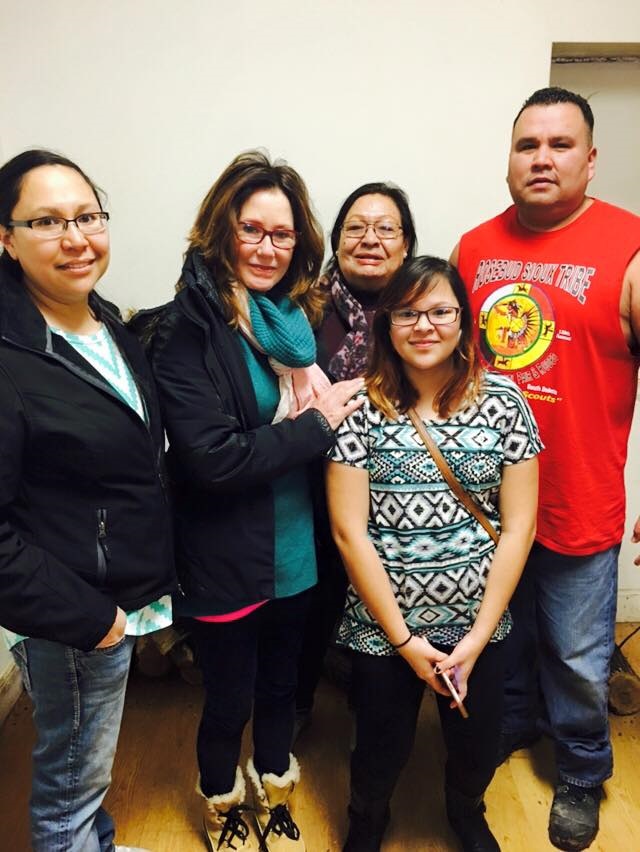
Mary McDonnell attended a birthday celebration held in rural Parmelee for spiritual leader Roy Stone, Sr. She was also adopted as a daughter in a Hunka ceremony by the late Fred and Doris Leader Charge. She is pictured here with her Hunka relatives, Shelley Means, Rita Means, Shylee Brave and Damon Leader Charge. Courtesy photo.


By Vi Waln

ROSEBUD – Mary McDonnell, the actress who played Stands With A Fist in the movie Dances With Wolves, spent the weekend in Rosebud.

The actress attended SGU Founder’s Day activities over the weekend. She facilitated an acting class for interested people on the SGU campus on Friday morning. She also participated a wacipi grand entry and was publicly honored by SGU.

“28 years ago I came here for the first time,” stated McDonnell at the honoring hosted by Sinte Gleska University (SGU). “Doris Leader Charge took me under her wing and she taught me many things about all of you. She took me to my first pow-wow. I’m very proud to be associated with Sinte Gleska University. I’m deeply grateful to all of you. It’s a whole lot of fun to be here.”

She took time to attend a Saturday afternoon celebration in rural Parmelee organized by family members of Chief Roy Stone, Sr. in honor of his birthday.

McDonnell received an Academy Award Nomination for Best Supporting Actress for her role in the 1990 movie. She learned her Lakota lines for the movie from the late Doris Leader Charge and the late Albert White Hat, Sr.

The public came forward to shake hands with McDonnell during an honor song for her at the wacipi Saturday evening. In addition, many local citizens posted pictures of themselves with McDonnell on their Facebook pages over the weekend. McDonnell currently stars in the TNT series Major Crimes, in the role of a police officer working in the major crimes division.