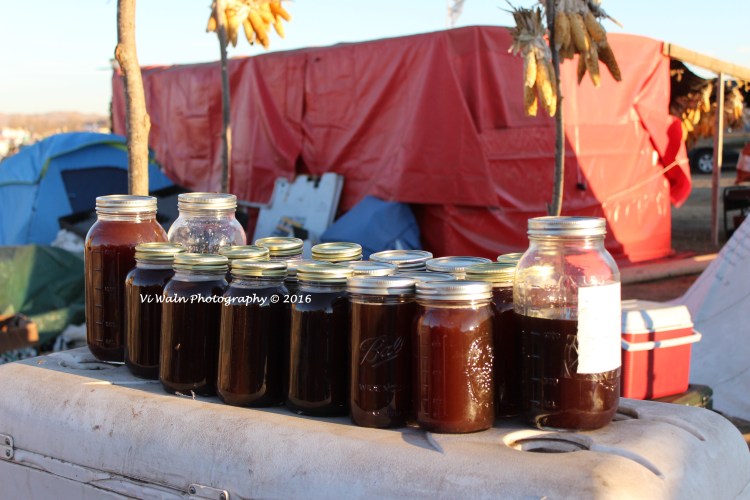
Several jars of herbal cough syrup were distributed to Water Protectors.
By Vi Waln
CANNON BALL – Anne White Hat, Sicangu Lakota Herbalist, created several remedies which were recently distributed to the Water Protectors residing in the Sacred Stone, Rosebud and Oceti Sakowin camps.
“I make an amazing cough syrup that is so good you can put it on your pancakes,” stated White Hat. She recently led a workshop to make the cough syrup at the Oceti Sakowin Camp. Herbs, raw honey and Mason jars donated to the camps were all utilized in this special formula. Several herbalist hopefuls crowded around her during the session to learn how to make the cough syrup.
“I work with essential oils as well and I put together a blend specifically for folks here at the camps suffering from post-traumatic stress disorder. There’s a lot of people affected with PTSD now,” White Hat stated. “I’ve given away everything I’ve made.”
The trauma people are suffering is a result of what they’ve experienced while participating in direct actions at the front line or during their arrest. The militarized police force now protecting the Dakota Access pipeline (DAPL) construction site have allegedly committed human rights violations against numerous Water Protectors. White Hat’s blend was created to help people recover from those experiences.
For instance, several people who have been arrested in connection with direct actions in Morton County, North Dakota reported that law enforcement took samples of their DNA by swabbing the inside of their mouth. They were concerned about this. However, the Water Protector Trauma Blend of essential oils created by White Hat will work to heal the DNA of those who are suffering from PTSD.
“We are working to heal people who suffer from PTSD using the essential oil blend that’s really non-invasive. Essential oils are actually flower essences and they work on the DNA level,” she said.
White Hat encouraged many people to “use this flower essence and forget that they took a sample of your DNA, that’s the old DNA, what we are going to do is rewrite the traumatized DNA that you’ve carried for over 500 years,” she said. “We are healing, we are empowering people to leave that DNA trauma behind.”
White Hat also makes arnica salve, a pain relieving ointment created from herbs and beeswax. Many residents on the Rosebud have used this salve and will testify to its pain relieving power. For example, at least one cancer patient on the Rosebud has used the salve to manage pain. Family members applied the salve all over the patient’s body to relieve some of the pain.
White Hat has been creating herbal remedies for about 20 years. She has led workshops on the Rosebud and Pine Ridge Reservations. She is planning another visit to Standing Rock in the near future.
Anne White Hat distributed the herbal cough syrup to elders and children at the Oceti Sakowin Camp.
Her special herbal cough syrup, arnica salve and other remedies can be ordered online. Visit www.whitehatherbs.com and place your order today. For more information or to make a donation, you can email whitehatherbs@gmail.com
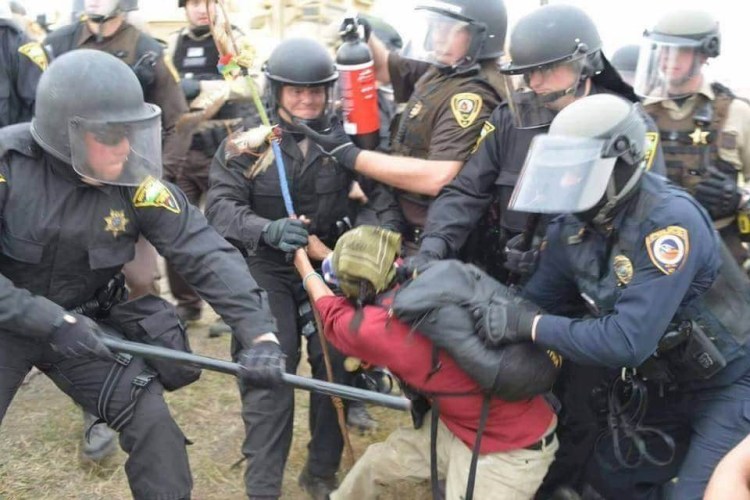
Members of the Morton Co. army subdue Terrell Iron Shell, a Sicangu Lakota Pipe Carrier of the International Indigenous Youth Council, on October 27, 2016 near Cannon Ball, ND. Taxpayers are funding police officers from surrounding states to abandon their posts and join a military force working against Water Protectors seeking to protect the Missouri River from the Dakota Access Pipeline. Photo from Facebook.
By Vi Waln
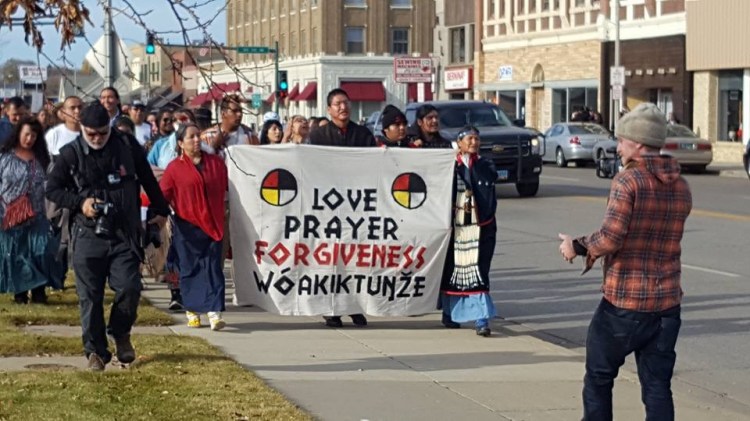
Our Indigenous women are amazing. Over the weekend an event was organized by Lyla June Johnston and Cheryl Angel in Mandan, North Dakota. This event was held to bring awareness to how crucial forgiveness is for the human race.
Most of you are aware of the events which have been happening near the Standing Rock Indian Reservation, as the construction of the Dakota Access Pipeline (DAPL) continues in North Dakota. Unfortunately, despite all intent to remain in prayer for the protection of the Missouri River from a crude oil pipeline, some direct actions did involve violence.
Many human beings have been brutalized by the police officers. These are officers who’ve abandoned their jobs in their own states and counties to join the military force. Taxpayers from several states, including South Dakota, are the financial sponsors for their police officers to join Morton County’s army. Many people who’ve been arrested have publicly shared their experience of what it’s like to be mistreated in North Dakota county jails.
All the people involved in these actions, whether in person or by watching social media live streams and video, have been adversely affected. This includes the police officers who are inflicting brutality. Post-Traumatic Stress Disorder (PTSD) is a real condition that many of us suffer from. Last week I wrote a little about how PTSD is passed down to our unborn generations through our DNA.
We may not realize it, but this subconscious PTSD carries over into our present lives. This is what is meant when people talk about historical trauma. It’s difficult to move forward when we carry PTSD in our bodies. It takes great effort to transform the trauma we carry in our DNA into forgiveness.
It may seem easier to engage in anger and violence as a way to release the pent-up trauma we carry. We might get so angry that we do things we later regret. Oftentimes, we don’t even know where the anger comes from. This is one example of historical trauma. Today, many of our people are incarcerated because their anger took over and propelled them to commit a violent crime.
Karen Little Thunder and Cheryl Angel, from the Sicangu Lakota Oyate, carry the “Love, Prayer, Forgiveness, Woakiktunze” banner to lead the Forgiveness walk held in Mandan, North Dakota on Sunday, November 6, 2016. Photo by Eileen Janis.
Still, we aren’t being productive human beings when we attribute the dysfunction in our lives to historical events. Our failure to work on transforming inner trauma creates a lifetime of unhappiness. We have to understand that we alone are responsible for our individual inner peace.
It takes tremendous courage to transform the DNA memories we were born with. Yet, when you work at becoming a better human being, you will definitely find happiness. Emptying ourselves of all the negative emotion and deeply buried historical trauma requires a hard look at what we carry inside.
Today, there are many Lakota people who claim they cannot forgive what was done to our ancestors. There are also many Lakota people who actively hold on to toxic energy over events they or their family suffered in this life. Many of us pass these unhealthy grudges to our Takoja, who actively carry them long after we pass away.
We have to forgive. Those of us who pray in traditional Lakota ceremony know that our prayers are greatly diminished when we choose to remain unforgiving. The level of our personal thought and inner emotion does affect the sacred energy we create in Lakota ceremony. So, because we pray with the Cannunpa and other sacred medicines, we have to forgive people who may have done great wrong to us or our family members. Forgiveness is the only way we are going to heal.
It really doesn’t matter if the person you are working to forgive is apologetic about what wrongs they might have committed. The ability to forgive is a gift you bestow upon yourself. You free yourself to higher levels of spirituality when you are able to forgive those who have done you harm. Forgiveness is not about the other person. The ability to truly forgive is all about self. Consequently, the hardest person to forgive is usually yourself.
The following paragraphs are excerpts from an address by Dave Archambault II, President of the Standing Rock Sioux Tribe, who spoke to the people gathered in prayer for the November 6, 2016 Forgiveness Walk in Mandan, ND.
“It’s been difficult because we react to law enforcement aggression. They’ve been doing these things for hundreds of years now. It’s time to start to change how we react and what we do.”
“If you were harmed by law enforcement, you have to take care of yourself and the only way you can take care of yourself is through prayer. To forgive doesn’t mean to forget, we will always remember the wrongs that were done to us. To forgive means to live in a good way, in a better way.”
“I know what we are doing is the right thing. We are protecting our water. We are protecting our land for our future generations and for mankind. This whole movement has been about peace and prayer,” Archambault stated. “We can control how we behave.”
Members of the Morton County army subdue Terrell Iron Shell, a Sicangu Lakota Pipe Carrier of the International Indigenous Youth Council, on October 27, 2016 near Cannonball, North Dakota. Highway Patrol from surrounding states abandoned their positions to join Morton County’s military and protect a private corporation from human beings who want to stop the Dakota Access pipeline. Photo from Facebook.
By Vi Waln
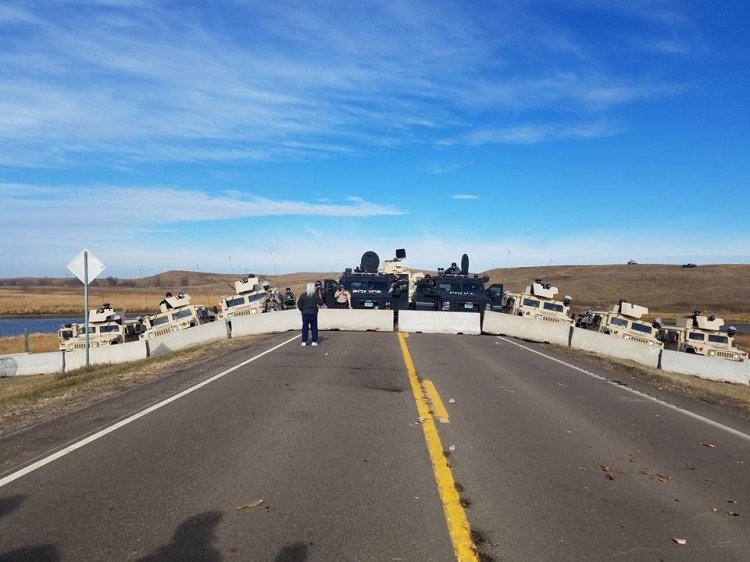
Technology allowed many of us to witness the violence perpetrated against innocent human beings last week by the Morton County military. The men and women who pushed innocent people south on North Dakota highway 1806, were fully clad in riot gear and can no longer be viewed as mere police officers. High-tech weapons specifically designed for war zones were used against unarmed human beings, bumping state troopers and county cops from several states to a whole different level.
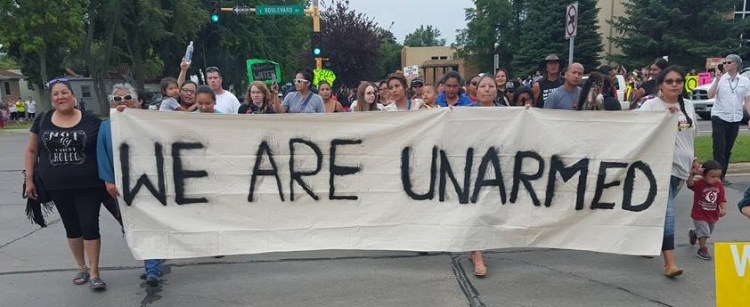
We have to remember the Water Protectors are unarmed. They established the new camp in the path of the Dakota Access Pipeline because they did not want any more sacred sites torn up. They bravely stood in front of the heavily armed military with their prayers, songs, sage and sacred instruments, including a Cannunpa.
The brutal actions of the Morton County military against peaceful Water Protectors on October 27, 2016 traumatized many people. The humans who were on the front line were the most affected by the violent tactics of the military. Those human beings are forever changed because of their experience. Post-traumatic Stress Disorder (PTSD) is very real. It never goes away. PTSD affects you for the rest of your life.
In addition, the PTSD buried in our deoxyribonucleic acid (DNA) was triggered for many of us as we watched the brutality on live video streams. The PTSD we’ve carried for generations in our DNA is a result of the violent atrocities our ancestors suffered at the hands of the military forces blessed by the US government. Thus, the physical, mental, emotional and spiritual distress many Indigenous people are still feeling is completely understandable.
You may have heard the PTSD contained in our DNA referred to as intergenerational or historical trauma. Experts have identified intergenerational or historical trauma, as well as PTSD, as afflictions affecting many areas of our lives. We must learn to understand these afflictions, which have been passed down through our ancestral lines, in order to empower ourselves and our children.
There is nothing to gain by continuing to blame the wasicu for the conditions we suffer today. We can’t change history. However, we can help ourselves by learning how these historical events affect us today. The more we understand ourselves and our history, the more empowered we are to help our youth move forward with an enlightened mindset to tackle the issues we all face.
Consequently, the wasicu also suffer from intergenerational trauma. They carry forms of PTSD in their DNA. However, their PTSD stems largely from the guilt they carry. This guilt is directly linked to the violent atrocities committed by their ancestors on the Indigenous people of Turtle Island.
Furthermore, the wasicu also carry ancestral fear in their DNA. That is, the prayers of Indigenous people have always been incomprehensible to the wasicu, causing them to feel great fear. For example, the 1890 massacre of innocent Lakota at Wounded Knee was a manifestation of the deep-seated fear of our Ghost Dance prayer. This subconscious trauma also continues to affect many areas of their life.
I’ve come to realize that this intergenerational trauma carried by the wasicu, contributes heavily to their perception of Indigenous people. For example, when you look at social media today, there are many wasicu who post their innermost thoughts and feelings about Indigenous people. They are not aware that their fear, anger, hate, denial, resentment and racism stem from the guilt left in their DNA by their ancestors.
Today, many Indigenous people understand the necessity of the man-made laws created by the wasicu. Most of the time, we appreciate the hard work of law enforcement in removing dangerous criminals, such as meth dealers, child rapists and murderers, from society. Yet, there are also the laws of Mother Earth, which we know as Natural or Spiritual Law. Consequently, the human beings who continue to place man-made law above Natural or Spiritual Law will one day have to face the wrath of Mother Earth in her Court Room.
Natural or Spiritual Law has no statute of limitations. Thus, the wasicu also hold deep seated fear of us because they know on a subconscious level that they will eventually have to atone for the legacy of guilt left by their ancestors’ war crimes. Karma does not forget.
The Morton County military, as well as Dakota Access Pipeline (DAPL) owners and employees, are also human beings. They are there to protect their intent to exploit the oil of Mother Earth so they can make more money. They are disconnected humans who have forgotten that their Water is alive. They don’t understand that Water is Life. The phrase Mni Wiconi is foreign to them because their mentality is clouded by man-made laws and the almighty dollar.
The Morton County military continues to protect the private corporation DAPL workers from being stopped by human beings who want to protect ancient graves and the Missouri River. Many cops from surrounding states abandoned their law enforcement posts to join Morton County’s army. Photo from Facebook.
As long as the Morton County military and DAPL security mercenaries remain disconnected from their real human purpose, they will continue to use their jobs to inflict needless abuse on innocent people who understand and work to follow the protocols of Natural or Spiritual Law. Their continued actions against Water Protectors are creating new DNA memories for their unborn generations. One day, they will understand what the Indigenous people have known all along: The Natural or Spiritual Laws of Mother Earth have no statute of limitations.
I continue to pray for our brave Water Protectors. I also offer prayers for the disconnected humans whose first loyalty is pledged to the American dollar. These folks desperately need our prayers. Their intergenerational guilt and fear determines how they treat all people of color.
We are all human beings. We have to get past our tendency to hurt one another over money. Human beings should not have to judge one another as an enemy. The real enemy is the inhumane, profit-seeking corporation working to destroy the graves of our ancestors and put our Mni Wiconi at serious risk to move crude oil through a flimsy, man-made pipeline in relentless pursuit of the almighty dollar.
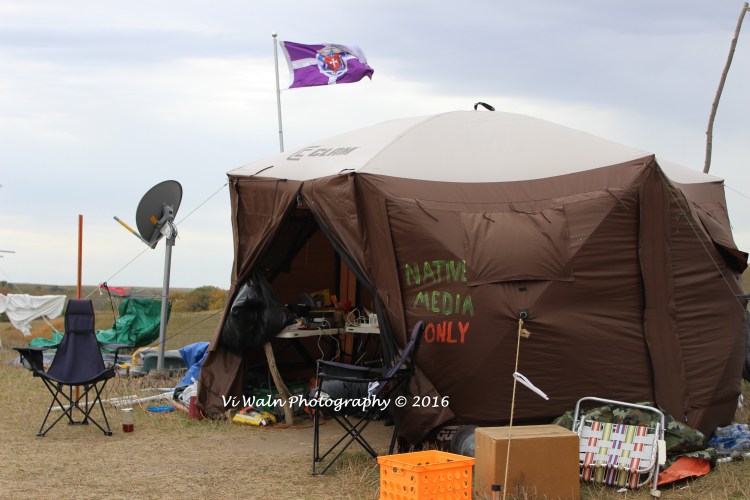
Access to the Oceti Sakowin Camp by journalists is restricted to Native Media Only, who are required to check in when they arrive.
By Vi Waln
Oceti Sakowin Camp, located just north of the Standing Rock Indian Reservation, is a place we all must visit. There have been many great photos, stories and video clips from this camp shared on social media sites. People who use social media and cannot travel to visit the camp in person, do appreciate all the shared photos and videos.
Certainly, a vicarious experience of what the camp is like can be had by viewing social media updates. Yet, unless you’ve actually visited the camp, you haven’t felt the level of spiritual energy present there. There’s a huge difference between viewing events online and being physically present to participate in living history.
In the movement to protect humanity’s Water of Life against the Dakota Access Pipeline (DAPL), there are several camps established in North Dakota. Sacred Stone Camp was the initial camp founded by Standing Rock tribal citizens last April. This camp is located on tribal land near the community of Cannon Ball, North Dakota.
Another camp was also established on Standing Rock tribal land. This camp is adjacent to the Cannonball River on the south side. This area is referred to as the Sicangu Spirit Camp, dubbed as such by the Rosebud tribal citizens staying there.
A group of concerned folks recently formed the Sacred Ground camp, located north of Oceti Sakowin. This camp was established after DAPL workers bulldozed an area said to contain burial sites and cultural artifacts. The people staying in that area are camped in the ditch off Highway 1806.
The Oceti Sakowin camp is the largest. It is located on federal land managed by the US Army Corp of Engineers. This camp is on the north side of the Cannonball River.
The Red Warrior camp is also located in this area. When viewing photos on Facebook, the Oceti Sakowin camp can be distinquished by the many flags posted along the entryway. These flags represent nations from all across Mother Earth.
Consequently, a camp of this size doesn’t exist without problems. Yet, I didn’t visit the Oceti Sakowin camp to focus on politics and drama. There is enough of that happening on my own reservation. I went to Standing Rock with the intent to pray for humanity’s Water of Life.
A helicopter appeared in the sky shortly after I arrived. Looking at pictures of helicopters on Facebook is totally different than seeing them in person. Yet, soon after I looked up to see the low flying helicopter pass over the camp, I also watched an eagle gracefully fly over. The mere act of that eagle flying over the camp right after the helicopter did, dissipated all the negative energy I felt the aircraft bring. I was amazed at the level of spiritual energy I witnessed in that one moment.
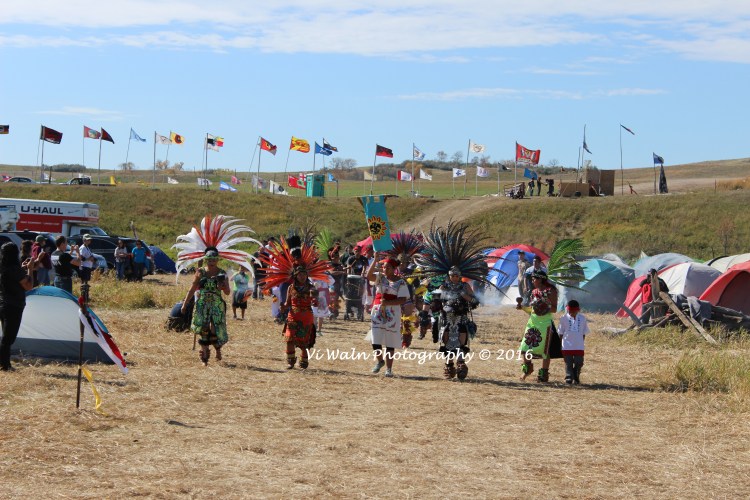
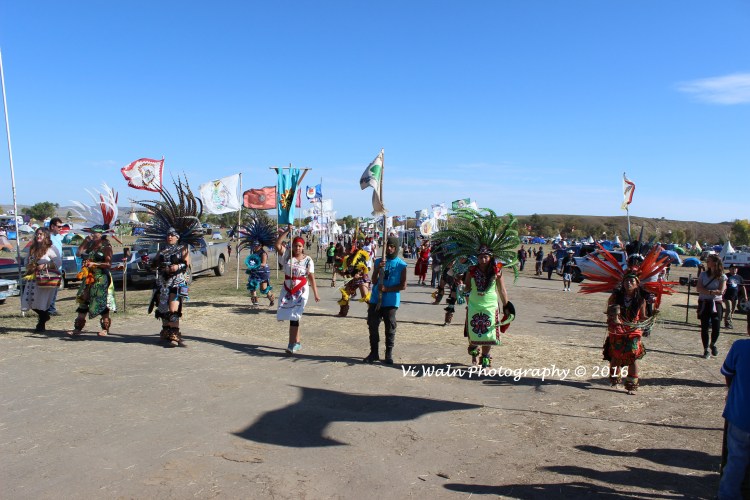
A large group of Aztec dancers from Minneapolis, MN began their prayer dance at the Oceti Sakowin Camp near the Cannonball River on October 1, 2016.
I was also fortunate to witness prayers from a group of Aztec dancers who visited the camp. Donned in full regalia, the group took the time to make their rounds dancing throughout the camping area.
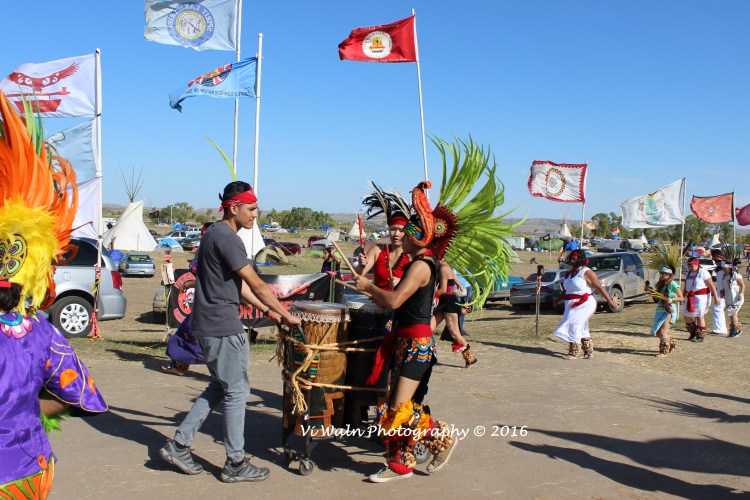
The Aztec dancers were accompanied by their drum.
They completed their ceremony at the main public gathering area near the entrance. We happened to be on the road as the group moved toward the main area. The spiritual energy of their powerful songs, prayer and dance was very intense. The only way to describe it is to say it nearly knocked me over.
A view of the Aztec dancers coming up the entryway as moved toward the main area.
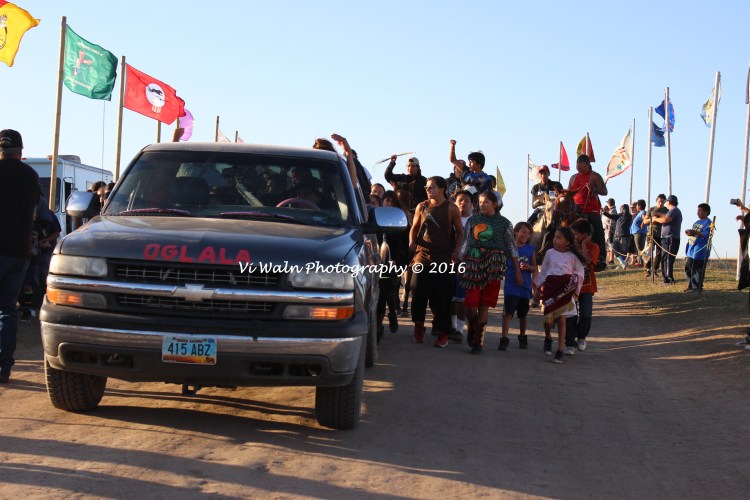
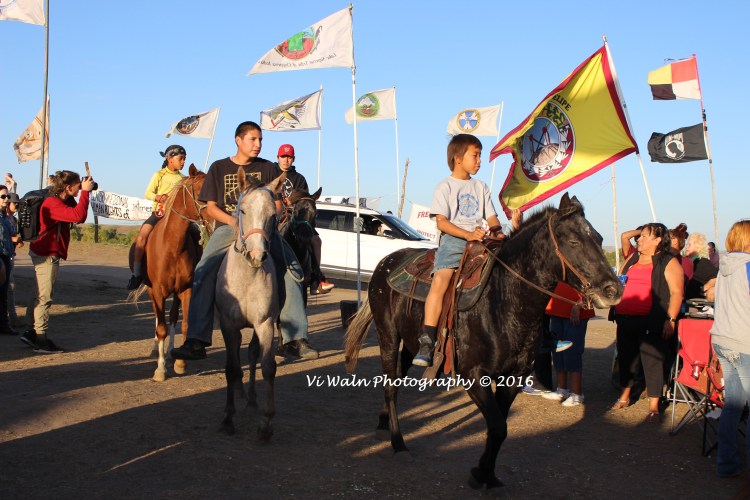
We also witnessed the arrival of the Oglala Lakota youth runners and horseback riders from Pine Ridge, who came in support of the No DAPL movement. The energy they brought was just as powerful as that of the Aztec dancers. That is, as we stood at the big drum singing the prayer songs, I experienced the same type of sacred energy I feel at sun dance. It was amazing.
A group of Oglala Lakota youth arrive at the Oceti Sakowin Camp on October 1, 2016.Oglala Lakota young people on horses were welcomed into the main camp area.
Also, my Native American Church relatives from Rosebud sponsored a prayer service while I was there. We offered prayers and spiritual food at the river following the ceremony. I truly appreciate the good intentions of my relatives in sponsoring this ceremony for the Water of Life.
Water Protectors who attended a Native American Church prayer service led by Chet & Melaine Stoneman, Sicangu Lakota, on October 1-2, 2016 were treated to this cake as part of the ceremonial dinner.
We have to keep praying for our Mni Wiconi. Our faith in the power of our prayers can help turn things toward the good in ways we may not expect.
I encourage you all to go visit the camps. Even if you stop in for a few hours, you won’t regret it. If you can’t make the trip to Standing Rock, please keep the human beings who are there in your prayers as they are now preparing for winter.
Pray every single day for our Water of Life. Our coming generations are depending on us to guarantee their access to clean drinking water.
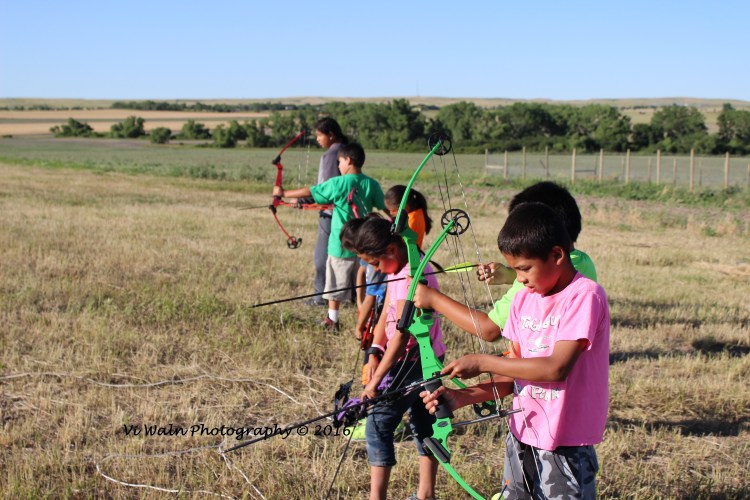
Sicangu Lakota children engage in an archery activity during a 2016 summer event.
By Vi Waln
Lakota social systems have always revolved around strong kinship ties. Yet, the ongoing colonization of our people has undermined our sense of relationship to one another. Still, despite all we have faced as Indigenous people, the basic virtue of caring for one’s extended family is still alive in contemporary Lakota society.
September is Kinship Appreciation and Awareness Month in South Dakota. This is a time to recognize the people who care for members of their extended family or others. It’s a time to let our grandfathers, grandmothers, aunts, uncles, brothers, sisters, as well as other members of our Tiospaye, know how much we appreciate their willingness to open their homes to children who need care.
There continues to be a great demand for suitable homes to care for Lakota children. Our reservation communities especially need sober, stable families to open their homes to children who desperately need a place to live. There are many Lakota grandparents who have stepped up to this challenge and are now caring for their own Takoja, as well as other children in need. We appreciate their efforts.
Kinship has always been an essential aspect of Lakota Society. Many Lakota people are aware of the history of our people’s willingness to care for the less fortunate tribal citizens, especially children, elders and others who may need extra help due to a disability. Prior to the coming of the wasicu, there was no such thing as orphans in Lakota society.
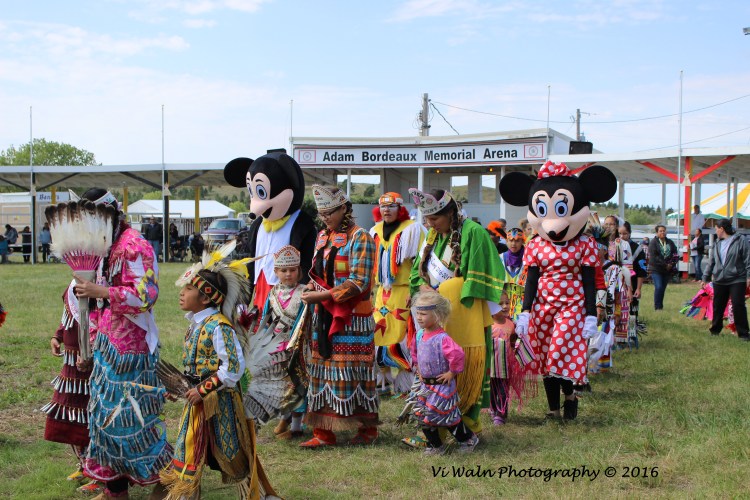
Sicangu Lakota youth participate in the 2016 Youth Wacipi Grand Entry.
Unfortunately, the strength of our Lakota kinship systems has deteriorated over the past 524 years. Today, many Lakota children are taken from their parents by the Department of Social Services and placed in long term foster care, usually in a non-Indian home. Unfortunately, when our children are placed with or adopted by non-Indian families, they are more likely to grow up without a sense of Lakota identity.
Still, even though our children might be placed in off-reservation homes with non-Indian people, they tend to find their way back to their blood relatives when they reach adulthood. Many Lakota people pray for these children who are lost in the system to return home. But it’s very difficult when these relatives who grew up off the reservation try to reestablish ties with their birth families.
For instance, we are well aware of the lateral oppression and violence which is so prevalent in most of our reservation communities. For one reason or another, many of our people work very hard at viciously tearing others apart on the reservation. The crab-in-a-bucket mentality is something everyone living on the reservation has experienced at some point in their life.
Consequently, this dysfunctional behavior makes it difficult for the people who were raised in non-Indian homes to ever experience the sense of kinship that those of us who live on the reservation take for granted. It isn’t easy for them to return to their families on the reservation. They often aren’t emotionally or mentally prepared to cope with the dysfunctional behavior exhibited by their own relatives.
For instance, relatives who grew up in non-Indian homes off the reservation are often called derogatory names by their own family members. They are often ridiculed or belittled because they were raised by white people. This is conduct unbecoming to Lakota people. This oppressive behavior directed at our own relatives doesn’t demonstrate the Lakota value of kinship.
So, even though many of us pray for these lost children to return to their Tiospaye, it often doesn’t work out for them. We have to remember that they were not exposed to the lateral oppression that those of us living on the reservation are accustomed to suffering on a daily basis. As a result, many of these relatives who were lost in the social services system as children, cannot cope with the treatment they face upon returning to the reservation. Many of them leave again to never return. They would rather stay away to avoid being mistreated by their blood relatives.
We have many Lakota grandparents who are raising their grandchildren, and in some cases, their great-grandchildren. These are the families holding our value of Lakota kinship intact. Also, many of our elders are surviving on a fixed income. They may face many hardships in providing for the basic needs of their grandchildren. It’s not fair to our elders when they must step in to raise their abandoned grandchildren. Yet, we rarely hear them complain because they truly understand the importance of Lakota kinship.
Our Lakota grandparents work hard to find ways to provide food, shelter and clothing for their grandchildren. Grandparents who do not hesitate to take their grandchildren into their homes are being good ancestors. They are determined to help their grandchildren grow up knowing their own Lakota culture. Those children who are fortunate enough to have the support of their extended families are blessed. Even though they may have a hard time, they are still able to have a childhood which allows them to grow up with family.
Many grandparents sacrifice an early retirement in order to provide for their grandchildren. It’s not easy to raise children on the reservation today. Alcohol, drugs, violence, peer pressure and bullying are realities we all live with. Still, many grandparents and other relatives don’t give a second thought to opening their home to extended family members in need.
Wopila to the Lakota people who continue to embrace our kinship values. You are the people ensuring Lakota culture stays alive. Wopila for your generous efforts to keep our sense of family alive for the unborn generations.
The number of people who abuse prescription narcotics is staggering. We all know someone who struggles with an addiction to opioids. These are the people who are constantly searching for prescription pills, such as hydrocodone, morphine or oxycodone.
September 19-23, 2016 is Heroin and Opioid Awareness Week. The US Department of Justice, along with the US Attorney’s Office, will sponsor activities across the country to raise awareness of the dangers associated with opioid addiction. They will host free screenings of the 1-hour movie “Chasing the Dragon: The Life of an Opiate Addict” this week. On Tuesday, September 20 the movie will be shown at the Kresge Recital Hall at Augustana University in Sioux Falls, SD beginning at 6:30pm.
On Wednesday, September 21 another free screening will be held at 6pm in the Elks Theatre located in down town Rapid City, SD. A panel discussion will follow each screening. The Drug Enforcement Administration (DEA), State’s Attorneys, Psychologists, Counselors and Emergency Medical Services personnel will discuss the effects of opiate drug abuse with movie goers.
Along with opiate overdoses, some of which have resulted in death, in South Dakota there have been at least 2 deaths attributed to heroin overdoses this year. The number of people who overdose and die from opiates will continue to rise as long as they do not seek treatment. Alcohol has been the scourge of the Lakota people since its introduction to us. Yet, today the number of our people addicted to opiates will soon match, or even surpass, those addicted to alcohol.
On the streets of our reservation communities, the widely sought prescription pills are referred to by the slang terms “hydros” or “oxys.” Heroin and opium are illegal drugs which are in the same drug class as these prescription pills. Many people don’t intend to become addicted to pills, but the dependence upon a prescription drug can happen fast. For example, people can become addicted when they are prescribed hydrocodone or oxycodone to manage post-surgery pain.
Consequently, it is estimated that at least 78 people die every day from an opioid overdose. The Centers for Disease Control and Prevention (CDC) states that “at least half of all US opioid overdose deaths involve a prescription opioid. In 2014, more than 14,000 people died from overdoses involving prescription opioids.”
Data compiled by the CDC also shows that people aged 25-54 years had the highest overdose rates. American Indians or Alaskan Natives have some of the highest overdose rates in this country. In addition, nearly 2 million people in the US either abused or were dependent on prescription opioids in 2014.
Obviously, this data proves how dangerous opiates are. Consequently, there have already been several deaths on the Rosebud Reservation unofficially attributed to an opiate overdose by local people. When someone dies from an unintended opiate overdose, the cause of death could be listed as suicide. Death by suicide is one of the highest statistics we have in Indian Country.
“To understand the appeal of opioids it is necessary to understand the effects. At low to moderate doses the ‘High’ from opioids is not intoxication or impairing (as with alcohol). It does not feel like alcohol or marijuana, or hallucinogens. It instead provides feelings of intense joy and comfort, more so than can be obtained naturally. It is similar to feelings of great accomplishment, or achievement of a lifetime goal, rather than an impairment. At higher doses, breathing is slowed, eventually to the point of death. This respiratory depression is the cause of overdose deaths.” From The National Alliance of Advocates for Buprenorphine Treatment
If you are taking opiates for pain, please know there are other ways to manage chronic pain. It takes strength and courage to overcome any addiction. Our children deserve to grow up in homes with adults who are sober and have clear minds. Remember, children will mimic everything you do, including the abuse of alcohol and drugs.
Please find a way to get off the pills. You could literally lose your breath by taking those drugs. When you unintentionally take too many hydros or oxys and stop breathing, you’ll likely be just another number driving up the suicide statistics in Indian Country.
The cigarette butt you throw on the ground stays there until it is picked up. Photo by Vi Waln
By Vi Waln
During the annual celebration at Rosebud, there were lots of complaints about trash. People didn’t like seeing litter all over the fairgrounds. Overflowing trash bins were an eyesore.
However, there were many fair goers who didn’t give a second thought when tossing their trash on the ground. For instance, candy wrappers were left all along the parade route. Later that afternoon, the wacipi grounds were strewn with used paper napkins, Styrofoam containers and plastic cups.
Even though there seemed to be trash everywhere during the 4-day annual celebration at Rosebud, we have to send Kudos out to our tribal Solid Waste crew. They kept on top of all your trash by disposing of it all in a timely manner. We can also thank the many children who camped with their family during the fair for their hard work in keeping the grounds clean. These young people were recruited by Rosebud’s Solid Waste program each morning to pick up trash. Each bag filled with fairgrounds trash was traded to Solid Waste for a strip of carnival tickets.
People who drove by the fairgrounds on Monday morning noticed much of the trash was gone, thanks to the efforts of the Rosebud Sioux Tribe’s Solid Waste program. In the past, there have been times when no effort was made to pick up the post-Rosebud Fair trash. It was all left on the ground to blow away.
So we didn’t see any rubbish caught on the fence at the softball field this week. Many of us appreciate those hard-working children who kept the fairgrounds picked up every morning during the fair. Also, the Solid Waste crews and the day laborers did an excellent job of clearing the fairgrounds of all that unsightly litter tossed aside by fair goers.
We hear many people complain regularly about all the trash in the ditches as they drive down the road. Yet, some of these same people will toss out trash from their vehicle without a thought as to where their garbage winds up. The blame always seems to fall on the Solid Waste program – it’s all their fault when trash winds up in ditches, in our yards, in our streets and stuck to barbed wire fences.
When everyone decides to take personal responsibility for disposing of their trash properly, the litter we tend to see everywhere might not be such a huge problem. Some people will take their bags of household trash and throw them in the ditches. This trash eventually winds up strewn along highways. One windy day can scatter that same litter for miles.
Sometimes families will clean up their yards and along their roads in an effort to keep their land free of trash. Yet, other people will drive along those same roads and throw their aluminum cans, empty food wrappers, glass containers and plastic bottles out into the ditches. Some people feel like it is a losing battle to keep their yards and land clear of debris.
Photo courtesy of Northern Illinois University
Another major litter problem is cigarette butts. People have attempted to clean up all the trash on the fairgrounds. Yet, when you take a closer look, the cigarette butts are still there because most smokers really don’t give a thought about leaving their waste behind. Consequently, the cigarette butts you threw on the ground while you were at the at the Rosebud fairgrounds will still be there next year.
Cigarette filters are a form of plastic and are not biodegradable. Cigarette butts can be found in all the places where people smoke. On the reservation, we see people smoking cigarettes everywhere. Unfortunately, most cigarette smokers have zero regard for their designated area, or any area for that matter. That is, a smoker will simply toss a cigarette butt on the ground, step on it and then walk away. It’s gross to see cigarette butts laying all over the place.
We can all help to keep our homelands free of trash by disposing of it in dumpsters. Smokers can help keep our reservation free of cigarette butts by disposing of their filters in an appropriate container instead of all over the ground. Children who watch adults throw trash on the ground and walk away from it will do the same thing. Please respect our land by keeping it clean.
HLN’s Morning Express with Robin Meade reported that people gathered near the Missouri River were “armed with weapons and pipe bombs.” Photo from Facebook.
By Vi Waln
I never wanted to be a journalist. The word “journalist” always conjured images of those paparazzi types with huge cameras chasing people or sneaking around to get photos. Journalists were always in the way or in close proximity to someone’s face. It didn’t seem like a very attractive way to share information.
There are unethical reporters taking information and running in the wrong direction with it. Many won’t bother to do any fact checking on the reports they get. Instead, they rush to their computer to create an often embellished account of what happened to share with the world. Consequently, dramatic reports of events will boost newspaper sales and draw readers to websites, even when the accounts are not true.
This is what happened last week when Kyle Kirchmeier, who serves as North Dakota’s Morton County Sheriff, was depicted in a video stating people were “preparing to throw pipe bombs at our line.” He was referring to the now thousands of human beings gathered to peacefully stand against the construction of the Dakota Access Pipeline (DAPL). He called the gathering “an unlawful protest.”
In addition, according to the Morton County Sheriff’s Department Facebook page, the officers’ “top priority in monitoring activity involving the protest of the Dakota Access Pipeline is to keep everyone safe, including those involved in any demonstrations. While officers have not seen weapons present in any of the protests, we have received information and heard mentions of the use of weapons. We treat these reports as viable threats and will take them seriously in order to ensure the safety of all individuals.”
The key words here are “officers have not seen weapons present in any of the protests.” Yet, the Morton County Sheriff made a conscious choice to pass along hearsay to national media outlets. This isn’t the way to “keep everyone safe.” Rumors like this are dangerous.
National media outlets quickly picked up the comment about pipe bombs and distributed the information worldwide. Still, they had no reason not to believe Sheriff Kirchmeier because, after all, he is a law enforcement officer. Obviously, news reports are not always accurate; spreading misinformation, like the embellished report from the Morton County Sheriff, is very risky.
Many people believe everything they read or see in mainstream media. That is, it was on the news so it must be true! For example, HLN’s popular Morning Express with Robin Meade show reported that protestors were “armed with weapons and pipe bombs,” This national television report was watched by millions of viewers, thanks to the skewed information put out there by Sheriff Kirchmeier.
The distortion of media reports last week is similar to the frenzied accounts about Indigenous people during the 19th century. Army officials and media outlets in the 1800s were quick to spread false information about our ancestors. This was especially true during the time of the Ghost Dance, which was a gathering of prayer. Sadly, these unfounded reports resulted in the killing of our ancestors. Tribal leaders, elders, women and children were mercilessly murdered, and often mutilated, by military forces.
Consequently, human emotion is based in either love or fear. What we saw in the news last week was fear-based. It’s a fact that many non-Indians still fear the world’s Indigenous people. They cannot comprehend our spirituality or the level we pray at (remember the Ghost Dance?) and it provokes their innermost fears. As a result of this fear, many angry or disparaging comments have been posted on social media and internet news outlets about the human beings gathered along the Missouri River.
When a person feels fear, they will often react with anger. Many people will deny being afraid; they would rather admit to anger. So, underlying all these reports of violence is a great fear of the peaceful group gathered to protect our Mni Wiconi.
When dealing with people who are afraid, we have to respond with love and prayer, instead of more fear and anger. When people remain calm in the face of adversary, it confuses an angry opponent. Many don’t know how to stay calm, especially when they haven’t dealt with their own inner fears of what the “wild Indians” are capable of. They expect people to react with the same emotion they do. It totally baffles them when others won’t give in to anger.
Water defenders demonstrated at the North Dakota capitol last week. Photo from Facebook.
In reality, the human beings gathered in support of our Mni Wiconi are only “armed” with love, prayer and song. Many are praying with their Cannunpa. The sage, cedar and sweet grass are being used to enhance the prayers for our Water of Life. The big drum is an instrument to spread our love for Water of Life throughout the universe with prayer songs.
Those of us who can’t travel to the camp really appreciate all the reports from the people there! Millions of social media users continue to watch and share the daily events reported from the growing camps near Standing Rock. Your relatives at home look forward to all the social media status updates, photos and video from the front lines. Keep sharing!
Be strong relatives, continue to walk your inner peace. Resist anger. Do not take on the fear of the wasicu. Contrary to the reports of violent acts against our people in the 19th century, which often took weeks or months to reach people in faraway places, today the whole world is watching. Law enforcement, government officials and DAPL know they are being watched by human beings all over Mother Earth.
Human love is a formidable weapon. Water has memory and will remember our powerful prayers. The human beings gathered to protect our Mni Wiconi flowing in the Missouri River are examples of what being a good ancestor looks like. Our most powerful weapons we can use to protect our Mni Wiconi are love, prayer and song. Wopila Tanka!
Photo courtesy of Unicornriot.Ninja. Used with permissionBy Vi Waln
Kudos to Standing Rock Chairman Dave Archambault II for being a leader willing to sacrifice his personal freedom to protect our Mni Wiconi (Water of Life). He was arrested by police last week when he joined other activists gathered to protect the Missouri River from the Dakota Access Pipeline.
Several other Standing Rock Lakota people were also arrested, including Dr. Sara Jumping Eagle and Tribal Council Representative Dana Yellow Fat. These brave Lakota leaders stood strong in protection of our Mni Wiconi. Wopila Tanka!
Human beings who are disconnected from life giving elements are like an empty shell. That is, they are unable to comprehend why other human beings are adamant in defending Mother Earth. The ignorance of these people prevents them from understanding the importance of our Mni Wiconi. Their ignorance is dangerous.
All human beings are Children of Mother Earth. We are all dependent upon nature’s elements to survive. Our survival is threatened when our life giving elements are the target for exploitation by big profit-making corporations.
When a lost Italian happened upon the east coast in 1492, our world was forever changed. The rush of immigrants to “America” was the beginning of an ongoing rape of Mother Earth. The immigrants who arrived by boat over 500 years ago were determined to possess the land, as well as all the elements meant to sustain Mother Earth and humanity.
As they made their way west, a major intent was to stake a claim on land. It was extremely rude the way they just showed up to push us all aside so they could try to possess the land. There was absolutely no concern for our ancestors who lived upon this Turtle Island since the beginning of time.
When an element with the potential to bring in cash is “discovered,” the immigrants inevitably set out to exploit it. For instance, our ancestors watched as the Black Hills Gold Rush of 1874 caused the desecration of the sacred HeSapa by immigrants looking to get rich. Today, gold, timber and other minerals are still being robbed from HeSapa by the immigrant’s descendants.
It’s always been about money for these immigrants. Money is their God. Today, the rush is for oil. Big corporations, who have no concept of Mitakuye Oyasin, want to extract all the oil from Mother Earth to sell for a profit.
The construction of oil pipelines, such as the Keystone XL and the Dakota Access Pipeline, provide temporary jobs for roughnecks. Consequently, the Lakota-Dakota-Nakota and other Indigenous activists of Mother Earth are continually being accused of trying to take jobs away when they stand up to defend the Water of Life. Profit seeking corporations, along with the roughnecks they employ, have no concept of how crucial water is to humanity. Their actions prove they will always choose money over life.
Indigenous activists aren’t trying to take anyone’s livelihood away. Grassroots activists standing on the front lines understand how crucial water is to our survival. All of us want to guarantee that our unborn generations have an abundance of good, clean water to drink. Many of us pray for the water every single day of our lives. The people standing on the front lines opposing oil pipeline construction are there for all of humanity’s unborn generations.
Many Lakota-Dakota-Nakota people, as well as other Indigenous activists, are being told to go back to the reservation. Those who want us to stay confined within the reservation boundaries are obviously not aware of the Treaty law our people still recognize. We are Children of Mother Earth. Many of us have never recognized the imaginary land boundaries created by the wasicu. We are all responsible to protect the health and well-being of Mother Earth.
Today, some of us depend on the underground aquifers for our water. Also, when the Mni Wiconi Rural Water System was established several years ago, it provided clean drinking water via the Missouri River to many people living on South Dakota reservations. Our entire water system is now being threatened by oil pipelines.
The Dakota Access Pipeline is a plan to build an oil transfer system under the Missouri River near Cannonball, North Dakota. We’ve all seen the reports of oil pipelines bursting, leaking or exploding. An oil pipeline under the Missouri River threatens all the human beings who depend on the river for their water. Animals and plant life also use the river as their water source.
Oil pipelines are an act of terrorism. Still, the quest for a cash profit apparently outweighs the risk of contaminated water for those who are blindly obsessed with fattening their bank accounts. As Children of the Earth, it is our duty to speak out and stand up for our elements, especially our Mni Wiconi.
Contrary to popular opinion amongst many non-Indians, activists and other Indigenous people are not trying to take anything back, we only want our descendants to have equal access to the necessities of life. Water is a necessity. Water is Life.
Once our water systems are all contaminated in the rush for cash, the game is over. Life will be done. We, along with Mother Earth, will die without water.
Please support the activists who are working to protect the Missouri River near Standing Rock. They are there to guarantee a future for our descendants. They are the epitome of being a good ancestor. There are many ways to support this effort to protect the water, including prayer.
In the on-going global war against terrorism, government officials display great ignorance as they overlook Mni Wiconi as our major source of life. Our water must be protected. Again, this human ignorance will be the death of our planet. The continued terrorist attacks by big oil corporations who want to build their dangerous pipelines over, under and through our water sources must stop.
Pray for your water every single day. Without water, there is no life.
An angel in the Book of Life wrote down my baby’s birth.
And whispered as she closed the book, “Too beautiful for earth.” ~Author unknown
By Vi Waln
This past week many Tiospaye suffered a great loss when 4 young women and a baby boy died in a car crash on the Rosebud. More lives were forever changed when a 13-year-old girl was shot and killed on the Pine Ridge. These were our Wakanyeja. We are all affected.
All week, I’ve felt the overwhelming sadness of the Lakota Oyate. These tragedies have affected young people. This past week has left moms, dads, brothers, sisters, grandparents, children, aunts, uncles, cousins, nieces, nephews, extended families, best friends, team mates, class mates, coaches, teachers and others hurting really bad. To lose a loved one unexpectedly is life changing. When a family loses a child, it alters their entire world.
I witnessed many Lakota people express their feelings about these deaths through social media. The outpouring of love and sympathy for the grieving relatives was amazing. The empathy and generosity Lakota people are known for was demonstrated this week as many came together in prayer to support those who are suffering.
A candlelight vigil to remember those who passed on, as well as the 2 people recovering in hospitals, was held at the Todd County Football Field in Mission. This event brought people from all faiths together to pray and comfort one another. Local schools offered access to counselors for our young people who needed support.
I noticed people being a bit nicer to one another. Even though the temperatures hovered close to the 3-digit mark, the people I encountered in public were more kind and understanding than they have ever been. This was amazing.
Lakota people sometimes talk about how a blood relative can take away all the bad from our lives when they pass away. For a long time, I didn’t understand what this meant. When someone died, I would look for the bad to go away from that family but it didn’t seem to happen very often.
When my Takoja died unexpectedly from an illness, it was the saddest time of my family’s life. It changed us. Those first few days after her passing were marked with emotional shock. We cried. We didn’t sleep. We wondered how we would go on. It was the hardest thing we ever went through.
Still, that experience also helped me understand how a relative could take the bad with them. Emotionally, nothing seemed to matter anymore when my Takoja died. That is, I didn’t want to have any hard feelings. I didn’t want to be mad at anyone. I wanted people to be happy and be good to each other. Takoja’s death showed me how precious life really is.
So, in addition to the suffocating sadness I felt this past week, I also felt a willingness from people to let go of hard feelings, to let go of grudges that have perhaps been carried on for generations. This gives me hope. We want our children to live happy. And the only way we can truly be happy is to let all the bad go.
As sad as the departure of Katie, Jenna, Jordyn, Kayden and Baby Bryer is, they also bought together the people in Rosebud like no one else ever has. I believe they feel our great sadness. And as hard as it is right now, they want the Lakota people to be happy, not sad.
They are in a spiritual place where they have the ability to take all our bad away. It’s up to us to let the bad go with them. They are in a beautiful place where deep sadness can be instantly transformed into a higher emotion. They will prepare a place for us to be with them when it’s our time to leave this world.
We can honor these 4 young ladies, as well as the precious baby boy, by allowing their passing to help us let go of the debilitating emotions that often cripple our communities. We’ve all made an effort to be more kind to one another this past week. A reservation-wide transformation like this doesn’t have to end after 4 days.
Please continue praying for the Tiospaye affected by these recent deaths, along with all parents who have lost a child. Let’s honor the memory of our children who have passed on by being good to each other. Nothing is going to change unless we begin living the changes ourselves.
Find a place inside where there’s joy, and the joy will burn out the pain. ~Joseph Campbell










 Sicangu News
You must be logged in to post a comment.