Rosebud signs Gaming Compact with State

ROSEBUD – The Rosebud Sioux Tribe successfully negotiated revisions to the Gaming Compact with the State of South Dakota to increase slot machines at the Rosebud Casino.

“Gaming, hospitality and tourism equals economic activity, economic activity means jobs,” stated RST President Scott Herman. “The Rosebud Sioux Tribe is in a position to grow our equity and community value through the new opportunity. One thousand (1,000) gaming machines means equal opportunity for
our people in terms of new jobs.”

Despite the onset of COVID19 virus restrictions in 2020, tribal and state officials worked hard to negotiate the terms of the new compact over the past three (3) years. The negotiation team held several meetings discussing terms of the compact. The sessions were held both virtually and in person at the State
Capitol building in Pierre.

Under the previous compact, which approved the Class III gaming operation, the tribe was limited to a total of two hundred and fifty (250) slot machines at the main property, located on US highway 83 at the South Dakota/Nebraska line. The groundwork for the Rosebud Casino began when the tribal council approved initial Ordinance 87-03, which was amended and adopted on December 6, 1990, to pursue a gaming operation.

On April 4, 1994, the tribe approved Resolution 94-63. On April 11, 1994 the National Indian Gaming Commission approved the legislation, which opened the doors of Rosebud Casino. The Ordinance was subsequently adopted as Title 13 of the RST Law and Order Code.

The RST Gaming Ordinance was again amended in 2006. The amended Gaming Ordinance 2006-04 was approved by NIGC on March 12, 2007. The tribe has a Gaming Commission to oversee regulatory issues at the Casino. The Casino General Manager reports to the Casino Board of Directors.

In addition, last May the tribe opened a Class II gaming facility located at the Prairie Hills Golf Course south of Mission. Patrons must be eighteen (18) years old to enter the facility at Prairie Hills.Rosebud Casino also features a hotel, buffet and fuel plaza at the South Dakota/Nebraska border. Bingo and Table Games are also offered to patrons. Regular specials are offered to customers who have a
Player’s Club card. Visit the Rosebud Casino website for the latest promotions.
Episcopal church burns to the ground

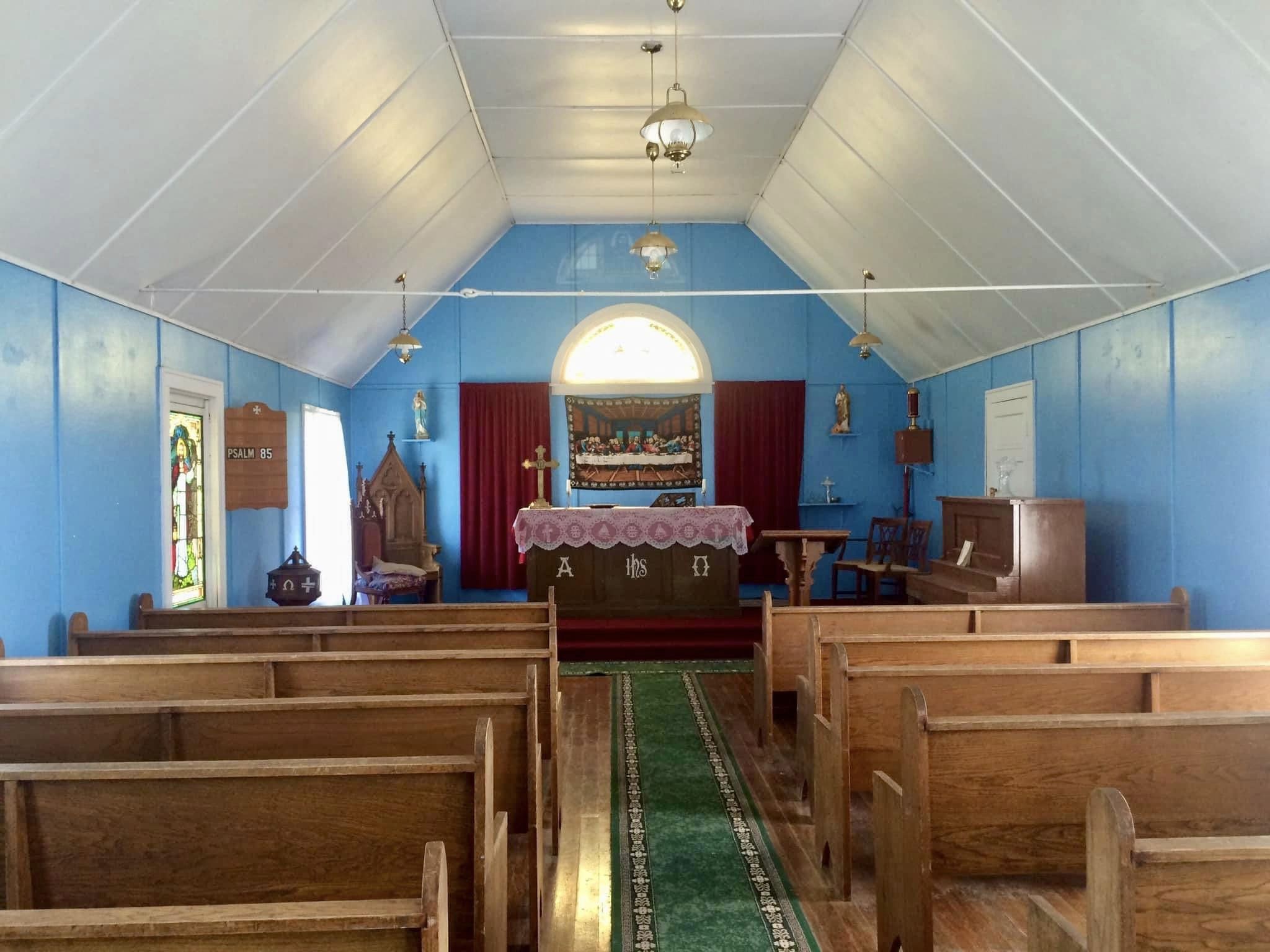
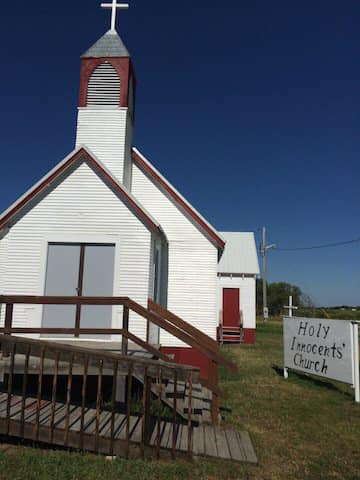
The entryway was upgraded with a handicap accessible ramp and a new door when the church was moved onto the new foundation. Photo from Facebook.

PARMELEE – The Holy Innocents Episcopal church burned to the ground over the weekend, devastating many local families who were baptized, married and received holy sacraments there. 

“We are confident it was not an electrical fire, because although electricity was attached someone would have had to be inside to turn it on to create a short to start a fire,” stated Mother Lauren Stanley of the Rosebud Episcopal Mission. “At the moment we are leaning toward arson.”

The Holy Innocents Church was established in 1890 when the area was known as Wososo Wakpa (or Cut Meat Farm Station). The area was a ration station for the Sicangu people who settled in the Upper Cut Meat, Lower Cut Meat, He Dog, Salt Camp and Ironwood areas. The town of Parmelee was named after a man who built a grocery store in the 1920s.

The church was very old and burned quickly to the ground. Photo from Facebook.

A small group of church leaders and community residents attended an abbreviated Eucharist service offered by Mother Lauren and Senior Catechist Erroll Geboe on Sunday. Another service will be offered on Saturday, November 4, 2023 at 10am at the guild hall. Everyone is invited to attend.

Prairie Rose DuBray-Chapin offered some history on the church in a Facebook post. “When the Episcopalians came, our great grandmother Crow gave this land for the church to be built and a cemetery to be established because her baby needed somewhere to be buried.”

The Parmelee Volunteer Fire Department, along with other emergency personnel, responded to the Saturday morning fire. The area is considered a crime scene and the fire is being investigated by the Rosebud Sioux Tribe’s Criminal Investigators. There were no injuries in the fire. The church is a total loss, but was fully insured. The Fire Marshall was expected to visit the site this week.

The church was once located east of the gravel road. But when the basement began deteriorating, the late Olive Pretty Bird coordinated the project to move the church onto a new foundation. A guild hall was also built west of the church.

“It will be up to this community to decide about rebuilding and how,” stated Mother Lauren. “For seven generations Holy Innocents has stood on this hill and we’re going to have it for seven more because that’s who we are.”

Anyone with any information regarding the church fire in Parmelee is encouraged to contact the Rosebud Sioux Tribe Dispatch at 605-856-2282.

The Holy Innocents Church served many local families. Photo from Facebook.

Wright sworn into tribal council

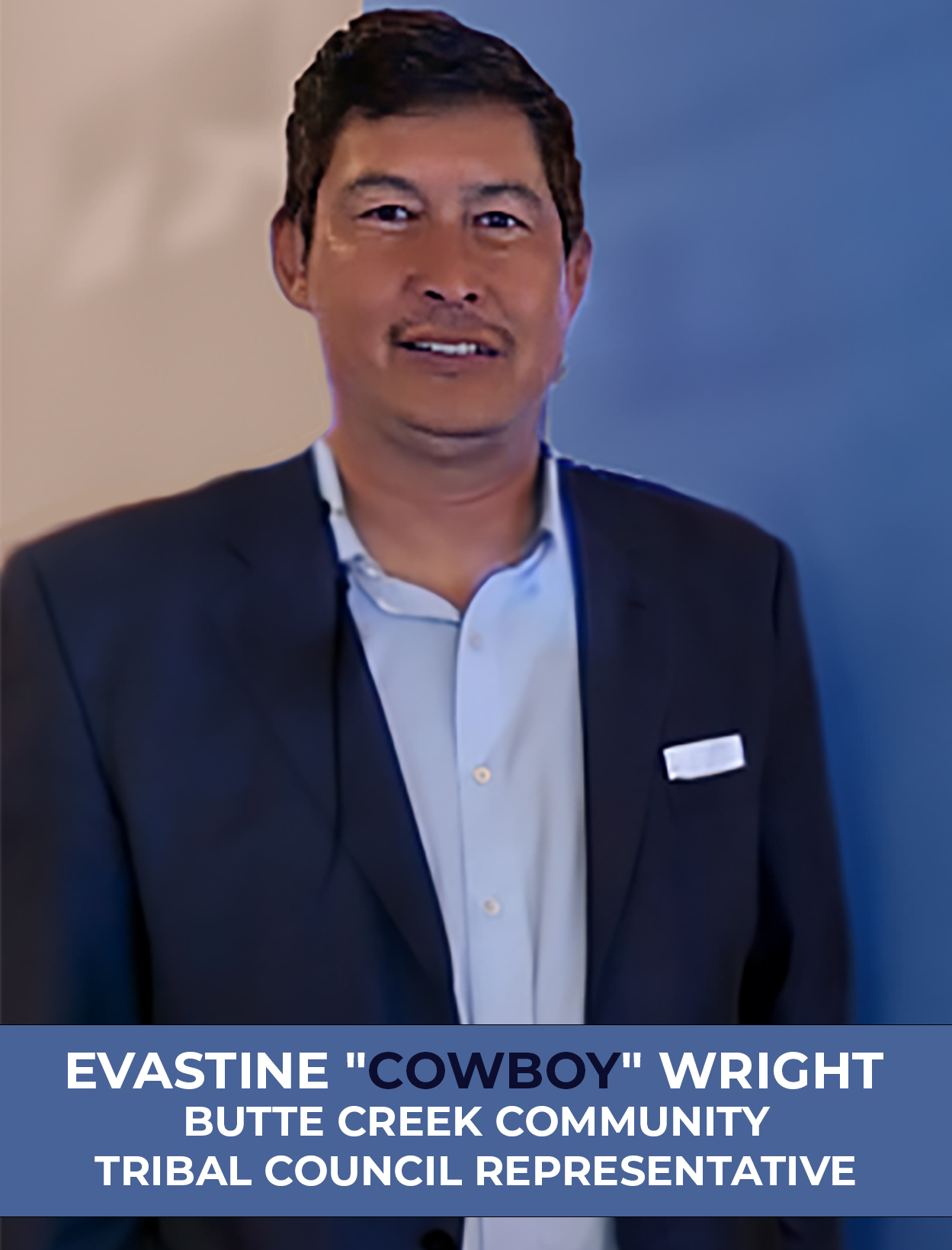
Councilman Wright will serve a three year term in office. Photo from Facebook.

ROSEBUD – Evastine “Cowboy” Wright was sworn into office by President Scott Herman to represent Butte Creek as the newest member of the Rosebud Sioux Tribal Council.

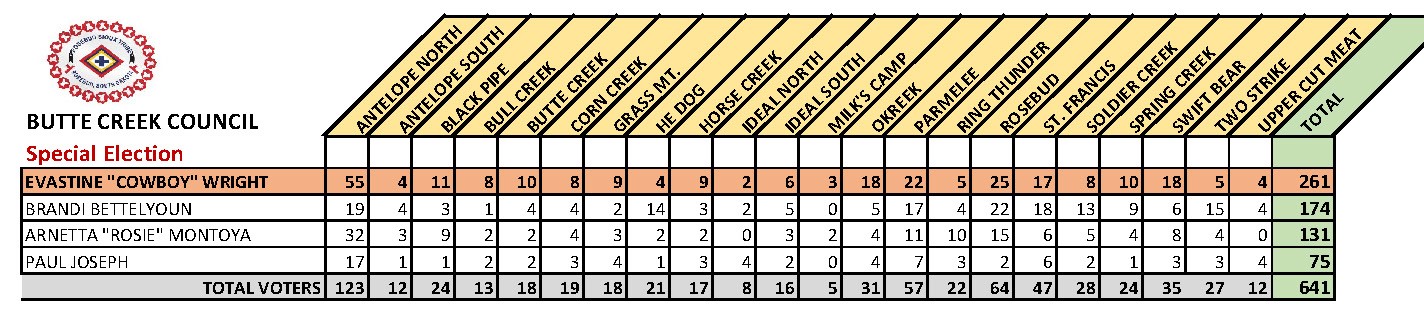
Wright was named winner of the Special Election after votes were tallied and certified by the Election Board. He will serve a three-year term on the tribal council.

The reservation wide election saw a total of 641 registered tribal voters go to the polls on October 26th. Other candidates who ran for the open council seat were Brandi Bettelyoun (174 votes), Arnetta Rosie Montoya (131 votes) and Paul Joseph (75) votes.

The Special Election was scheduled when the tribal council seat for Butte Creek community, located within the reservation boundaries in Mellette County, was declared vacant after Travis Wooden Knife declined the position after winning the General Election. The public was not given a reason as to why Wooden Knife, an employee at the RST Court House, didn’t accept the position.  

In the General Election held in August, Wooden Knife received 1,191 votes over challenger Brandi Bettelyoun, who finished with 734 votes. Former legislator Steven Brave, who was initially elected to office in 2017, could not seek re-election because the Rosebud Sioux Tribe’s constitution limits council representatives to serving two consecutive terms.  

The General Election saw an estimated 1,977 registered tribal voters cast a ballot last summer. According to the 2020 Census, there are approximately 26,000 tribal citizens living on the Rosebud reservation. In order to be eligible to vote in local elections, citizens must be tribally enrolled, 18 years old and reside within the exterior boundaries of the reservation. There are no provisions set in the Election Ordinance allowing for absentee ballots or early voting. An estimated 7,000 tribal citizens are registered to vote.

The Rosebud Sioux Tribal Council will hold their next regular meetings on November 8 and 9, 2023 at the council chambers. Tribal Citizens who use Facebook can follow the Rosebud Sioux Tribal Council page for updates.

Tribal citizens can call the Election Office at 605-747-2381 for more information on how to register to vote.

Tribal council hears ARPA report

ROSEBUD – The Rosebud Sioux Tribal Council recently heard a report on the funding received and expended under the American Rescue Plan Act from Director Jim Wike.

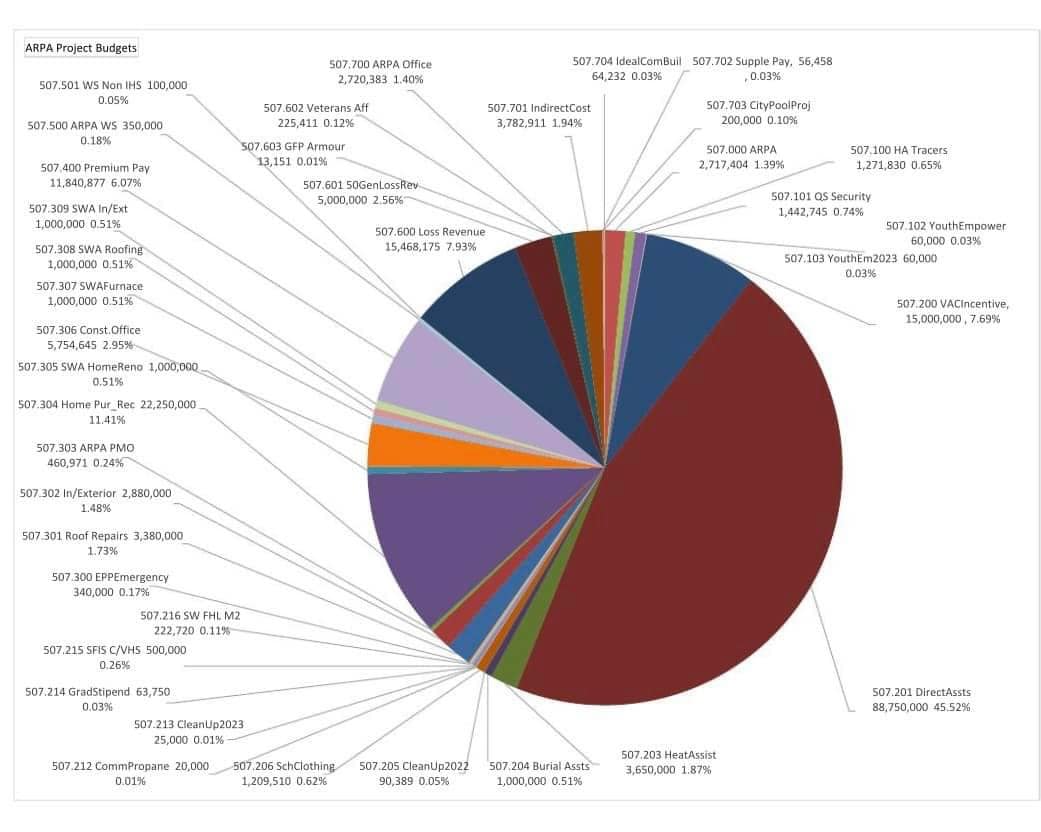
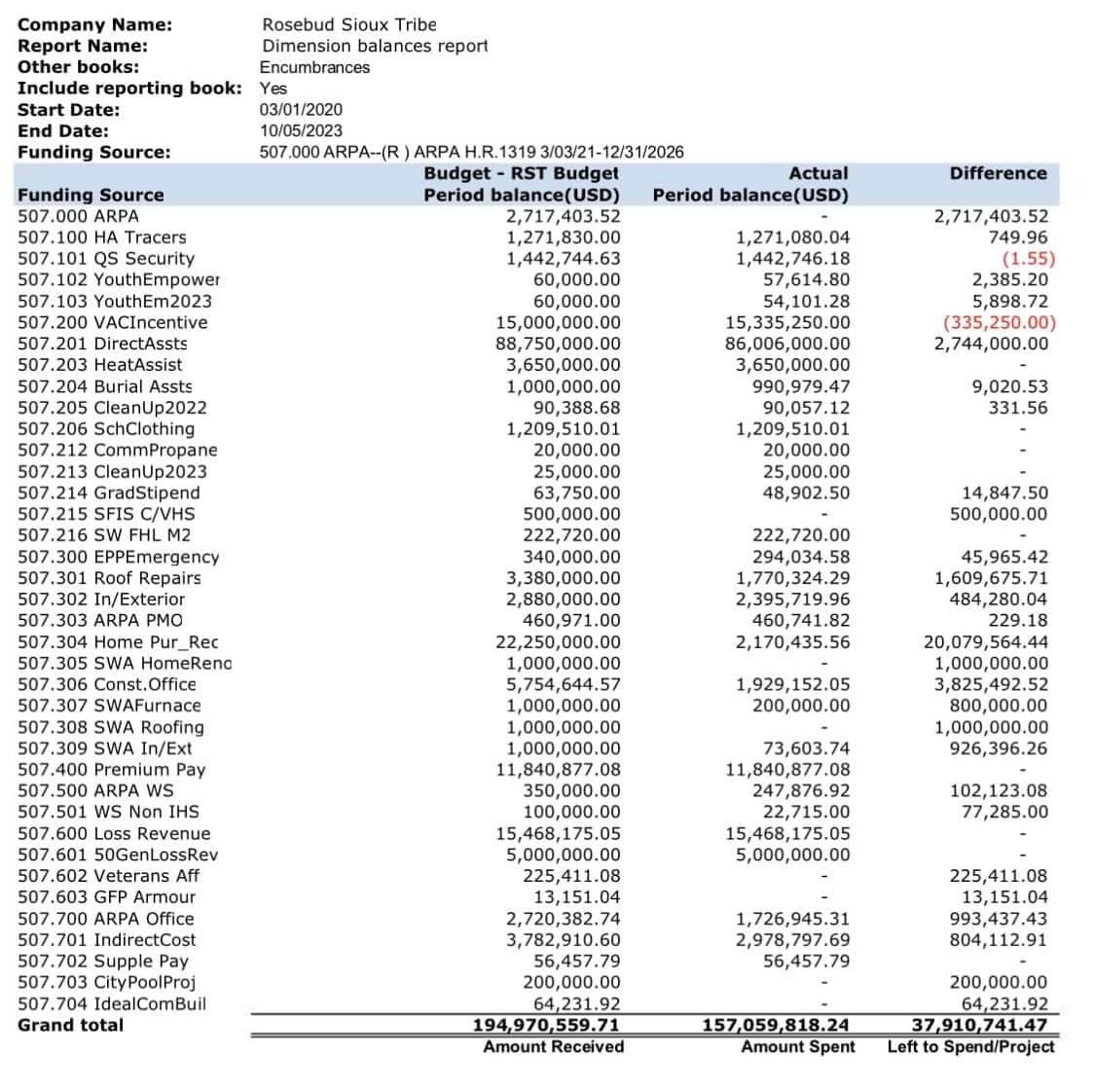
Wike reported on each line item by naming the council resolution or APRA Committee meeting dates approving the expenditures. Rosebud received $194,970,559.71 in ARPA funding. The amount of money spent through October 5, 2023 totals $157,059,818.24. The remaining balance of $37,910,741.47 will be used to fund already approved projects. All funds must be expended in full by December 31, 2026.

The APRA funding paid for goods and services to assist the tribe in several areas affected by the government declared economic disaster, which ensued following the onslaught of the COVID-19 virus. The biggest allocation from the ARPA funding totals over fifty three percent (53.21%) in direct financial assistance and vaccine incentive payments to enrolled tribal citizens, which totaled $103,750,000.00.

Funding was also allocated to pay for school clothing assistance for tribally enrolled students attending Head Start and K-12 schools. Lisa White Pipe made the motion to pay for clothing orders out of the ARPA funds. Seconded by Lila Kills In Sight. Question by Jordan Rahn. Vote was 16-0-0. The motion also included language to set the deadline for adult/children direct financial assistance applications as November 15, 2023.

RST Treasurer Wayne Boyd explained the both the Vaccine Incentives and Direct Financial Assistance had no definite deadlines and the resolutions were amended to extend the deadline to allow everyone to apply. As a result, there are funds which can be used to cover a deficit in the Vaccine Incentive fund in the amount of $400,000, as well as allocate $400,000 for any remaining adult financial assistance and $100,000 for children’s financial assistance payments from the 2022 payout to process remaining applications. A line item was created to pay for the 2023 School Clothing funds.

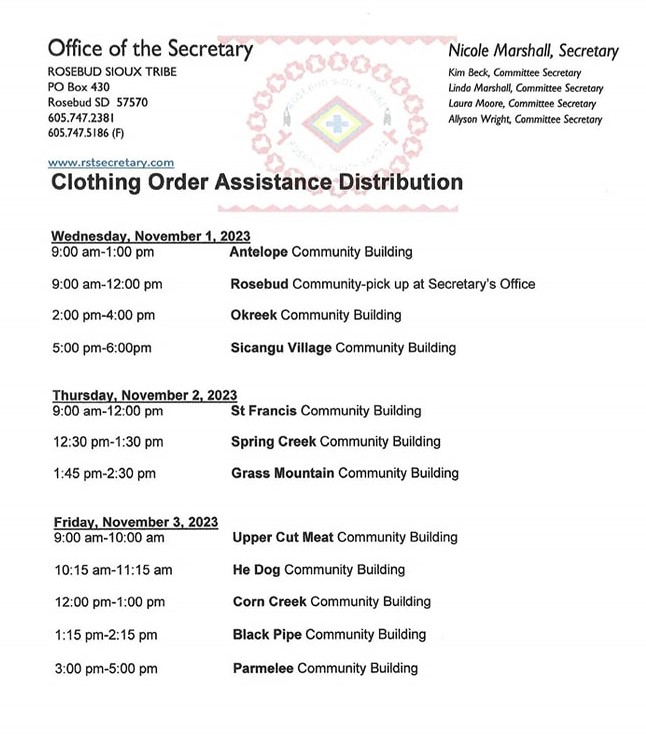
School Clothing assistance checks will be issued to tribally enrolled students beginning on November 1, 2023. The Tribal Secretary’s office has scheduled time in all twenty communities to distribute the checks. Call 605-747-2381 to get the distribution schedule for your community.

The total financial report included line items for ARPA (remaining unbudgeted funds $2,717,403.52), Health Administration Tracers ($1,271,830.00), QS Security ($1,442,744.63), Youth Empowerment ($60,000.00), Youth Empowerment 2023 ($60,000.00), Vaccine Incentive ($15,000,000.00), Direct Financial Assistance ($88,750,000.00), Heat Assistance ($3,650,000.00), Burial Assistance ($1,000,000.00), CleanUp2022 ($90,388.68), School Clothing ($1,209,510.01) and Community Propane ($20,000.00).

Also, Clean Up 2023 ($25,000.00), Graduate Stipends ($63,750.00), SFIS Vocational HS ($500,000.00), SW FHL M2 ($222,720.00), EPP Emergency ($340,000.00), Roof Repairs ($3,380,000.00), In/Exterior ($2,880,000.00), ARPA PMO ($460,971.00), Home Purchase Rec ($22,250,000.00), SWA Home Renovation ($1,000,000.00), Construction Office ($5,754,644.57), SWA Furnace ($1,000,000.00) and SWA Roofing ($1,000,000.00).

Also, SWA In/Ext ($1,000,000.00), Premium Pay ($11,840,877.08), ARPA WS ($350,000.00), WS Non I H S ($100,000.00), Loss Revenue ($15,468,175.05), 50GenLossRev ($5,000,000.00), Veterans Aff ($225,411.08), GFP Armour ($13,151.04), ARPA Office ($2,720,382.70), IndirectCost ($3,782,910.60), Supple Pay ($56,457.79), CityPoolProj ($200,000.00) and IdealComBull ($64,231.92).

The Rosebud Sioux Tribe CARES/ARPA office was created in 2020 to support actions and plans to help with the Protection, Prevention and Response to the Coronavirus pandemic for the RST communities according to US Treasury Guidelines. For more information on the services provided by the office please call (605) 747-3185. Click here to view the council meeting discussion on the ARPA funds received by the tribe.

Rosebud meets with US Attorney

ROSEBUD – The Rosebud Sioux Tribal Council met with staff from the US Attorney’s office to discuss local crimes involving human trafficking, sexual abuse and drug use.

The meeting was the result of a motion approved last summer where the tribal council asked to speak with federal officials regarding the process of prosecuting sex trafficking and drug distribution offenders on the Rosebud reservation. In attendance was US Attorney Allison Ramsdale, US Attorney Troy Morley and US Attorney Gregg Peterman. Peterman is also a member of the Not Invisible Act Commission.

According to the US Attorney’s website, the Not Invisible Act Commission was created in 2022 to “make recommendations to the Departments of the Interior and Justice to improve intergovernmental coordination and establish best practices for state, Tribal, and federal law enforcement, to bolster resources for survivors and victim’s families, and to combat the epidemic of missing persons, murder, and trafficking of Native American, Alaska Native, and Native Hawaiian people.”

Morley also serves as the Tribal Liaison for seven tribes in South Dakota, a position he has held since 2015. Most recently, he was also named the MMIP Great Plains Regional Coordinator. His office was responsible for the recent indictments for a 1991 murder on the Sisseton Wahpeton Oyate reservation, as well as a sex trafficking crime committed by a tribal citizen from Standing Rock.

“There are agents out there and they are working hard to get these cases to where they belong and hold people accountable,” stated Morley, who works with law enforcement on seven reservations in South Dakota. “We’ve been doing cold case reviews since 1999 when the FBI looked at that list from Pine Ridge. Again, in 2012 we went back through that list and also included any case from any reservation in South Dakota. There were some cases from Rosebud that were reviewed and still remain on that list.”

Steve DeNoyer, Jr., who serves as the RST Police Chief Administrator, told the tribal council that they “should be aware of what is going on in your communities and you know some of what’s going on but realistically you have no clue.”

“Our reservation is bad in some areas. It’s bad when you have people putting horse tranquilizers in drugs to have their way with women. Those women wake up in the middle of the pasture with no clothes on and no idea of what happened,” continued DeNoyer. “That makes our job tough. It makes your job tough. The federal prosecutors don’t hear about these cases because there isn’t enough evidence to send to them.”

DeNoyer also noted that over 90% of the crimes that happen on Rosebud are drug related. “Alcohol is still our number one problem. Meth isn’t far behind but alcohol is still our problem by far.”

US Attorney Ramsdale stated her office prosecutes cases referred by local police, the BIA, the FBI and other cases that come to them. “We do not take cases referred by the tribal president,” she said. “I came here to talk about human trafficking. I wanted to share with you that two months ago we indicted a man and woman from Winner for human trafficking.” She urged tribal officials to report any human trafficking crimes to her office.   The US Attorney and her staff are also available to speak to students in local schools. The entire meeting can be viewed on the RST YouTube channel.

Rosebud plans to compact IHS hospital

ROSEBUD – The Rosebud Sioux Tribe hosted a consultant and lawyer to answer questions about the plan to compact the existing hospital into a tribal healthcare system.

Consultant Chris Walker (Cherokee), founder of the Tribal Health Alliance (THA), and attorney Elliott Milhollin, of the Hobbs, Straus Dean & Walker law firm, were both hired by the tribe to assist with formalizing the plan to compact the Indian Health Service hospital at Rosebud.

The consultant firm THA has been working for several years assisting tribes to improve health care delivery by helping tribes assume operations away from the IHS and turning existing facilities into tribal healthcare systems. Most recently, THA helped the Winnebago Tribe of Nebraska compact their IHS facility in 2018.

The Rosebud Sioux Tribe has talked about compacting the hospital for several years. The process took a step forward on May 17, 2023, when the tribal council passed Resolution 2023-143 approving the charter forming the Sicangu Oyate Health System (SOHS).

The tribal council subsequently approved Resolution 2023-239 which appointed a seven-member board to oversee the compacting process. Board members include Dr. Donald Warne (Oglala Lakota), Dr. Allison Kelliher (Athabascan), Dr. Darrell Plumage, Bill Snyder, an unnamed pharmacist, Scott Herman (RST President) and Lisa White Pipe (Chairwoman of RST Health Board).

The difference between contracting and compacting the Indian Health Service is best answered by the federal agency itself. IHS has an Office of Tribal Self-Governance to oversee the contracting/compacting of health care facilities. The following is taken directly from their website:

“Both Title V and Title I provide for Tribal administration of programs formerly administered by the IHS. The major difference is a matter of oversight. Under Title V, a Tribe may redesign or consolidate PSFAs [Programs, Services, Functions and Activities] and reallocate or redirect funding without IHS approval in accordance with the ISDEAA [Indian Self-Determination and Education Assistance Act of 1975]. In contrast, IHS must approve any substantial changes to a Title I Contract. The programs are not exclusive. Because Tribes can choose which PSFAs (or portions thereof) to assume, a Tribe may combine Title V, Title I, and direct services to best meet the needs of its community.” https://www.ihs.gov/selfgovernance/faq/

In addition, in order to be determined as eligible to participate in the IHS Tribal Self Governance Program (TSGP), tribes are required to (1) complete a planning phase, (2) request participation in the self-governance program and (3) provide evidence of three years of financial stability and management capability. In other words, the tribe must have three years of clean audits to be eligible to compact a healthcare facility.

The Rosebud Sioux Tribe has received grant funding for the planning phase and hired the Tribal Health Alliance to assist with this process. However, only two attempts were made to inform the public of the process in the compacting project. One was a virtual question and answer session held on August 18, 2023 (https://tinyurl.com/ed4untu7). The other public information session was held in Antelope Community.

The RST Health Administration is responsible for scheduling future public meetings in the reservation communities to share information with tribal citizens. To learn when a meeting is scheduled for your community, tribal citizens can call the RST Health Administration program at 605-747-5100.

Interested persons can listen to the all-day discussion on the Indian Health Service compacting process by viewing the October 12, 2023 RST council meeting on YouTube at https://tinyurl.com/hcrp25ry

Four file for open council seat

ROSEBUD – Four tribal citizens submitted affidavits to be placed on the ballot for the vacant tribal council seat to represent Butte Creek on the Rosebud reservation.

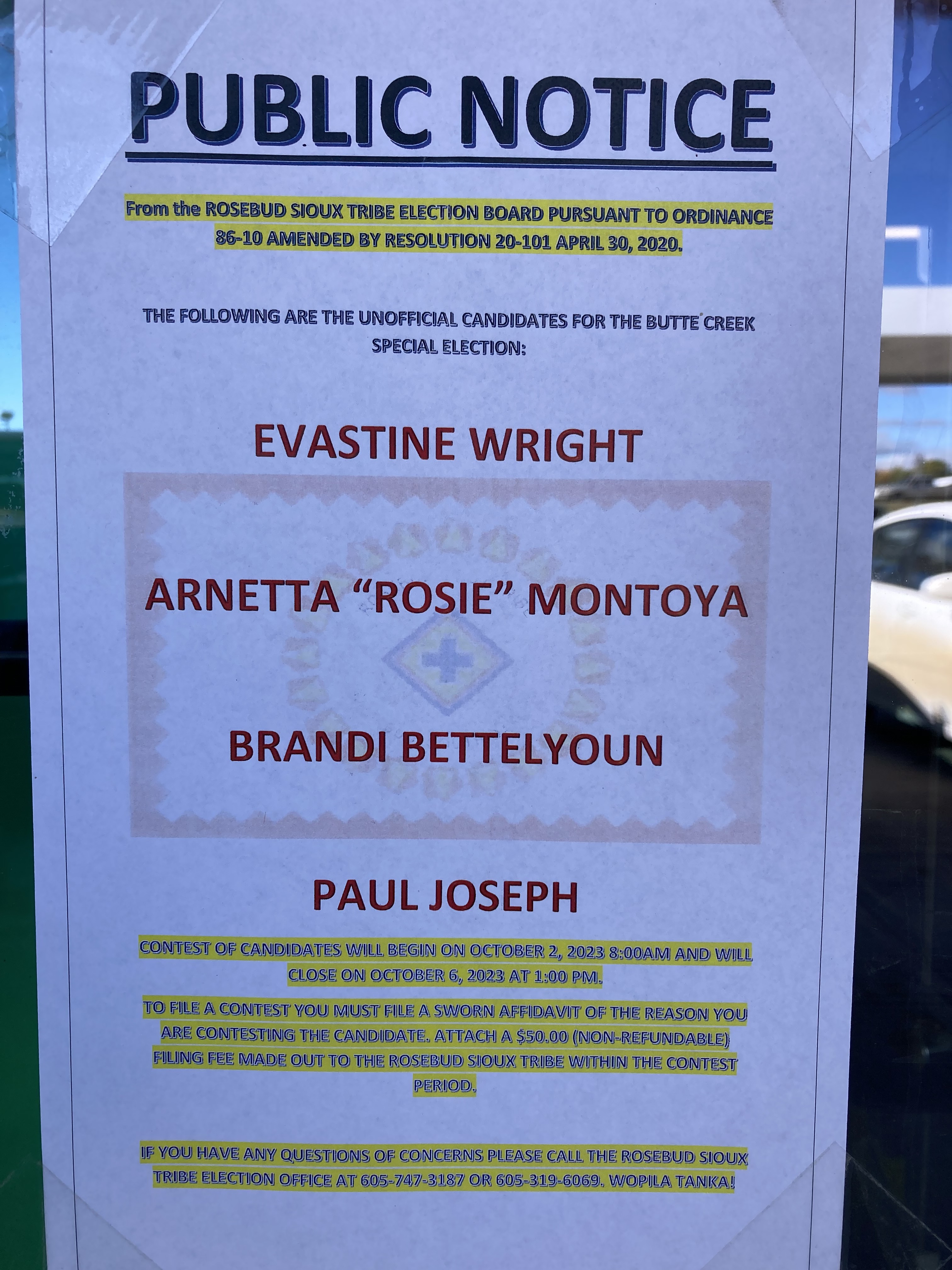
The candidates filing for the Butte Creek council representative are Evastine Wright, Arnetta Rosie Montoya, Brandi Bettelyoun and Paul Joseph. All four candidates were certified as eligible by the Rosebud Sioux Tribe’s Election Board last week after no challenges were received.

The tribal council seat for Butte Creek community, located in Mellette County, was declared vacant when Travis Wooden Knife declined the position after winning the General Election. There was no reason given to the public as to why Wooden Knife, an employee at the RST Court House, declined the position. Wooden Knife received 1,191 votes over challenger Brandi Bettelyoun who finished with 734 votes. Former council representative Steven Brave was termed out of office after serving two terms.


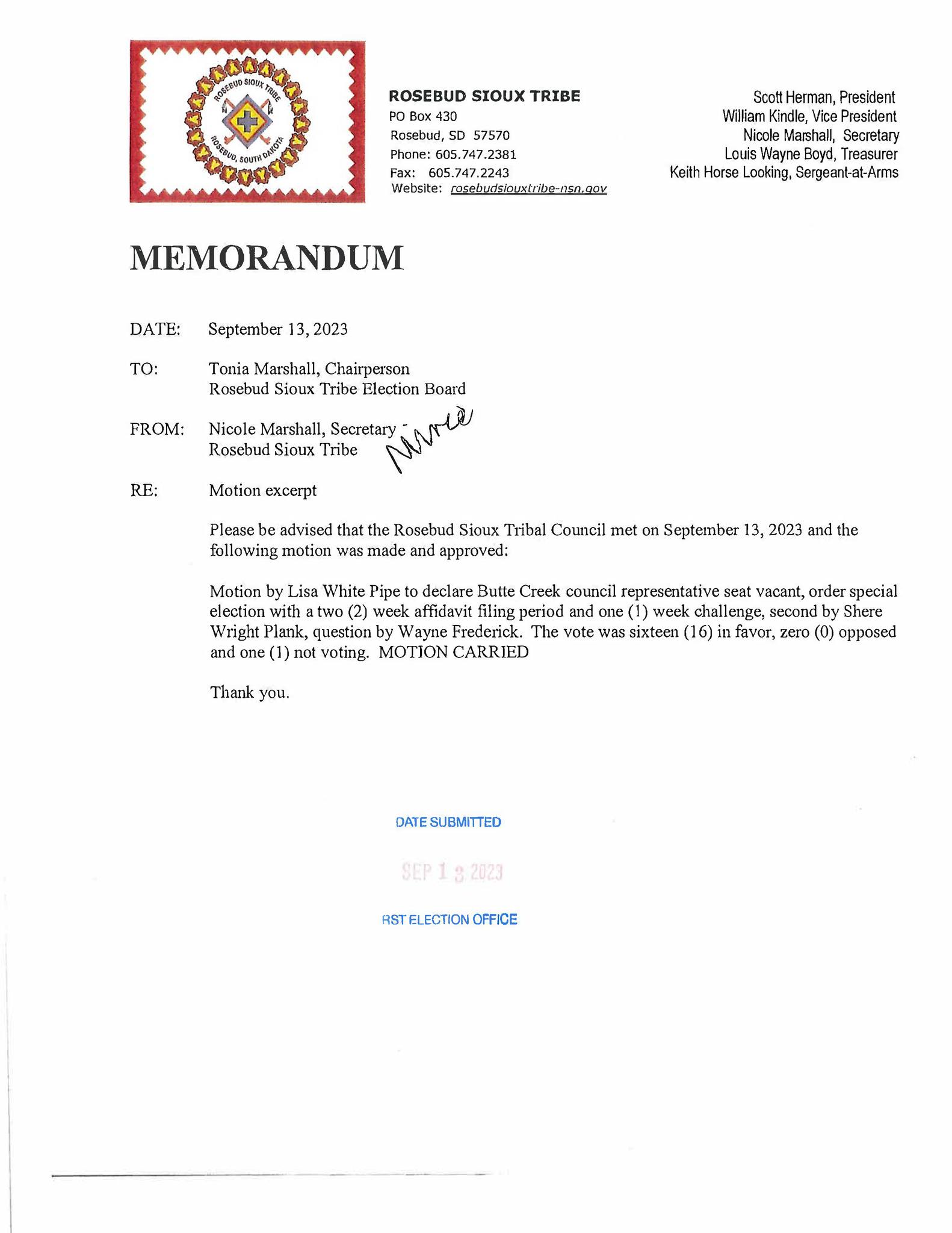
According to a Motion Excerpt issued by the Tribal Secretary, the action was approved after a lengthy executive session held during the September 13 regular tribal council meeting. The action reads “Motion by Lisa White Pipe to declare Butte Creek council representative seat vacant, order special election with a two (2) week affidavit filing period and one (1) week challenge, seconded by Shere Wright Plank, question by Wayne Frederick. The vote was sixteen (16) in favor, zero (0) opposed and (1) not voting. MOTION CARRIED.”


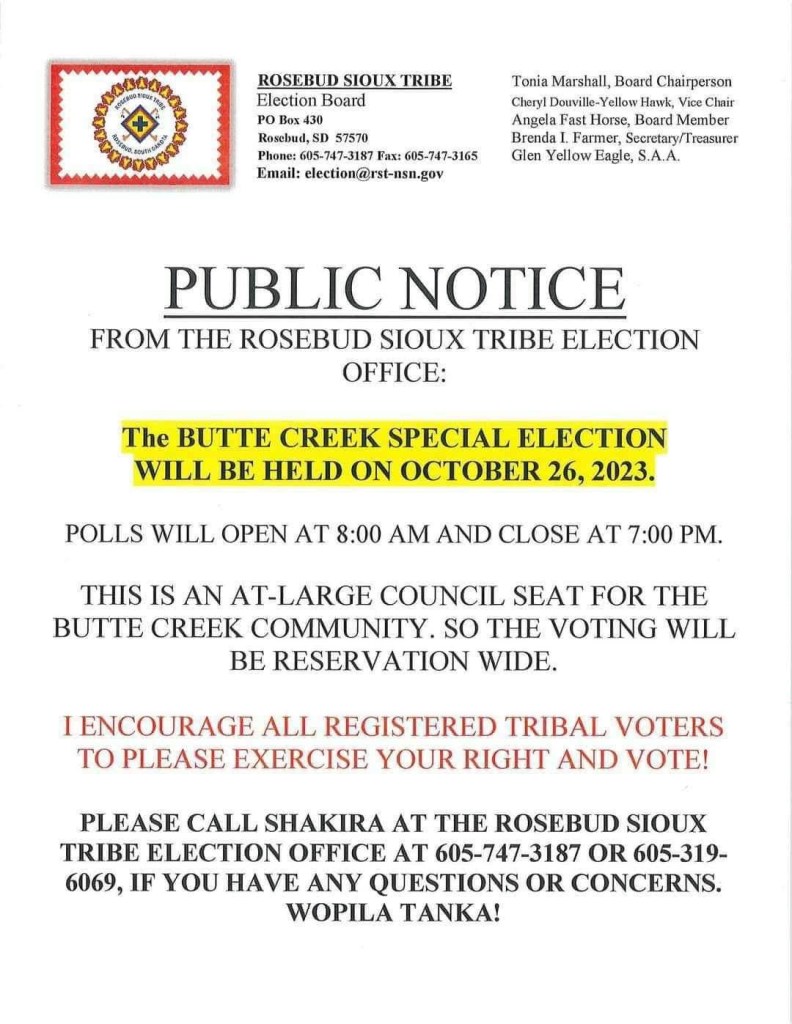
A date for the special election has not been set and will likely be determined at the next regular tribal council meeting scheduled for this week. The Special Election will be held reservation wide as the tribal council representatives are elected at-large by all registered voters.

The Election Code states “if the office of any community representative becomes vacant before the expiration of the term and a year or more of the term remains, the tribal council, within thirty (30) days after the vacancy, shall order a special election to allow all registered voters to vote for the vacant position.”

In the General Election held in August 2023, nearly 2,000 registered tribal voters cast a ballot. According to the 2020 Census, there are approximately 26,000 tribal citizens living on the Rosebud Reservation. In order to be eligible to vote in local elections, citizens must be tribally enrolled and living on the reservation, as there are no provisions set in the Election Ordinance allowing for absentee ballots. An estimated 7,000 tribal citizens are actually registered to vote.

The tribal council representative is elected for a three-year term. Tribal citizens can call the Election Office at 605-747-2381 for more information on how register to vote in the special election for Butte Creek.

UPDATE

Rosebud approves school clothing incentive

ROSEBUD – The Rosebud Sioux Tribal Council approved the distribution of $300 clothing incentives for Headstart through twelfth grade students living both on and off the reservation.


The action came after several months of the tribal council discussing the distribution. Last fall, the tribal council approved a school clothing incentive of $250 per student, per semester to be paid out of ARPA (American Rescue Plan) funding over three years, which totaled $1500 per student. Gift cards were issued to parents in the amount of $250 per child. However, some parents alleged their gift cards had no funds available when they tried to use the card.


The tribal council then approved a lump sum payment for each child of $1500, minus the amount they were issued on the gift cards. Several council representatives repeatedly stated there would be no school incentives issued for three years following the payout last fall.


However, with the election of new council representatives the school clothing incentive was again brought to the floor during a regular council meeting on September 27 and approved. Parents must complete an application and the tribe will verify both school and tribal enrollment before issuing a school clothing incentive check.


Parents and guardians, including the South Dakota Department of Social Services, will be required to complete an application with student name, current address, telephone number and tribal enrollment number. Parents and guardians applying for the incentive must provide proof of guardianship of students. Social services will receive the incentive for all students who are placed in their care.


Applicants living on the reservation must provide photo identification to pick up their incentive. Off reservation student incentives will be distributed by certified mail. In addition, off reservation applicants must submit a student schedule or enrollment verification document from the school when applying.


The clothing incentive will be in the form of a check and can be used for clothing, shoes, toiletries, school supplies and other related needs only. Applications are available at the Secretary’s Office in Rosebud, local schools and on the website until December 1, 2023. Off reservation applicants can download the form at https://tinyurl.com/yc873tn3


The Rosebud Sioux Tribe is not responsible for lost or stolen incentives. If you have questions, please call the Tribal Secretary’s office at 605-747-2381 or email nicole.marshall@rst-nsn.gov

Rosebud Sioux Tribe advertising committee vacancies

ROSEBUD – The Rosebud Sioux Tribal Council appointed recently elected members to serve on standing committees and are seeking tribal citizens to apply for at large vacancies.


Tribal citizens who are eighteen (18) years and older can pick up and submit applications to the Tribal Secretary’s office for the following at-large commission or committee vacancies: two (2) members to serve on the Ethics Commission, five (5) members to serve on the Liquor Commission and one (1) member to serve on the Judiciary Committee. Also, one (1) member to serve on the Social Services Committee and three (3) members to serve on the Transportation
Committee.


Tribal committees and commissions meet at least once a month. The meetings are held to review requests and issues from tribal programs. Committees make recommendations for tribal council to review.


A Special Election will be held to fill the Butte Creek council seat, however, the tribal council did reserve committee spots to be filled by that person once the election is complete.


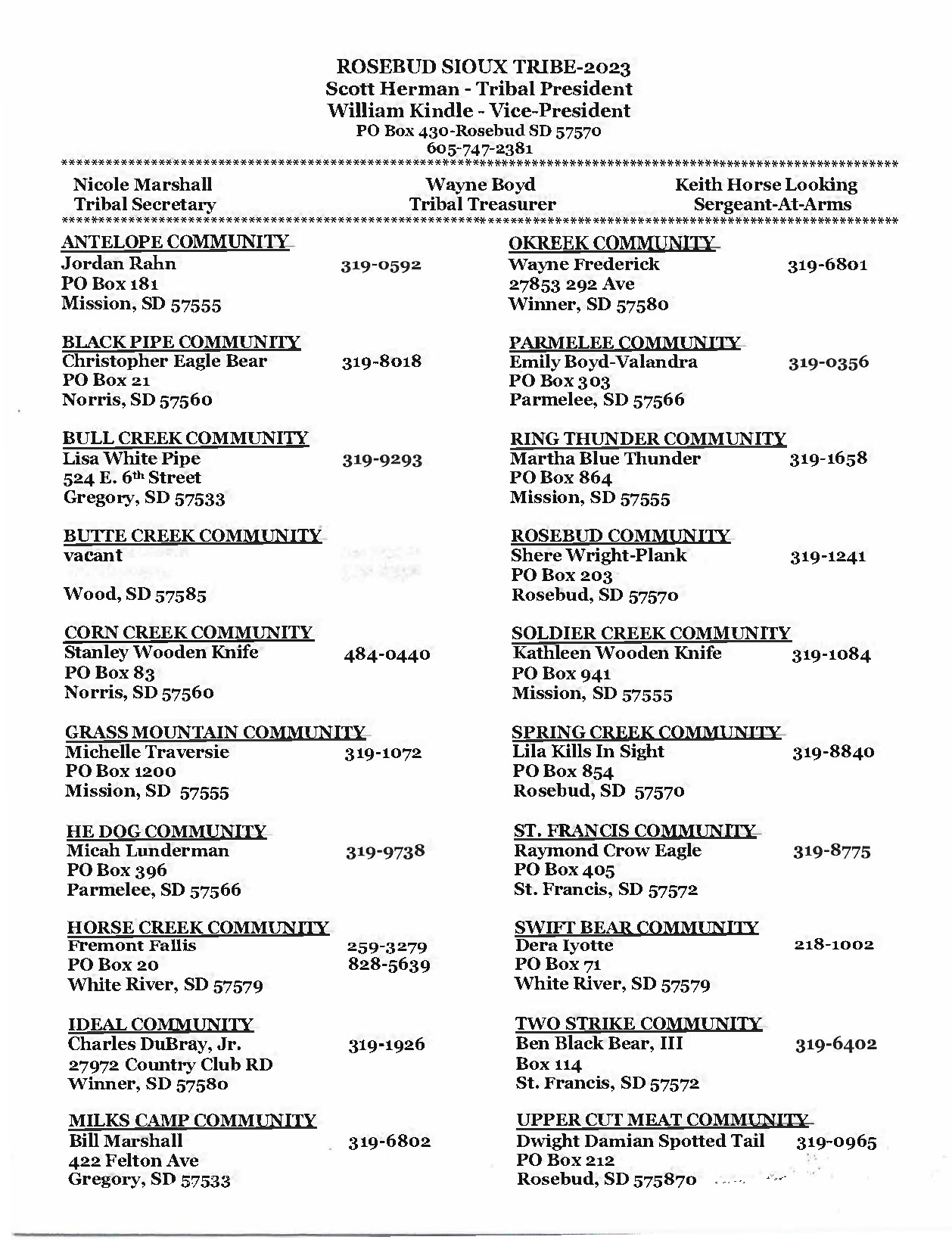
Committee members currently include: Budget & Finance: Lisa White Pipe, Wayne Frederick, Raymond Crow Eagle, Micah Lunderman, Shere Wright Plank and Jordan Rahn.


Economic Development/Cannabis Committee: Wayne Frederick, Shere Wright Plank, Micah Lunderman, Christopher Eagle Bear, Raymond Crow Eagle and Jordan Rahn.


Education Committee: Lila Kills In Sight, Micah Lunderman, Raymond Crow Eagle, Jordan Rahn, Emily Boyd Valandra, Nora Antoine, Teryl Running Horse and Howard Valandra.


Election Board: Tonia R. Marshall, Cheryl Yellow Hawk, Angela Fast Horse, Brenda Farmer and Glen Yellow Eagle.


Ethics Commission: Mandy Medearis, Esther Moore, Valencia Guerue and two (2) vacancies.


Gaming Commission: Gerri Night Pipe, Patsy Valandra, Patti Romero, Totes Waln and Owen Marshall.


Governmental Affairs: Christopher Eagle Bear, Emily Boyd Valandra, Butte Creek, Shere Wright Plank, Ben Black Bear III, Micah Lunderman, Michelle Traversie and Sergeant at Arms.


Health Board: Lisa White Pipe, Wayne Frederick, Dwight Spotted Tail, Emily Boyd Valandra, Martha Blue Thunder, Stanley Wooden Knife, Jordan Rahn, Ben Black Bear III, Scott Herman (RST President), Craig Lafferty and Marty Jones.

Hemp Commission: Wayne Bear Shield, Ken Wike, Sunrose Iron Shell, Brian Dillon and Alex Frederick.


Judiciary Committee: Michelle Traversie, Dwight Spotted Tail, Micah Lunderman, Shere Wright Plank, Ben Black Bear III, Charles DuBray Jr., Robert Becker and Christopher Rahn.


Land & Natural: Emily Boyd Valandra, Wayne Frederick, Dera Iyotte, Fremont Fallis,
Christopher Eagle Bear, Charles Dubray Jr., Charles Bull Bear, Richard Tuffy Lunderman and Delano Clairmont.


Liquor Commission: five (5) vacancies.

Personnel Committee: Lila Kills In Sight, Raymond Crow Eagle, Kathleen Wooden Knife, Michelle Traversie and Bill Marshall.


REDCO/Sicangu Co: Wayne Boyd, Oliver Semans Sr. Nora Antoine, Stephan DeNoyer III, Lisa White Pipe and Wayne Frederick.


Social Services: Lila Kills In Sight, Melinda Yellow Eagle, Martha Blue Thunder, Butte Creek, Stanley Wooden Knife Jr., Kathleen Wooden Knife, Totes Waln and one (1) vacancy.


SWA Housing Board: Melinda Yellow Eagle, Trent Poignee, Patsy Valandra, Kathleen High Pipe, Paula Antoine, Emily Boyd Valandra and Bill Marshall.


Tax Commission: Mandy Medearis, Ronald Neiss, Calvin Hawkeye Waln, Lisa White Pipe and Troy Lunderman.


TECRO Commission: Chance Colombe, Wilbur Smith, Clifford Moran, Anthony Bordeaux Jr., Dera Iyotte and Shawn Bordeaux.


Transportation: Charles DuBray Jr., Fremont Fallis, Butte Creek, Raymond Crow Eagle and three (3) vacancies.


Tribal Land Enterprise: Totes Waln, Dera Iyotte, Antoine Tony Metcalf, Scott Herman (President), Howard Valandra, Lisa White Pipe and Vanessa Red Hawk Thompson.


Treaty Council: Claude Two Elk, Nick Elk Looks Back, Fremont Fallis, Rose Stenstrom, Philip Little Thunder, Keith Horse Looking, Dwight Spotted Tail, Delano Clairmont and Conrad Black Bear.


Tribal Utilities Commission: Ronald Neiss, Ed Clairmont, Irvin Young Jr., Butte Creek and one (1) vacancy.


Veterans Affairs: Rod J. Bordeaux, Maureece Heinert, Darla Engle, Mark Witt, Daryl Jones, Bill Marshall and Ben Black Bear III.


All interested individuals can call the Tribal Secretary’s office at 605-747-2381.

Rosebud prepares for Special Election

ROSEBUD – One of the first actions taken by the newly seated Rosebud Sioux Tribal Council was to schedule a special election after a candidate declined the position.

Travis Wooden Knife was the highest vote getter in the election for a tribal council representative from Butte Creek. Wooden Knife received 1,191 votes and Brandi Bettelyoun garnered 734 votes. There was no reason shared with the public as to why Wooden Knife, who is a tribal employee, declined the position.

According to a Motion Excerpt issued by the Tribal Secretary, the action was approved after a lengthy executive session at the September 13 regular tribal council meeting. The action reads “Motion by Lisa White Pipe to declare Butte Creek council representative seat vacant, order special election with a two (2) week affidavit filing period and one (1) week challenge, seconded by Shere Wright Plank, question by Wayne Frederick. The vote was sixteen (16) in favor, zero (0) opposed and (1) not voting. MOTION CARRIED.”

A date for the special election has not been set. The Election Code states “if the office of any community representative becomes vacant before the expiration of the term and a year or more of the term remains, the tribal council, within thirty (30) days after the vacancy, shall order a special election to allow all registered voters to vote for the vacant position.”

According to a Facebook post on the RST Communications page, affidavits for eligible residents of Butte Creek community will be available from the Election Office at 8am on Monday, September 18, 2023. The closing date for affidavits is 5pm on Friday, September 29, 2023. The filing fee for tribal council positions is $150.00 paid by money order to the RST Finance office. Prospective candidates must show a valid ID and be able to pass a background investigation.

The period to file a challenge against any candidate will be from 8am on Monday, October 2 through 1pm on Friday, October, 6, 2023. Tribal citizens who wish to challenge a candidate must file their affidavit with the $50.00 filing fee, paid by money order to the RST Finance Office.

Tribal citizens can call the Election Office at 605-747-2381 for more information on how to file an affidavit or registering to vote in the special election for Butte Creek. The tribal council representative is elected at large for three (3) year term.

An estimated 26,000 tribal citizens reside in twenty communities on the Rosebud Reservation. There are an estimated 7,000 tribal citizens registered to vote. Election tallies show less than 2,000 registered voters went to the polls on August 24 to cast a ballot.