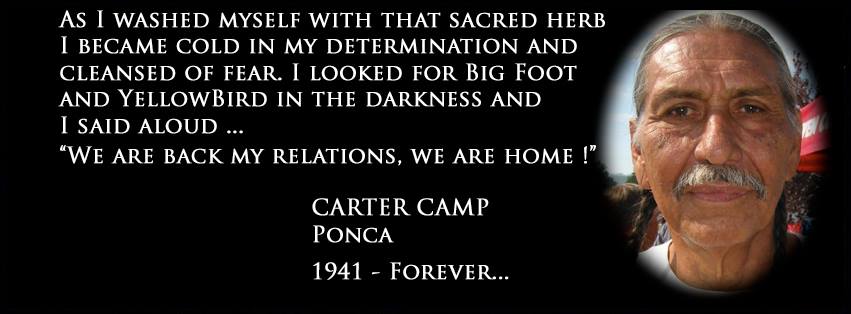
Be a good ancestor, our descendants are depending on you.

Christmas is a fallacy. Our winter ceremonies were replaced by the notion of a fat man in a red suit who could visit every house in the world in a matter of hours.


I write this on the sacred day known as Winter Solstice. The first day of Waniyetu was a time for our ancestors to offer their most powerful prayers. Yet, it seems as though prayer has been replaced by commercialism.


December also is a month which holds some of the most painful memories for the Lakota, Dakota and Nakota people. On December 15, 1890 Tatanka Iyotake (Chief Sitting Bull) was murdered by Indian Police at his home.


December 26, 1862 was the day when 38 Dakota were hanged at Mankato, Minnesota. 2 more were executed in 1865.


Finally, the senseless murders of over 300 unarmed men, women and children on December 29, 1890 by the 7th Cavalry is an event branded into our cellular memory.   


How do we heal?


Today, there are horses and human beings who sacrifice during bitterly cold days and nights to pray for our survival– much like our people who sacrifice every summer in the sun dance.


Prayers will ensure the healing of the Seven Generations.


The Omaka Tokatakiya – Future Generations Ride originally began as the Big Foot Memorial Ride. This ride traces the route in which Si Tanka (Chief Big Foot) and his band walked after the murder of Tatanka Iyotake. It is held annually as a spiritual ride for the youth.


The Dakota 38+2 Memorial Ride follows a route from the Crow Creek Indian Reservation along the Missouri River to Mankato, Minnesota. The day after Christmas execution of 38 Dakota was the largest mass hanging in the dark history of the United States of America. Although President Lincoln is remembered by many for abolishing slavery, he is known to the Dakota as the one who sent the 38+2 to the gallows.


In my lifetime I cannot easily forget these anniversaries of the atrocities committed upon our people during the month in which I was born. Our ancestors are the reason why we still have our language and ceremonies. Our descendants must also remember our culture. We have to help them come back into the circle of ceremony.


Our great grandparents, grandparents, parents, ourselves, our children, grandchildren and great grandchildren are what comprise the Seven Generations.  The concept of the Seventh Generation is here – now – in this very moment.


The Seventh Generation is us.


December is very emotional for us because we carry the memory of the murder of our ancestors in our DNA. It’s in our cellular memory. The way to transmute those dark memories is through prayer.


The human beings and horses sacrificing this week on spiritual rides have us all in their prayers.


Pray relatives. Pray at new moon and full moon. Pray at summer and winter solstice. Pray at spring and fall equinox. Pray at sunrise and sundown.


Be a good ancestor, our descendants are depending on you.


Lack of leadership and financial accountability lead to Probation at SGU

MISSION, SD – Sinte Gleska University (SGU) has been placed on Probation by the Higher Learning Commission (HLC) North Central Association, which oversees academic accreditation.


The action was effective October 31, 2013.


In a six page letter to SGU President Lionel Bordeaux, the HLC detailed several areas where the tribal university is out of compliance. Lack of leadership and financial accountability top the issues listed in the letter.


According to the November 12th letter, SGU’s Board of Regents did not hold a meeting for 30 months prior to the HLC visit in March 2013. The SGU Board also did not carry out duties specifically assigned to them through their By-Laws, “such as approving the budget, evaluating the chief executive officer, ensuring that a qualified chief financial officer was appointed or developing policies or strategies for resolving serious issues confronting the University related to student debt, monies due from the Tribe and other issues.”


Also, SGU “has not appropriately managed its financial resources: it has been operating with increasing deficits in the general fund since 2006, and, while changes in accounting practices will change the appearance of financial reports, University administrators do not seem to recognize or acknowledge that increasing deficits is not a sustainable practice.”


The letter also states SGU “lacks appropriate human resources to provide financial oversight and conduct timely accounting activities: it does not have competent and trained financial personnel to complete basic functions such as accounting for expenses and revenue in a timely fashion and preparing for audits, thus requiring the assistance of an accountant working remotely from Chicago to complete these basic functions; it does not have an experienced and qualified Chief Financial Officer to manage and oversee the accounting office, timely create a budget for each fiscal year, and oversee financial planning.”


According to the Public Disclosure Notice also issued by the HLC, SGU “is required to file a monitoring report no later than February 1, 2014, outlining how it plans to ensure compliance with the Commission’s Assumed Practices.”


SGU must also “file a Probation Report in March 2015 providing evidence that the University has resolved the concerns of the [HLC] Board identified in the Probation action and evidence that the University meets the Criteria for Accreditation, Core Components and Assumed Practices.”


Finally, SGU “will host a comprehensive evaluation in May 2015 to determine whether the concerns of the [HLC] Board identified in its action have been resolved and the Criteria for Accreditation have been met. At its meeting in October 2015, the [HLC] Board will review materials related to this evaluation and determine whether the University can be removed from Probation. If the University has not resolved the [HLC] Board’s concerns that led to the imposition of Probation and has not demonstrated that it is in compliance with all Criteria for Accreditation, other action may be appropriate.”


The HLC documents pertaining to SGU can be viewed by the public online.


There’s no stopping me. I’ll always be a writer

The fall semester is quickly coming to an end for students attending colleges and universities. As you read this there are many Lakota/Dakota/Nakota and other tribal students reading college textbooks and going over their class notes in preparation for final exams. When you are a full-time college student, your work load is akin to that of a full-time job.


I have always encouraged people to return to college. It is never too late to expand your knowledge. After all, life is a learning process which can only be enhanced through applied studies.


Education is freedom. When you make a choice to drop out of high school you are severely limiting your opportunities. It used to be that a high school diploma could help you get most any job. Today it’s very different as people with college degrees are often given preference over job applicants with a high school diploma or GED.


Yet, it is very difficult to finish school. Many of our children and teenagers are extremely disillusioned with the educational process they are experiencing. And those students who are determined to learn all they can and complete high school in preparation for college admission are often overwhelmed with the social challenges they face every day in our local schools. Challenges such as bullying and physical assaults often serve to push students out.


I realize there are some of our people who equate education with assimilation. There are many of our own people who are jealous of their fellow tribal members who have attained a college degree. I remember when I was in college pursuing an undergraduate degree and a family member asked me if I was a “white girl” yet.


Comments like that just show how ignorant people really are.


When you work hard to earn a college degree, you will also grow as an individual. Much of that growth brings you strength to avoid taking personal the thrashing dished out by your family and fellow tribal members.


Consequently, I’ve learned one advantage of attending college is overcoming your own ignorance. Thus, education is freedom in more ways than one.


Next week I will finish my first semester as a graduate student. I am studying Mass Communication at South Dakota State University. I decided to return to school to pursue an advance degree in order to improve my skills as a journalist.


My columns and news articles are provided for my readers. Sometimes I post to my blog, which you can find online at www.sicangulakota.net


Being a writer isn’t something you can easily walk away from. There are times when I need a break, such as the one I recently took in order to adapt to the demand of full-time graduate studies.


Journalism works its way into your blood and once there it never leaves. I will continue to do my best in providing you with quality news updates and columns.


There’s no stopping me. I’ll always be a writer.


Wopila for your readership. I appreciate all of you!

Recall Petition at Rosebud falls short

ROSEBUD, SD – A recall petition seeking the removal of Cyril Scott as Rosebud Sioux Tribal President failed to obtain the number of signatures required to be valid.


The petition was the second attempt by tribal voters to initiate the process of recalling the tribal president. The petition alleged that President Scott had lost the confidence of the tribal members to lead the tribe by his actions toward tribal elders along with his hiring/firing practices and misuse of funds.


Article VII, Section 3 of the RST Constitution and By-Laws calls for “thirty (30) percent of the number of persons who voted in the last tribal election” to sign a recall petition in order for it to be valid. There were 865 signatures on the petition and only 428 were deemed valid, according to Tribal Secretary Julie Peneaux.


The voters list from the General Election held in August of 2012, where 2,538 ballots were cast, was used to determine the validity of signatures. The numbers from the 2012 General Election requires 761 valid signatures on any recall petition in order for it to be considered.


Of the 865 signatures on the petition, 428 were from registered voters who did vote and were thus determined as valid signers. 293 tribal members who signed the petition were registered voters who did not vote in the August 2012 election. Also, 111 signers of the petition were not registered tribal voters, 24 people signed twice, 1 person signed three times while still another person signed 4 times. In addition, there were 4 signatures which were illegible.


President Scott was elected in August 2012 to a three (3) year term, which ends in 2015.

Earth’s gravity altered by 2011 Japanese Tōhoku earthquake

Interesting

The Extinction Protocol's avatarThe Extinction Protocol

December 4, 2013TOKYOJapan’s devastating earthquake in 2011 left its mark on more than the town of Fukushima. The European Space Agency (ESA) says that it had an impact on Earth’s gravity as well. Scientists used data from ESA’s GOCE satellite to show the effects of the 9.0 earthquake that struck east of Japan’s Honshu Island on March 11, 2011. The strength of gravity varies from place to place on Earth, and earthquakes can deform our planet’s crust and cause tiny changes in local gravity. GOCE spent four years mapping out Earth’s gravity with unrivaled precision. One reason values of gravity differ on Earth is because the materials within Earth are inhomogenous and are unevenly distributed. Since earthquakes shift around rock and other material tens of miles below the surface, they cause small changes in the local gravity. Earthquakes under oceans can also change the shape of…

View original post 289 more words

Two US Senate candidates absent from SDIBA forum

PIERRE, SD – Three hopefuls for South Dakota’s United States Senate seat answered questions about economic development, taxation and the Indian Child Welfare Act (ICWA) last week.

Democrat Rick Weiland, along with Republicans Dr. Annette Bosworth and Stace Nelson, are all candidates for the seat currently held by retiring Senator Tim Johnson. All three were on hand to greet several tribal members and answer questions at a forum sponsored by the South Dakota Indian Business Alliance (SDIBA).

Former SD Governor M. Michael Rounds along with Larry Rhoden, also candidates for the US Senate seat, did not attend the forum. The forum was held in conjunction with a SDIBA policy meeting.

“The same folks that were missing last night are missing today,” stated Stace Nelson, who currently serves as State Representative from District 19. He was referring to a forum held at the South Dakota School of Mines and Technology in Rapid City, SD on November 21, which both Rounds and Rhoden did not attend.

“More taxes are a problem for all of us,” stated Nelson in response to a question about the complex taxation issues residents of Indian reservations face. “When I take your money, I take your freedom.”

Weiland stated he will seek “a seat on the Indian Affairs Committee” if elected to Senate. He believes this will allow him to help South Dakota’s Indian tribes be better served in times of disaster, such as blizzards or flooding on reservations. “The Sandy Relief Act is legislation which allows tribal governments to go directly to the federal government with requests for disaster assistance,” he said.

In response to a question about ICWA, Dr. Bosworth stated “the mental, emotional and physical health of children goes back to how and where they were raised.” She is a Physician who has provided counseling to many tribal children in South Dakota. “The worst day in the memory of many Indian children is the day they are separated from family,” she said. “It is valuable to keep Indian children with their own culture and family.”
Kevin Killer, State Representative from District 27, and Ryan Maher, State Senator from District 28, were also in attendance. Both gave a preview of their plans for the 2014 South Dakota State Legislature, which will begin on January 14, 2013 at the State Capitol.

Killer will focus on dental health of children, ICWA, tribal college funding and Indian artists as entrepreneurs on the reservation during the 2014 Legislature.

Maher will focus on access to financial capital, literacy and domestic violence initiatives.

The day ended with several roundtable discussions led by SDIBA officers.

Personal happiness affects your attitude

The best learning experience is realizing what you don’t want. I’ve learned I have to experience something I don’t want in order to know what I do want. This is a free will zone and choosing to do something is the only way we will know if it is really what we want.


Does that make sense?


There are times when we make choices in our lives which lead to unhappiness. This is how we learn. Yet, so many people make a choice in their lives and upon learning it is something they really don’t want, they refuse to choose something else.  


For instance, when you get a job which you think you’ll like but a few months into it you realize it isn’t what you thought it would be. But instead of seeking a more fulfilling job, many choose to remain where they are.


That doesn’t make sense.


Life is way too short to be unhappy, especially when it concerns your work. The way you make your living occupies much of your time so it’s better to be happy with your job, isn’t it?


When you are unhappy with your work it shows. People who you are supposed to serve while you are at work will easily pick up when you are not satisfied with what you are doing. Personal happiness affects your attitude.


Furthermore, oppressive environments in the workplace are a source of undue stress for many employees. Do you feel like you are walking on eggshells throughout your workday?  Employees who feel threatened or intimidated on the job could easily be coerced into doing something which they otherwise wouldn’t do.


High stress levels in the work place are very unhealthy.


For the last 13 months I have been employed by the Rosebud Sioux Tribe. For the most part I have enjoyed working for my tribe and also appreciate most of my co-workers. Still, it can be an extremely oppressive environment when one works for the tribe. Tribal employees are often at the whim of the people elected to office.


Tribal corruption trickles down from the top. When the people at the bottom of the rung are negatively affected by what is happening at the top, the workplace quickly becomes an extremely toxic environment. Bad behavior exhibited by just one person can bring the morale of an entire department down.


It’s not fun working with people who act like your salary is being funded out of their bank account. Some employees are extremely vociferous about the actions of their coworkers. Yet, they fail to see they often exhibit the same behavior.


Consequently, I view the Bible as a guide of sorts. I have some favorite passages, one of which is Matthew 7:3, which reads: “Why do you see the speck that is in your brother’s eye, but don’t consider the beam that is in your own eye?”


When you work diligently to improve your own behavior, there is no time to worry about the behavior of your co-workers.