Historical Trauma Impacts Us All

November 12, 2017

Vi Waln

Historical or intergenerational trauma is real among our people. Many issues our teenagers and children are dealing with today are rooted in historical or intergenerational trauma. Our lives, as well as those of our descendants, will be affected by trauma as long as we don’t make a conscious effort to heal.

People who tell you that the effects of historical or intergenerational trauma shouldn’t be talked about are in denial. We have to heal our past to understand the issues of today and work for a better future. Don’t let anyone tell you to be quiet about the trauma we’ve suffered. Again, we have to consciously face traumatic events of the past so we can bring healing for ourselves and our unborn generations.

One glaring example of how historical or intergenerational trauma impacts us in the present is the sexual molestation and sexual assault of our children. Many children being sexually abused today are victimized by people who were also sexually molested. Children sexually molesting other children is more common than you believe. It’s been going on since before I was a child.

When a child is sexually molested they may have no idea of what is happening. They are forced by the abuser to feel what they wouldn’t usually experience until adulthood. An innocent child has no idea of what they’ve experienced as being wrong, especially if it felt good.

Many children who’ve been sexually abused tend to block out the memory of who molested them. However, the behavior children exhibit in public is generally a dead giveaway that they’ve been sexually molested. Sometimes the sexual behavior of molested children manifests in a classroom setting, other times it shows up at home.

Innocent children are often oblivious to the sexual behavior they may exhibit in public. A teacher or daycare provider might notice the sexual behavior of a child. It’s best to report any unusual behavior at school to the principal or counselor. If nothing is done at school to address the sexual behavior of children, it should be reported to law enforcement, a medical provider or social services. Keep reporting until someone investigates. In many cases, it’s quite possible the child is being regularly victimized at home.

Trauma impacts every single one of us. Even if you don’t believe you are affected, you are. Because of the horrendous experiences our grandparents survived, trauma is in our genes. We were also born with the genetic trauma of our ancestors, who were brutalized in a number of ways. This genetic trauma is passed down to our children, grandchildren and great-grandchildren. If we don’t live a healthy life, we can exacerbate the trauma effects our children suffer.

Trauma affects our entire life. Many of our people suffer from drug and alcohol addictions their whole life because of trauma. Other people are incarcerated because of genetic trauma. That is, many of our people will spend decades behind bars because genetic trauma worked in way to bring about the violent or sexual victimization of an innocent adult or child.

Please don’t let an ignorant educator, or any other uninformed adult, tell you that trauma is simply historical and doesn’t need to be addressed. Nothing is going to heal your trauma and the impact it has on your life until you face it. Healing can be found in many places but the process has to start somewhere.

Our children will continue to be brutalized until we face and heal our trauma. It’s up to all of us to stop the sexual victimization of small children. The sexual abuse of small children is happening right now in homes located on every single Indian reservation on this continent. It will continue as long as we look away and refuse to talk about ways to heal our trauma.

It isn’t easy to face the wrongs we’ve committed. Yet, admitting that you’ve acted from a place of historical or intergenerational trauma is a start. Please don’t be afraid to face your trauma. Don’t be afraid to seek help. It’s the first step to healing.

Our children and unborn generations are depending on us to heal our historical trauma.

Did you like this post? Consider making a donation to help maintain this website. Wopila!

Donate Button with Credit Cards

Akicita Isnala Najin

037 light

October 29, 2017

By Vi Waln

“I will never ever give up on finding my brother. I will bring him home someday.” Eva Iyotte, Swift Bear Community.

Eva’s statement appears online at the Korean War Memorial of South Dakota: In Memory of US Army Sergeant Phillip James Iyotte. Last week, the Sicangu Lakota people witnessed the Iyotte Tiospaye prayer being answered. The homecoming of the late Sergeant Phillip James Iyotte was an event which united the Lakota people.

Born on December 22, 1929, Phillip James Iyotte was a teenager when he volunteered for the US Army. He was a member of Company E, 2nd Battalion, 21 Infantry Regiment, 24th Infantry Division. According to the Korean War Memorial site, his “battalion was one of the first sent into battle. On September 2, 1950, Sergeant Iyotte was wounded in battle, but he recovered and returned to the front lines on September 21, 1950. . . [he was] taken as a prisoner of war on February 9, 1951. . .He died on September 10, 1951, while held captive by the North Koreans.”

Lakota culture includes stories about the Tokala or Sash Wearers. These were the Akicita who went into battle with no intent of return. They vowed to stake themselves to the ground and fight the enemy to death. Sergeant Phillip James Iyotte was a true Tokala. Only the Tokala is strong enough to return to the front lines of a war zone 19 days after being seriously wounded in battle.

Sergeant Phillip James Iyotte’s parents were the late Joseph Iyotte Jr. and Florence Menard of White River, South Dakota. His late siblings included Judy Iyotte Black Elk, LeRoy Iyotte and Lawrence Iyotte Sr. He is survived by his youngest sister Eva, as well as a large extended family of nieces and nephews. Eva prayed every day to fulfill her fathers’ wish – to find her brother and bring him home. What a powerful prayer!

Our communities are known for great hardship. Today, many Lakota people reside in counties designated as the poorest in the country. Yet, the homecoming of Sergeant Phillip Iyotte was a rich display of Lakota culture, love and support for an Akicita. He was a Tokala who willingly went to war to protect his Tiospaye, knowing full well he might not return.

The technology of today allowed the whole world to watch the Lakota bury their long-lost soldier. From the time Sergeant Phillip James Iyotte’s remains landed in the HeSapa, to the time he was buried next to his late father, our Akicita did an excellent job of honoring one of their own.

Lakota people in the Eagle Nest, Corn Creek, Wososo, Rosebud, Horse Creek and Swift Bear areas decorated the highway with American flags. Large groups of veterans, singers, students and tribal families welcomed Sergeant Phillip James Iyotte as the motorcade passed through our communities. His niece Dera provided impromptu narratives through Facebook live streams, which included a wealth of family and community history, as the procession traveled through Lakota territory.

homecoming

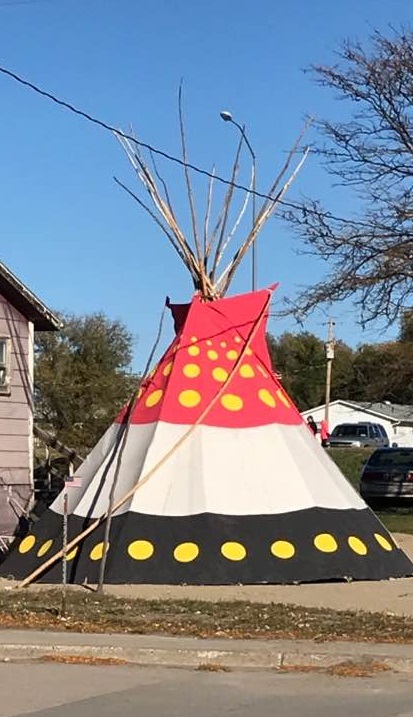
When the motorcade arrived in the Swift Bear Community, a large crowd of relatives and veterans were waiting. Sergeant Phillip James Iyotte arrived at his Sister’s residence by horse drawn wagon. The Bad Hand singers rendered many Red Leaf songs outside of the painted tipi, where our fallen Akicita laid in state until dusk. The Red Leaf songs recounted a remarkable story of Akicita Isnala Najin, the young soldier who traveled far from home to serve as a courageous Tokala. It was a beautiful tribute to one of the bravest Akicita the Sicangu Lakota have ever known.

The outpouring of support by numerous veteran groups and community people was a display of heartfelt grief marked by Lakota honor and generosity. There are too many who were involved to list here individually. The Lakota Oyate appreciates all the veterans from different eras who came in support of Sergeant Phillip James Iyotte and his Tiospaye.

We acknowledge our Sicangu Lakota Akicita Eugene Iron Shell Sr., Homer Whirlwind Soldier Sr. and all veterans of the Korean War. The homecoming of Sergeant Phillip Iyotte helped many of us realize how fortunate we are to have our Leksi Iron Shell and Leksi Whirlwind Soldier in our lives all these years. They both served on active duty in Korea and returned home to care for their families.

We also want to recognize all the American Legion Posts and Lakota Warrior Societies who helped bring Sergeant Phillip James Iyotte home to his final resting place in Two Kettle. The Chauncey Eagle Horn Post 125 of Rosebud provided a tremendous service to their fallen comrade. We are grateful to all veterans and active duty soldiers who paid tribute to one of their own.

As I watched the internet live streams on the day Sergeant Phillip James Iyotte came home to Swift Bear, I saw my people come together as one to honor a fallen soldier. Please pray for continued unity in our everyday lives as we work to overcome our hardships and provide the basic necessities for our families.

Wopila Tanka. Mitakuye Oyasin.

Did you like this post? Consider making a donation to help maintain this website. Wopila!

Donate Button with Credit Cards

Lakota Teachings Do Not Advocate Suicide

Facebook-suicideprevention

September 23, 2017

By Vi Waln

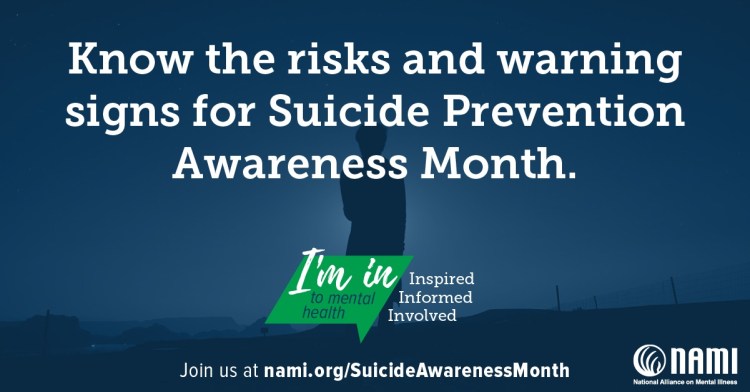
September is designated as National Suicide Prevention Awareness Month. “Take a Minute, Change a Life,” is this year’s theme. Many Lakota people have been affected by the suicide of a loved one. If you are contemplating suicide, please take a minute to read on, it could change your life.

Lakota people grounded in spirituality understand the sacredness of human life. It doesn’t really matter how you pray, the important thing to remember is Tunkasila, Wakan Tanka, Creator or Father God puts every human being on Earth for a purpose. Each one of us has a certain amount of time on Earth to fulfill our life purpose. You were born with the inner strength to complete your life’s mission.

Lakota teachings do not advocate suicide. Lakota spirituality focuses on life. A central prayer is for Wicozani or health. Most of the sacred songs we hear at Sundance, Inipi, Lowanpi and Yuwipi ask for strength and courage to live in this world. The Native American Church prayers and songs also focus on life.

Still, many Lakota people suffer from depression, post-traumatic stress disorder, mental illness or other afflictions invisible to those around them. These conditions are hard to overcome, especially when you are young. Healing is always possible, no matter how dark your life might seem.

Suicide is not an escape. You will not have an easy time when you choose to end your own life. Lakota teachings say birth involves certain Spirit helpers who assist our transition into the human body when we are born.

It is believed these same Spirit helpers are there to help us make the end of life transition when Death comes. However, you must consider the possibility that those Spirit helpers might not be there if it isn’t your time to leave this world. The spiritual pain you experience could be intense when you commit suicide.

Love will overcome all your darkness. Family members often pay attention to one another to make sure they are okay. Yet, there are times when no one can see a suicide coming. A person makes a rash decision to end their life.

As difficult as it may be, you must think about the enormous pain your self-inflicted death will cause those who love you. You must also remember that if it isn’t your time to die, the risk is great. That is, the spiritual help you might expect when you kill yourself might not be there. Your Spirit will have to depend on the prayers of the human family you’ve left behind.

In 2003, my oldest Takoja walked into the spirit world. My family was devastated. The loss of a child is something you never really get over. My Takoja passed away from an infection called Group A streptococcus, which you may hear people refer to as strep throat.

A temporary doctor working for the Indian Health Service Hospital at Rosebud, SD failed to diagnose her illness. She was 5 years old. I filed a wrongful death lawsuit against the US Government and won a settlement.

On the day of Takoja’s funeral, the late Dinah Crow Dog-Running brought a small basket filled with spiritual food (wasna). I had watched her make spiritual food many times during her life. Tunwin Dinah would often blend 3 sacred foods into her wasna. This is the kind of wasna she would serve to the public when she was asked to pray at a gathering.

Sacred food generally refers to the 3 bowls of wasna served with the morning water in the Native American Church (tobacco/cornhusk) prayer services. Dried buffalo or deer meat, dried chokecherries and dried corn are each prepared into an individual wasna. After the morning water is shared, the 3 bowls of wasna (morning food) are served to the people.

The basket Tunwin Dinah prepared for my Takoja was covered with a piece of red felt. She uncovered the basket and I saw a tipi made from sage on the wasna. She told me to use my finger to make a door in the tipi and to take some wasna to put in the small bundle she prepared for my Takoja. I did as she asked and then shared the sacred food with my family.

With a prayer, she helped me put the small bundle of food in my Takoja’s hands. We stepped back when we were done and stood looking at my Takoja. Then an incredulous look came over Tunwin Dinah’s face and she whispered, “they all followed her.”

She told me there are many lost Spirits who don’t know where to go when they die. On the day we buried my Takoja, many of those Spirits followed her to the other side. My Takoja helped them find the way to where they are supposed to go. I believe many of those Spirits who followed her were relatives who committed suicide and left this world before their time.

It’s important to remember who we are. The way a Lakota family buries a blood relative can bring spiritual help in ways we may not understand. Spiritual help can come when the family prepares spiritual food with a prayer to send with the loved one making their journey. The prayer put into that sacred food creates a path for many to follow.

It’s time for all Lakota people to live their culture. The Lakota teachings we still carry weren’t left to us for nothing. When families begin regularly making the spiritual food with a prayer, we will see our society turn itself around. Consequently, wasna is meant to be shared regularly, not just when someone dies.

Life might seem hard, but please know that wandering on the other side will likely devastate your spirit even more. Many believe the suffering in the spirit world is more intense than the pain we experience in our body.

People love you! Call 1-800-273-8255 to speak with someone who cares, or text NAMI to 741-741 to be connected to a free, trained crisis counselor.

Mitakuye Oyasin.

Did you like this post? Consider making a donation to help maintain this website. Wopila!
Donate Button with Credit Cards

Vote in the RST General Election

August 19, 2017

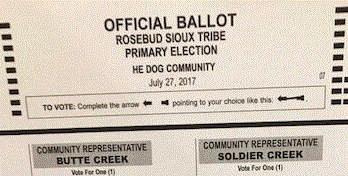
Ballot2

The Rosebud Sioux Tribe will have a General Election on Thursday, August 24. Voters will elect a tribal secretary and 10 tribal council representatives. Since Wayne Boyd was the only candidate to file for tribal treasurer, he will remain in that position.

According to the Election Board, there are approximately 7,306 tribal citizens registered to vote on the Rosebud. This number does not include anyone who registered in the last 2 weeks. 2,041 (28%) of Rosebud’s registered voters cast a ballot in the Primary Election. This is the highest turnout we’ve ever had for a tribal election.

Elections are important. It’s an opportunity for you to have a say in your government. In the past, Rosebud has had a 22-26% voter turnout in tribal elections. This means less than 1/3 of people registered to vote on the reservation decide who is elected to serve in tribal government.

Many tribal citizens complain that the same people are elected to office over and over. Since the voter turnout has been historically low, it’s safe to say that the same people are voting in tribal elections. Tribal citizens have the power to change the outcome of any election when they register to vote and act by casting a ballot.

There were 5,265 registered tribal voters who didn’t vote in the July 27 Primary Election. Those voters alone have the potential to change the outcome of an election. If you are a tribal citizen who is registered but choose not to vote, please reconsider. We need your input.

Voters must consider each candidate running for tribal council. Look at what they have contributed to our society. Those of you who watch or attend tribal council meetings know who speaks for the people and who sits silent.

Here is a list of candidates on the General Election ballot:

Tribal Secretary
Martina “Teema” LaDeaux
Linda Marshall

Black Pipe
Russell Eagle Bear
William Morrison

Bull Creek
Byron Andrews
Alfred Old Lodge

Butte Creek
C. Steve Brave
Paul Joseph

Grass Mountain
Vanessa Red Hawk Thompson
Rita Means

Ideal
Gabriel Medicine Eagle
Shizue M. LaPointe

Okreek
Steven L. DeNoyer
Wayne W. Frederick

Parmelee
Eileen Shot
Brian K. Dillon

Spring Creek
Pamela J. Kills In Water
Lila Kills In Sight

Soldier Creek
Kathleen Wooden Knife
Dennis Charlie Spotted Tail

Two Strike
Richard “Smokey” Whipple
Ben Black Bear III

We elect candidates to vote on issues during tribal council meetings. When elected representatives abstain from the tribal council vote, they’ve made a choice to not represent the people who put them there.

Voters are also encouraged to examine the employment record of candidates. If a candidate wasn’t performing well at their job, they likely won’t perform as a tribal council representative either. Just because an employee has a long history of employment, it doesn’t mean they excelled at their job or saved the tribe money.

It is crucial for voters to consider the criminal records of tribal council candidates. Tribal council representatives make decisions about all our programs. This includes law enforcement, health, education, finance, etc.

It’s true that people with felony convictions may have changed their lives for the better since being released from prison or probation. Yet, there’s a reason for a criminal conviction remaining on one’s record for the rest of their lives. People with felony records are eligible to register and vote in tribal elections.

However, in terms of candidates for tribal council, it isn’t appropriate to elect people with criminal records to positions where they have decision-making authority over tribal programs.

Many tribal programs are funded through federal contracts. Currently, the federal government is represented by people whom we’ve never considered to be our friends. The federal government may seem distracted by other issues, yet they will be reviewing their relationship with tribal governments at some point.

We have to protect our interests by electing tribal citizens who can clear a criminal background investigation. There are tribal citizens who don’t vote for candidates with larceny, illegal drug or other non-violent felonies on their criminal record. We are responsible for our children and must act to protect their future. Giving decision making power over federal dollars to convicted felons could jeopardize our funding.

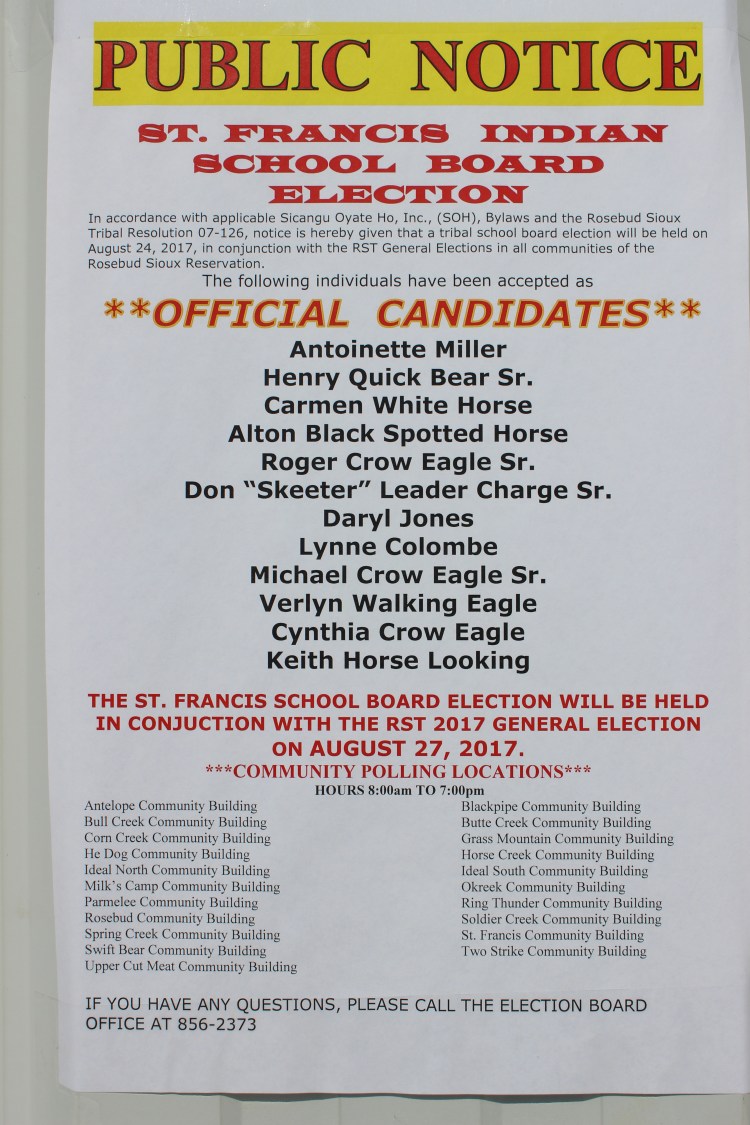
Sicangu Oyate Ho, Inc. (St. Francis Indian School), a chartered entity of the Rosebud Sioux Tribe, will hold their school board election in conjunction with the General Election. All registered tribal voters are eligible to cast a vote to elect school board members. Please vote for candidates who will work to ensure that SFIS is accountable as a student-oriented institution.

041

Tribal government belongs to all of us. St. Francis Indian School is a tribally chartered entity which receives federal funding through the Rosebud Sioux Tribe. It is an educational institution belonging to our families and children.

Other chartered entities include Tribal Land Enterprises (TLE), Sinte Gleska University (SGU), Sicangu Wicoti Awayankapi, Inc. (SWA) and the Rosebud Economic Development Corporation, Inc. (REDCO).

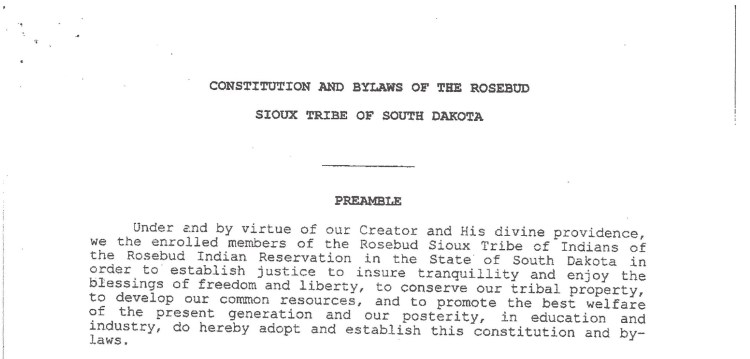
Article IV of the Constitution of the Rosebud Sioux Tribe addresses the Powers of the Rosebud Sioux Tribal Council. Section 1 lists the Enumerated Powers, including the following excerpts:

(n) To charter subordinate organizations for economic purposes and to regulate the activities of all cooperative associations of members of the Tribe. . .
(u) To delegate to subordinate boards or tribal officials, to the several communities, or to cooperative associations, which are open to all members of the Tribe any of the foregoing powers, reserving the right to review any action taken by virtue of such delegated power.

The constitution authorizes the governing body to oversee chartered organizations, communities, boards and associations. Your tribal council has the authority “to review any action taken” by the tribal entities it oversees. In addition, charters approved by the tribal council can be suspended, revoked or dissolved. The tribal council is elected to work for all of us. Tribal voters have the right to question actions they disagree with and bring issues to the tribal council.

The future of our Nation depends on our tribal voters. We have a responsibility to our children to elect tribal council and school board representatives who will work for what is in the best interest for all our people. Excessive travel, felony criminal records and absenteeism aren’t really in the peoples’ best interest.

Please vote on August 24, 2017.

Did you like this post? Consider making a donation to help maintain this website. Wopila!
Donate Button with Credit Cards

Confiscating Sacred Instruments: Do We All Need A FWS Permit?

July 30, 2017

By Vi Waln
Sicangu Scribe

Summer is a time when we would do well to be accommodating to the visitors from other tribes who come here for ceremony. The way we treat our guests not only reflects upon us as individuals, it also demonstrates how well we represent our tribe. Consequently, the bad behavior of a few people will reflect upon all Rosebud tribal citizens.

Lakota people who attend ceremony have established relationships with visitors from other tribes, such as the Dineh (Navajo). Ceremony singers travel long distances to come here and pray with us. Our tribal officials need to take into consideration that their treatment of ceremonial visitors from out of state reflects on the entire Rosebud Sioux Tribe.

It was an embarrassment to us as ceremonial people to learn that a Dineh man was recently stopped by Rosebud’s law enforcement. This relative has traveled here to sing at our ceremonies for many years. He was carrying sacred instruments with him. Apparently, he did not have a permit from the US Fish and Wildlife Service (FWS) authorizing him to have eagle feathers and parts with him, so the officer confiscated the items from him.

There are many ceremony people who carry permits from the FWS. I didn’t obtain an actual permit until I received bald eagle feathers from the FWS. The permit is just a letter from the FWS authorizing me to have eagle feathers, etc. in my possession. Still, long before I was given a permit by the FWS, I was given eagle plumes in a ceremony.

A tribal identification card/abstract should be sufficient for tribal people to travel with their sacred instruments. We should not be harassing people from other tribes who’ve traveled over a thousand miles or more to come pray with us. Again, I’m embarrassed that this happened to my relative.

I realize we are suffering a meth epidemic, yet the police officers should already be trained to recognize drug-related behavior before they search a vehicle. Maybe the police administrator could post on their Facebook page the tribal regulations surrounding the possession of eagle feathers, etc. so everyone will be aware. The police officers and game wardens need to complete cultural sensitivity training. How unfortunate that Lakota people don’t understand their own culture!

Don’t be surprised if Rosebud police stop you because of an eagle feather dangling from your rearview mirror. You’d best have a FWS permit to legally have that eagle feather in your possession on future trips to Rosebud. Consequently, I was always taught not to leave my feathers in a vehicle. I didn’t hunka my car, that’s why my eagle plume isn’t dangling from my rearview mirror.

It’ll be interesting to see if RST law enforcement, along with our Game, Fish & Parks officers, stop wacipi goers at Rosebud Fair for having eagle feathers in their possession. The idea of local officers confiscating eagle feather bustles because the dancer lacks a permit might seem ridiculous. Yet, based on what my Dineh brother experienced, it’s highly possible.

Did you like this post? Consider making a donation to help maintain this website. Wopila!
Donate Button with Credit Cards

Ceremony Protocol: Respect Yourself First

Vi Waln
Sicangu Scribe

The Wiwang Waci is perhaps the most sacred ceremony gifted to the Lakota by Pte San Win (White Buffalo Calf Woman). At one time, there was just a single ceremony held near the time of the summer solstice. Our ancestors made an annual pilgrimage to pray at this sacred summer ceremony.

Many don’t understand that Wiwang Waci is a 12-day ceremony. There are 4 days of purification, followed by 4 days of dance. The 4 days after the dance are also important. There are many ways to explain the 4 days following the dance, but for the sake of space, let’s just say it is a time to reflect on the ceremony.

Purification is a crucial aspect of the sun dance. It requires great physical, mental, emotional and spiritual preparation to be a part of Wiwang Waci. Individuals who commit to be in the ceremony must be ready; many prepare for years before they step onto to the altar.

Today, people enter the sun dance circle unprepared. Their mental, physical, emotional and spiritual bodies aren’t ready. Also, if purification is not taken seriously, your ability to pray is affected.

Many people hang on to an array of personal, unhealed junk which affects their outlook on daily life. For instance, emotional and mental toxins are junk that must be cleared from your body before you pray. Lots of people walk into a sun dance circle carrying not only a cannunpa, they also bring their spiritual, mental, emotional and physical toxins. These toxins, junk, or baggage, do influence their prayer.

People believe they are ready for 4 days of prayer. Yet, many have not prepared their minds. Undisciplined humans who’ve not cleared their personal energy field of junk, are unaware of all the unseen toxins they emit. Consequently, your state of mind affects the ceremony and everyone around you.

People who are considering a commitment to sun dance respect themselves enough to prepare in a proper manner. One way to prepare is to attend inikaga (sweat lodge) at least once a week for a whole year before dancing. We live in a very violent world today and the inikaga helps to remove unseen toxins we pick up from our environment.

Whether you are a dancer or not, you also have the responsibility to come to sun dance with your mind and emotions in the right place. It would be great if everyone would purify themselves. People often misbehave at sun dance. Wiwang Waci is a ceremony, it’s not a pow-wow. Ceremony is not the place to use drugs, drink, look for sexual encounters, gossip, judge other people or engage in hateful thinking.

Sun dancers will attest to the fact that it’s extremely difficult to remain in prayer when they are in proximity to those who haven’t prepared. Purification is the time to clear your mind and emotions. Remember, you are not standing on that altar alone, the other dancers absorb all bad energy.

It’s disrespectful to yourself and others to not prepare. As human beings, we are all affected by the energy of other people. If you haven’t dealt with your mental and emotional junk, you will leave traces of dark energy behind for others to pick up and carry home with them.

Sun dancers who treat others with genuine kindness, have loving hearts, believe in the good in all people and walk their daily lives without using drugs or alcohol, will carry the burden of unprepared dancers. Examples of being unprepared are those who drink or use drugs, harbor negative thoughts, judge or hate people, gossip and make trouble for others all year round.

It’s selfish when individuals aren’t prepared to pray in Wiwang Waci. Another example which demonstrates a lack of self-respect is posting on social media about how you finished 4 days of sun dance or completed a hanbleciya. Your ceremony is between you and Creator, not all of Facebook, Twitter and Instagram.

Wiwang Waci is a sacred place of prayer. Our universe depends on the sacred energy created in ceremony to thrive. I always encourage Lakota people to pray at sun dance. However, people shouldn’t play with this ceremony by showing up unprepared as a dancer, singer, helper, supporter or guest.

Personal conduct speaks for your character. When everyone gets truly serious about keeping our ceremony sacred our people will see the Wicozani we all pray for.

We Don’t Want A Redskin Playground

Vi Waln
Sicangu Scribe

There are many National Football League (NFL) fans living on reservations. There isn’t anything wrong with following professional sports. In fact, NFL games are great entertainment. Many of us have no problem with professional football.

However, some of us do have a problem with what professional sports teams choose as mascots. Racist mascot names have made news headlines for a long time. Legal battles have been fought to get professional sports teams to change offensive mascot names.

Last week, the US Supreme Court issued a ruling concerning the First Amendment right of free speech. This ruling basically allows any name to be used by sports teams, bands and other entertainment organizations, even if those labels are offensive. News reports state the ruling basically ends an 11-year legal battle to ban offensive mascot names brought by Amanda Black Horse (Dineh/Navajo) against the Washington Redskins.

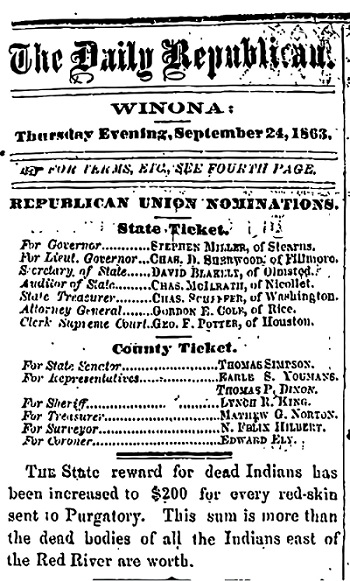
Dan Snyder, who owns the Washington Redskins, is quoted by news outlets stating that the name was chosen to represent American Indians with “honor, respect and pride.” However, for many of us, the term “redskin” conjures memories of a time when our ancestors were murdered for cash. That is, bloody body parts of men, women and children were delivered to various state officials for payment.

Print

Even though many of us work hard to just survive and have no time to join the ongoing battle, we still oppose the use of “redskins” as a mascot name. Gyasi Ross, a Blackfeet writer, echoed this largely silent opposition in 2013 when he wrote: “Many of us, even those who agree with that stance, are simply too busy keeping the lights on to worry too much about mascots. . .Most Native people have no inherent problem with Indian mascots; what matters is the presentation of that mascot and name.”

Thus, even though many support the movement against the professional football team using the word “redskins” in their mascot logo, we don’t have time to fight over it. Still, there are times when we must speak out against the continued use of the word “redskin.” Recently, members of my community were presented with information about a possible offer of playground equipment for our local youth by a donor affiliated with the Washington Redskins.

I’m not in favor of accepting any donations from the Washington Redskins. Those contributions could be viewed as support for a racist mascot name. For example, if we were to accept any kind of donation from them, they would likely say our youth endorse the “redskin” mascot name.

The Washington Redskins could state: “We understand you are offended by our use of the mascot name ‘redskins,’ but the children of Rosebud support us using the name because they accepted a donation of playground equipment from us.” This scenario might seem extreme, but it is still a possibility.

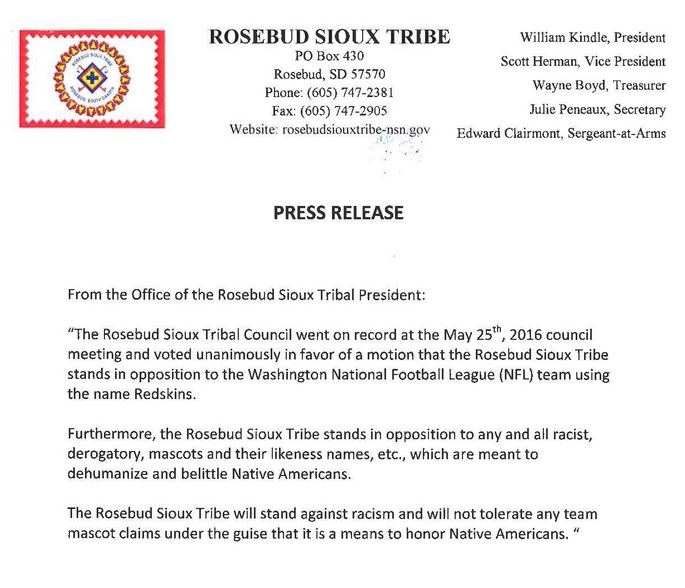
Furthermore, on May 25, 2016 the Rosebud Sioux Tribal Council did go on record opposing “the Washington National Football League (NFL) team using the name Redskins.” A statement to this effect was issued by the Office of the Rosebud Sioux Tribal President.

RST on record in opposition to Redskins

For many of us, the term redskin still conjures images of bloody body parts of our ancestors; specifically, human skin stained red with fresh blood. For instance, over 250 women and children were violently butchered by crazed soldiers at Sand Creek. Those same soldiers wore the blood-stained scalps, along with other bloody body parts cut from the murder victims, as trophies.

Our children would enjoy new playground equipment very much. They would also enjoy other activities offered by wealthy donors affiliated with the Washington Redskins. But those of us who carry the memory of our recent history in our DNA must stand by our principles. We must refuse to accept a handout from an organization which arrogantly uses the offensive “redskin” mascot name.

I challenge the tribal citizens who want to accept these donations to consider what our ancestors, especially those who journeyed to the Milky Way sans scalp or other body part, would say about it all.

Did you like this post? Consider making a donation to help maintain this website. Wopila!
Donate Button with Credit Cards

Felons and Tribal Elections

By Vi Waln

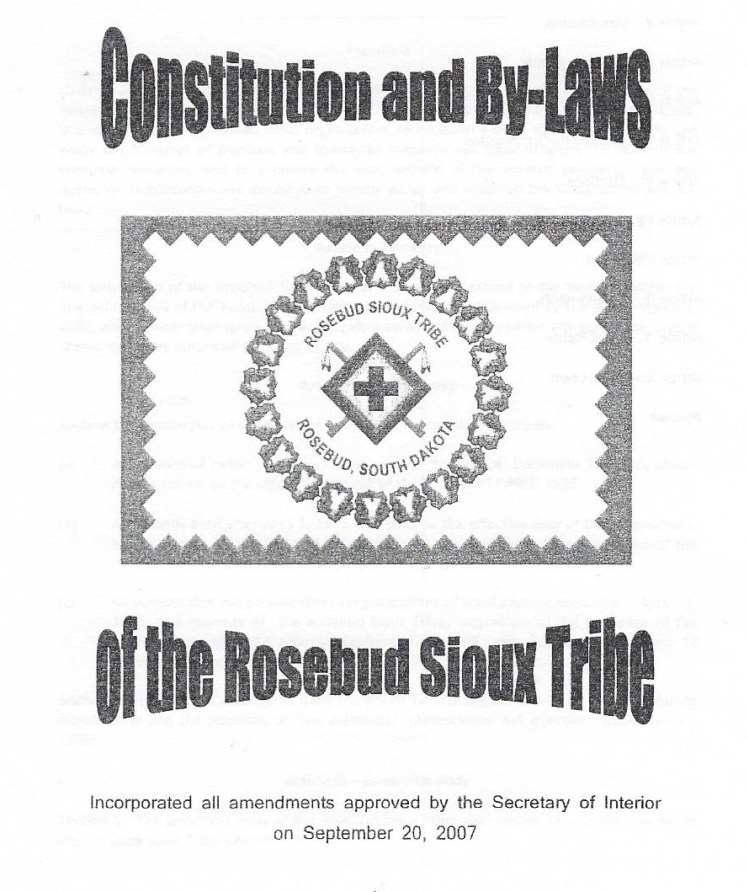
Constitution Picture

The Rosebud Sioux Tribe will have a Primary Election on July 27. There are 10 tribal council representative positions open, along with the tribal treasurer and secretary positions. According to a public notice issued by the Election Board, 38 tribal citizens have filed nominating affidavits seeking election to 12 open seats.

During the Constitutional Convention held at Rosebud in 2004, tribal voters proposed an amendment they believed would bar citizens with felony criminal convictions from seeking office. Voters in that secretarial election obviously wanted the tribal council and constitutional officer positions filled by candidates without a felony criminal backgrounds. Consequently, after the constitutional amendments went into effect in 2007, the Election Board required all candidates to undergo background investigations. Tribal citizens with a felony conviction were subsequently disqualified from seeking office.

Many tribal citizens believe people with felony convictions should not be able to run for election. They feel strongly against electing people with criminal backgrounds to represent us. Yet, some tribal citizens with felony convictions on their record, who wanted to run for office, appealed to the Rosebud Sioux Tribal Court to rule on the constitutional amendments. So, due to the language contained in the constitution, a Tribal Judge ruled in their favor.

RST Cons

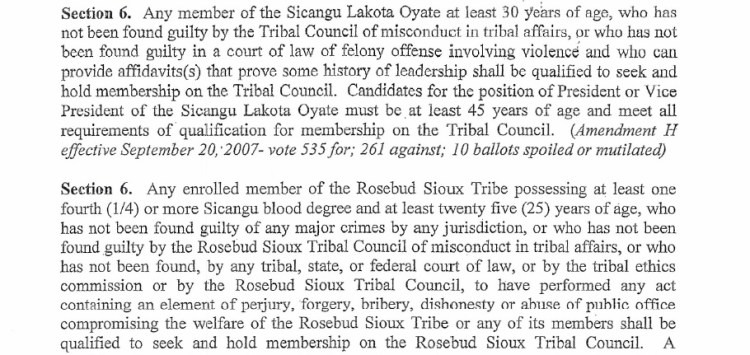
There are 2 sections in the RST Constitution which address the qualifications of candidates seeking election. An excerpt of the first Section 6 reads: Any member of the Sicangu Lakota Oyate at least 30 years of age, who has not been found guilty by the Tribal Council of misconduct in tribal affairs, or who has not been found guilty in a court of law of felony offense involving violence and who can provide affidavits(s) that prove some history of leadership shall be qualified to seek and hold membership on the Tribal Council.

In addition, an excerpt of the second Section 6 states: Any enrolled member of the Rosebud Sioux Tribe possessing at least one fourth (1/4) or more Sicangu blood degree and at least twenty five (25) years of age, who has not been found guilty of any major crimes by any jurisdiction, or who has not been found guilty by the Rosebud Sioux Tribal Council of misconduct in tribal affairs, or who has not been found, by any tribal, state, or federal court of law, or by the tribal ethics commission or by the Rosebud Sioux Tribal Council, to have performed any act containing an element of perjury, forgery, bribery, dishonesty or abuse of public office compromising the welfare of the Rosebud Sioux Tribe or any of its members shall be qualified to seek and hold membership on the Rosebud Sioux Tribal Council.

Despite the flaws with our constitution, it’s a document put in place to govern us all. We must respect it. Many tribal citizens would never consider looking for a way around the rules so they could be elected to office. People who look for ways to get around the rules aren’t on my list of role models.

I don’t want my Takoja to believe it is okay to get in trouble, be sentenced to prison and then come home to work on changing their life so they could run for office. It is a blatant display of disrespect for the rules put into place by tribal voters. It also demonstrates arrogance and a lack of self-respect.

Granted, there are many tribal citizens with felony criminal records who’ve turned their lives around after completing their prison sentence or probation. Many are my blood relatives. They’ve changed their lives for the better. They are sober, productive members of society. They are active in Lakota ceremony.

Still, there are many things they cannot do. They will never clear a criminal background investigation. There are certain places, like schools, who will not hire them because of their criminal history.

Consequently, I’ve been attacked on social media for my opinion on tribal citizens with felony convictions running for office. Anger has been directed at me because of my strong opinions. Still, many tribal citizens echo my concerns. In any case, the anger projected at me is not mine, it’s an emotion that the people who carry it must deal with.

Before the constitution was amended to bar felons from elected office, there was a tribal council representative who traveled to Washington DC to attend meetings with federal officials to advocate for the Rosebud Sioux Tribe. When he arrived at a building where one meeting was to be held, he was denied entrance because of his criminal background. Other tribal council representatives expressed to me their embarrassment over this incident.

When I go to the polls to vote in both the primary and general elections, I will support candidates who have cleared a background check. I cannot support anyone on the ballot with a felony conviction, no matter how much they have changed.

Many of us don’t want our children to grow up to be adults who look for ways to get around the rules. Our children need role models who respect the rules to serve as their elected tribal officials. Respecting the rules is being a good ancestor.

Our tribal government might not be the best one around, but it’s the only one we’ve got. It’s up to us as tribal citizens to make sure it isn’t compromised. We all talk about making the laws better, yet the language in the Rosebud Sioux Tribe’s Constitution will remain as is until the people decide to come together and change it.

RST Constitution


Did you like this post? Consider making a donation to help maintain this website. Wopila!
Donate Button with Credit Cards

You Give Me Hope

By Vi Waln

Life is hard for many Lakota people. It may be especially difficult when you are living on the land where your ancestors grew up. There are times in life when you might lose something that’s important to you. There are also times in your life when people who mean a lot to you are taken away.

Yet, finishing school is an accomplishment that will never be taken away from you. Education is definitely an achievement that you will never lose. Nobody can take away your high school diploma or college degree. An education is yours to keep. Forever.

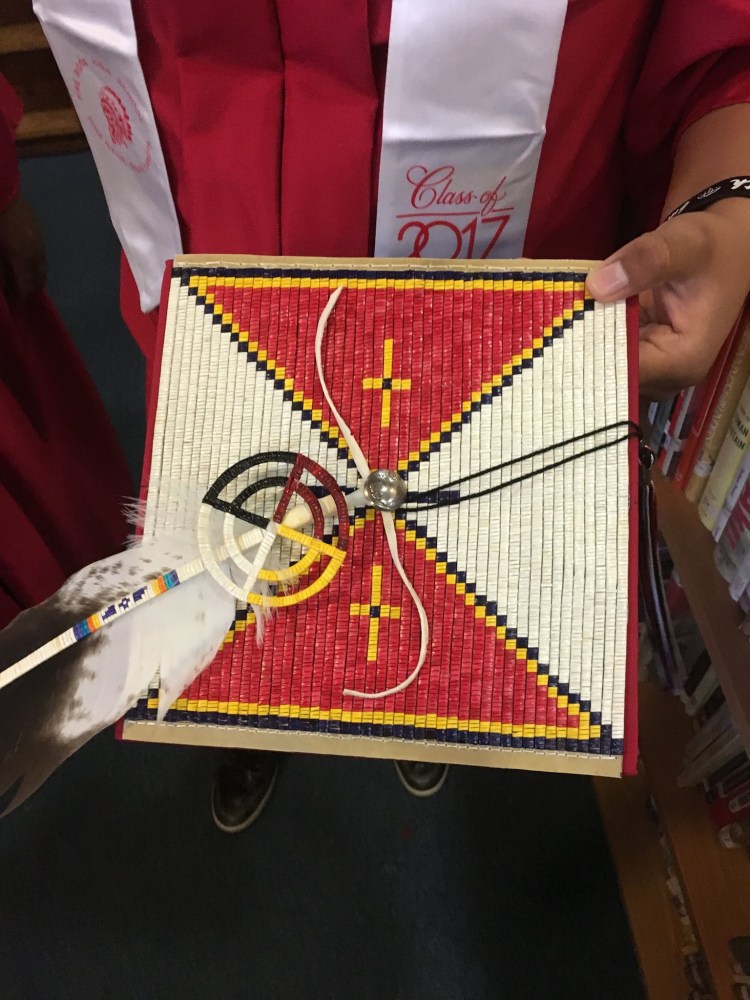
Quills
A 2017 graduate of Pine Ridge High School wore a mortarboard decorated with porcupine quills. Photo from Facebook

This month, we’ve seen many of our young people graduate from high school. In an area designated as one of the poorest in the country, finishing high school is a great achievement. Some of our young people grow up in extreme poverty. The fact that our young Lakota students were able to persevere to complete high school is an achievement their Tiospaye can be very proud of.

It’s even more difficult for our people to leave home for college. We are all aware of how tight-knit our Lakota Tiospaye can be. Young people who have enrolled in a program of study at a college or university far away from home often have a hard time. They experience extreme loneliness. They might even fall into the wrong crowd.

Yet, many have dealt with the issues that come with being away from home and family. Those of us who use social media were privileged to see the photos of college graduates recently shared by family and friends. All of the Lakota college graduates from across the country have made us all very proud. Lakota people are smart!

But even though we are smart, we often engage in lateral oppression. It’s not smart to make fun of people who’ve earned a college degree. People who make fun of their relatives should examine their own behavior. You look foolish when you make fun of others.

Before the advent of the internet and social media, we made fun of others either in person or behind their backs. Our ancestors probably had more self-control than we will ever have. Our ancestors worked hard to ensure the entire tribe was provided for. They didn’t have time to engage in lateral oppression by making fun of each other. They were too busy being self-sufficient.

Consequently, there are smart Lakota people who have decided not to attend college because they don’t want to be a target of lateral oppression. Lakota people who’ve earned a degree are often accused of thinking they are better than everyone else. There are also Lakota people accused of somehow morphing into a wasicu after they graduate from a university. Again, you look really foolish when you engage in lateral oppression.

College graduates are also overlooked when it comes to being hired for a tribal job. I once witnessed my tribal council chose a person with a high school diploma for a director job. He was hired over a qualified applicant with a college degree. This may be another reason why our young people are discouraged from attending college. Today, many Lakota people voice their concern that a college degree doesn’t matter when you try to work for your tribe.

In any case, Lakota people would do well to encourage one another to get educated. There isn’t anything wasicu about graduating from a university. You better yourself and your tribe by earning a college degree.

If you are a Lakota person who regularly puts down your fellow tribal citizens by making disparaging remarks about their college education, I encourage you to look in the mirror to figure out why you do it. We are proud of our college educated tribal citizens. You should be proud of them too.

Congratulations to everyone who overcame all obstacles to finish high school and college. You give me hope.

Did you like this post? Consider making a donation to help maintain this website. Wopila!
Donate Button with Credit Cards

It’s Destroying Us

By Vi Waln

It’s destroying us.

Those words say a lot. It is what a health care provider at Rosebud Hospital told me. We were talking about the growing methamphetamine epidemic on the Rosebud Reservation.

Meth is taking over our people. There have been numerous homes burglarized on the Rosebud in the last several weeks. Meth users will do anything to get their drug, including breaking into homes and stealing what others have worked hard to provide for their family.

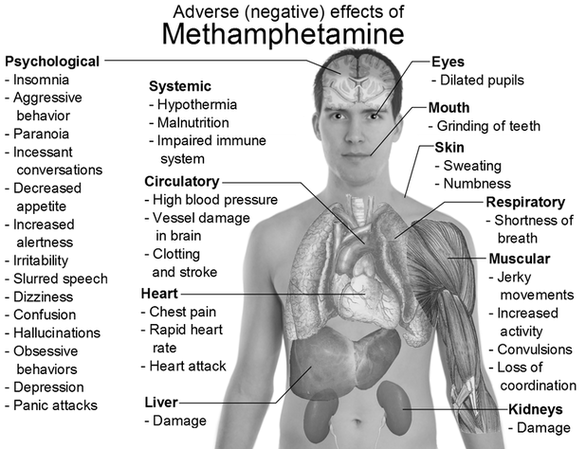
Every time you use meth, you are destroying your body. Our young people who are addicted to meth show up at the hospital with symptoms they shouldn’t have until they are elders. More and more of our young Lakota people are walking around without any teeth. Using meth robs you of your mind, body and spirit.

There are elders and children suffering greatly because of the meth addicts in their family. Elders are abused and left destitute because their adult children and grandchildren steal what little income they have. Small children are left alone in houses for days without supervision or food because the parents are on a meth binge.

Currently, there are many vacant houses on our reservation. The unofficial number of houses on Rosebud contaminated by meth users is at 400 or more. It’s not safe for people, especially our fragile children and elders, to live in a house filled with meth residual. The Rosebud Sioux Tribal Council does have a standing resolution for our local housing authority to evict residents when a house has a meth residual level of 2.0 or higher.

Kudos to the Rosebud Police Department. They have been working hard to get meth users and dealers off our streets. Many people have recently been charged in our Tribal Court with possession of narcotics. Some of those charges are for prescription pills, but the majority of the drug charges arraigned in Tribal Court are likely for meth.

The RPD usually informs tribal citizens through social media about arrests involving meth and other drugs. They don’t release names but SicanguScribe.com does publish the RST Criminal Court arraignments online so you can see who is arrested for drugs. It used to be that public shaming did a lot to deter crime on our homelands. Today, people are not at all ashamed when they go to jail for a crime involving meth.

effects_of_meth

We are a spiritual people. Yet, our people addicted to drugs or alcohol don’t have a clear grasp of reality. Their brains are irreversibly damaged by heavy drinking or drug use. Their sense of what is real is clouded by the effects of the drug. By the way, alcohol is a drug.

Addicts, including those who drink, are likely to attract entities that can attach themselves to the user. Local people can attest to this as many have had experiences in their homes when someone was using meth heavily. Some may have brushed these strange occurrences off as something they’ve imagined, while others know the experiences are very real.

Highly intoxicated people often don’t remember doing things while they were drunk. It’s quite possible that an entity took over their body and helped them to commit heinous crimes. Yet, it’s impossible to blame an entity you cannot see. You alone are responsible for your choices.

Lakota people who are heavy meth users, prescription pill addicts, drug dealers, bootleggers and alcoholics are not good ancestors. Unfortunately, there isn’t much we can do for an individual who doesn’t want to get sober or stop selling poison. Still, dealers, bootleggers, addicts and alcoholics are our relatives.

They may be our relatives, but they are also the people abusing our children and elders. Meth users are ruining public housing units and causing entire families to be evicted. They are breaking into private homes to rob families of personal possessions they’ve worked hard for. We live in sad state. Our ancestors would be ashamed.

It’s destroying us.

Did you like this post? Consider donating to help maintain this site.

Donate Button with Credit Cards