Tobacco is Sacred, Cigarettes are Not

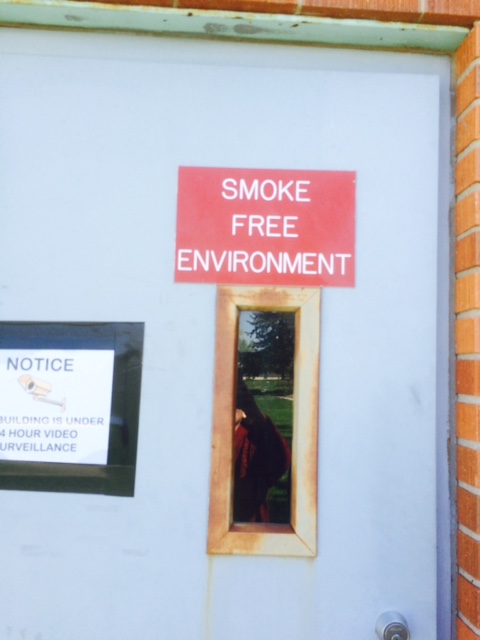
The Rosebud Sioux Tribal Building has red signs posted at the entrances declaring the building a "Smoke Free Environment" yet employees are allowed to smoke inside the furnace room.
The Rosebud Sioux Tribal Building has red signs posted at the entrances declaring the building a “Smoke Free Environment” yet employees are allowed to smoke inside the furnace room.

Kudos to the Cheyenne River Sioux Tribe for taking a huge step forward and being the first Lakota tribe to outlaw smoking in public places. The CRST Smoke-Free Air Act took effect on May 1, 2015 and bans smoking in “any enclosed public place.” Smoking is also not allowed “within fifty feet of outside entrances to public buildings.” Violators are subject to a fine.
Unfortunately, there are many of us living on the Rosebud Reservation who can’t visit certain places because of cigarette smoke. For instance, our casino allows patrons to smoke indoors. Those of you who don’t smoke are adversely affected by the toxic blue smoke that fills the Rosebud Casino. Non-smokers walk away from an outing at the casino reeking of cigarette smoke. They will also cough for an extended period of time after inhaling all that deadly second hand smoke.
Also, the Rosebud Sioux Tribal Building has red signs at all the entrances proclaiming it to be a “Smoke Free Environment.” But the employees who work there know this isn’t true. Smokers will gather in packs in the room where the furnace is to smoke indoors. The toxic blue smoke wafts through the vents to permeate the entire building. That’s why you can often smell cigarette smoke in some offices in the Tribal Building.
I challenge all tribal councils to follow Cheyenne River’s lead and enact the same type of smoking ban on all reservations. Cigarette smoke is deadly. When children are inside a building where people are allowed to smoke, they are affected by it because the smoke goes everywhere. And those non-smoking areas sitting right next to the smoking sections don’t really do much good because cigarette smoke permeates everything.
The Centers for Disease Control (CDC) offer us some staggering numbers regarding American Indians and Alaskan Natives (AI/AN) who are currently smoking cigarettes. For instance, in 2013, 26.1% of AI/AN adults in the United States smoked cigarettes, compared with 17.8% of U.S. adults overall. That means over one quarter of people in Indian Country are cigarette smokers.
The CDC also reported that the prevalence of current cigarette smoking was higher among AI/AN men (32.1%) than among AI/AN women (22.0%). Some good news is that from 2005 to 2013, current cigarette smoking prevalence decreased among AI/AN adults (from 32.0% in 2005 to 26.1% in 2013). That means in 2013 there were 5.9% less cigarette smokers in Indian Country than there were in 2005. I have to wonder if that percentage decreased by 5.9% because those cigarette smokers died before they quit smoking.
Cigarettes will definitely kill you. Cigarette smoking is the number one cause of preventable death among our people. Still, I know how the mind of a cigarette smoker reasons out the addiction. I can list all the statistics and health risks that smoking causes but it will never be enough to convince you to put out your cigarette for good. You have to do that on your own.
In January 2008, after decades of nicotine addiction, I put my cigarette out to begin a new life as a non-smoker. After smoking up to a pack or more each day, I have not smoked a cigarette in over seven years. I searched for resources to help me overcome my drug addiction. I bought several books to read. One of them was The Easy Way To Stop Smoking, written by Allen Carr. His book was down-to-earth and made total sense to me.
“If you are apprehensive, panic-stricken, or feel that the time is not right for you to give up, then let me assure you that your apprehension or panic is caused by fear,” Carr wrote. “That fear is not relieved by cigarettes, but created by them. You didn’t decide to fall into the nicotine trap. But like all traps, it is designed to ensure that you remain trapped. Ask yourself, when you lit those first experimental cigarettes, did you decide to remain a smoker as long as you have? So when are you going to quit? Tomorrow? Next year? Stop kidding yourself! The trap is designed to hold you for life. Why else do you think all these other smokers don’t quit before it kills them?”
Today, I am happy to be a non-smoker. There are people on my Rez who have terrible health problems caused by their addiction to cigarette smoking. Yet, they continue to buy and smoke those deadly cigarettes. Sometimes I see them at the post office or the hospital, gasping for air as they drag an oxygen tank behind them. Watching those people struggle to breathe helps me feel even more grateful that I overcame my addiction.
A recent report issued by the American Lung Association states that “today’s children are now being cultivated to become tomorrow’s tobacco users.” So remember—when you smoke cigarettes, you show your children and grandchildren that it’s an acceptable addiction.
Wopila to the Canli Coalition and the Cheyenne River Sioux Tribe for setting an example for all other Tribes to follow.

Tribal Council, Constitutional Officer Seats Open for Election at Rosebud

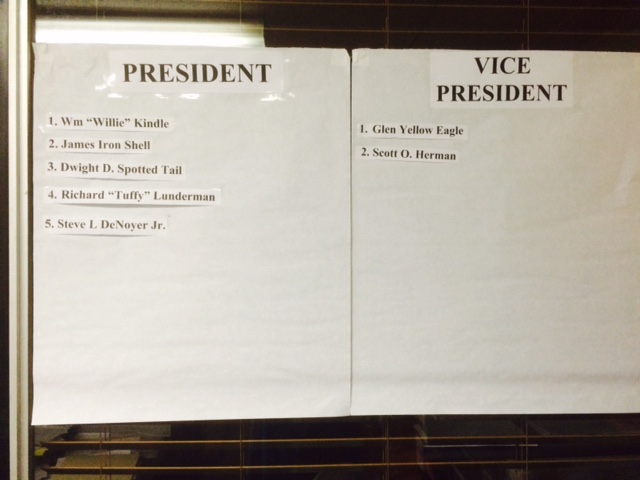
The public can view an updated list of candidates for the Rosebud Sioux Tribe 2015 Election. The list is on display at the Tribal Secretary’s office in Rosebud, SD. Photo by Vi Waln.

ROSEBUD, SD – The Rosebud Sioux Tribe’s Election Board recently issued a Public Notice announcing both the Primary and General Elections scheduled for this summer.

Registered voters will select a President, Vice-President, Secretary and Treasurer. In addition, there are ten (10) Tribal Council Representative positions up for election. The Antelope, St. Francis, Rosebud, Corn Creek, Ring Thunder, Horse Creek, Swift Bear, Bull Creek, He Dog and Upper Cut Meat tribal council seats are all being advertised as open for candidate hopefuls.

As of press time, no candidates have yet filed affidavits for the Tribal Secretary position. In addition, there have not been any candidates filing for the Tribal Council Representative positions in the communities of Rosebud, St. Francis, Corn Creek, Bull Creek and Upper Cut Meat. The following candidates have filed their nominating affidavits:

President: Willie Kindle, James Iron Shell, Dwight D. Spotted Tail, Richard Tuffy Lunderman, Steve DeNoyer, Jr. Vice President: Glen Yellow Eagle and Scott Herman. Treasurer: Byron Barney Wright and Muriel Fast Horse.

Antelope: Calvin Hawkeye Waln (incumbent), Santiago Morales, Eddie Sonny Farmer, Jr. and Shawn Bordeaux. Ring Thunder: Patricia Douville. Horse Creek: Fremont Fallis. He Dog: Mary F. Waln (incumbent) and Royal Yellow Hawk. Swift Bear: Delano Clairmont.

The first day to file a nominating affidavit was May 1, 2015. Prospective candidates have until May 29, 2015 at 5pm to file an affidavit. Candidates must pass a criminal background check and meet other qualifications as outlined in the Election Code. Affidavits can be picked up from the Tribal Secretary.

Prospective candidate must be members of the Rosebud Sioux Tribe, with at least one quarter of Indian blood listed on their tribal abstract. Candidates for the Tribal Council, Secretary and Treasurer positions must have reached their 25th birthday by the date of the General Election. Candidates seeking the President or Vice President position must have reached their 45th birthday.

Candidates must not have been found guilty by the Rosebud Sioux Tribal Council of misconduct in tribal affairs. In addition, candidates must not have been found guilty of any major crimes by any jurisdiction. Also, they may not have been found guilty of any tribal, state or federal court of law, or the tribal ethics commission to have performed any act containing an element of violence, perjury, forgery, bribery, dishonesty or abuse of public office compromising the welfare of the Rosebud Sioux Tribe or nay of its members.

Candidates must also prove some degree of leadership in their affidavit. Tribal Council candidates must also have been living in the community of candidacy for at least one year preceding the date of the Primary Election. Candidates for the office of President, Vice President, Treasurer and Secretary must have been living within the original boundaries of the Rosebud Reservation for at least one year preceding the date of the Primary Election.

A filing fee of $300.00 is required for the offices of President, Vice President, Treasurer and Secretary must be paid by money order to the Tribal Finance Office. Tribal Council Candidates are required to pay a filing fee of $150.00.

An updated list of all candidates who have filed a nominating affidavit is on display at the Tribal Secretary’s Office.

The Election Board members are Gerald Eagle Bear, Ronald Neiss, Ed Clairmont, Patti Romero and Meredith Kills In Water. For more information you can contact the Election Board Office at (605) 856-2373.

Musical Talent Showcased at He Dog School

The He Dog School Band is led by Conductor Sarah Nelson at the Spring Concert. Band members include Judd Cortier, Elena Murray, Jordan Smith, Anthony Stone, Callie Olson and Danya Witt. Photo by Vi Waln.

PARMELEE, SD – The elementary students at He Dog School dedicated many hours practicing to present a successful Spring Concert to parents, grandparents and community members last week.

Sarah Nelson is the Vocal/Instrumental Director at He Dog. She led the school band in their presentation. Playing the clarinet were Judd Cortier, Elena Murray, Jordan Smith and Anthony Stone. Callie Olson played the Alto Saxophone. On the trumpet was Dayna Witt. They played Farm Out, Lightly Row, Melody and Star Chase.

The musical continued with the fourth grade students demonstrating their skills with the recorders. They played three songs—Mary’s Little Cha-Cha, Country Hoedown and the Cabbage Song.

Students in the other grades sang several songs for the crowd. The first grade did a great job with Down in the Valley, I Love the Mountains and The Garden Song. The Kindergarten A and B students were a big hit with their families. They sang Sandy Land, Over in the Meadow and Down the River.

Also combining their vocal talents as a group were the fourth and fifth grade students. They sang Simple Gifts, Lift Every Voice and Sing and The Water is Wide. The second and third grade student group wrapped up the musical presentations with Blue Skies, Home on the Range and What a Wonderful World.

Named after the Lakota Chief He Dog, the elementary school is one of the oldest on the Rosebud Reservation. The original He Dog Day School opened in 1893. In 1935, the new consolidated He Dog Day School was opened. In August of 1950, He Dog School became part of the Todd County School District.

Today, the He Dog School campus has eight buildings housing classrooms and offices, a gymnasium, bus garage and several housing units for staff. The school long served students in pre-school through the eighth grade. However, district restructuring saw the sixth through eighth grades moved to the Todd County Middle School several years ago. The school currently serves students from pre-school through the fifth grade.

He Dog School is located on the western end of the Rosebud Reservation near Parmelee. It is one of nine elementary schools in the Todd County School District. He Dog School currently serves over 100 students from three communities—He Dog, Upper Cut Meat and Parmelee. The student body is 100% Native American. Principal is Deb Boyd.

Sicangu Lakota Educator Honored

Dr. Bordeaux’s family accompanied him in the honor song rendered by the Red Leaf Singers. Community members, students and staff stepped forward to acknowledge his accomplishments as TCSD Superintendent. Photo by Vi Waln.

PARMELEE, SD – The accomplishments of Dr. Roger Bordeaux, Superintendent of the Todd County School District, were acknowledged in a special honoring ceremony at the He Dog School 30th Annual Wacipi.

Dr. Bordeaux has served as Superintendent at Todd County since 2012. The Rosebud Sioux Tribe issued an Executive Proclamation naming May 1, 2015 as Dr. Roger Bordeaux Day on the Rosebud Reservation. Students, staff and community members came forward to shake his hand during an honor song rendered by the Red Leaf Singers at the Wacipi.

“He is the greatest Educator that Indian Country has,” stated Hawkeye Waln, who spoke on behalf of the Rosebud Sioux Tribal Council.

Dr. Bordeaux has a lifetime of educational accomplishments. He carries the Lakota name. Wounspe Wawokiya Yuha Mani (Walks and Helps Others) as well as a Dakota name Wambdi Ob Mani (Walks With Eagles). His parents are the late Bo and Rose Bordeaux of St. Francis, SD.

Roger graduated from St. Francis Indian School in 1970. He went on to complete a Bachelor of Arts Degree in August 1974 at the University of South Dakota, where he majored in Mass Communication. He minored in Indian Studies and the Dakota Language. He completed a Master of Arts Degree in Education Administration in August 1988. And in August 1990 he completed his Doctor of Education Degree. He also holds a Secondary Certification from Black Hills State University as well as a School Improvement Specialist Certificate from the University of Nebraska.

Dr. Bordeaux has a very impressive resume. He has dedicated his educational career to Indian students in several capacities. He served as the Principal Advisor for the National Association of Secondary School Principals. He served on the American Association of School Administrator’s Rural School Study Group and the College Board’s Indian Education Issues Group. He provided testimony on behalf of Indian Education in front of various Committees of the United States Congress. He is a founding member of the Association of Contract Tribal Schools and the Dakota Association of Contract Tribal Schools.

Dr. Bordeaux holds numerous awards and recognition for his distinguished accomplishments in the field of Indian Education. He was named Administrator of the Year by the National Indian School Board Association. He received the Distinguished Service Award by the South Dakota High School Activities Association, as well as the Education Leadership Award by the Dakota Oyate Challenge.

Dr. Bordeaux has held professional memberships with the Association for Supervision and Curriculum Development, American Association of School Administrators and the Phi Delta Kappa Fraternity. In the past, he has offered presentations on school reform, school administration, curriculum development, assessment and testing, school facilities, systemic reform, school correlates, student data and accreditation, as well as writing several scholarly articles on education.

Last month, Dr. Bordeaux was appointed to the Native American Student Achievement Advisory Council by Governor Daugaard. He is working with several other Indian educators to identify strategies to improve the achievement and graduation rates among Indian students in South Dakota. The Advisory Council will report their findings to the Governor in December 2015.

When his contract as TCSD Superintendent ends on June 30, Dr. Bordeaux plans to reside in Sisseton, SD and serve as an Educational Consultant.

Politically Educated Officials

TCSB

As the end of another academic school year comes to a close, I want to address the importance of education. Learning is a never ending process. I was always encouraged by family and educators to stay in school when I was young. We are never too old to learn something new.

Today, we listen to parents, tribal officials, community members and school personnel harp on students about how extremely important education is to our people. We encourage our young people to finish high school. We push our young people to pursue college degrees after they graduate from high school. We tell them that a college degree is something that can never be taken away from you.

Still, I see many Lakota people who have worked diligently to earn higher education degrees pushed out of jobs they are highly qualified for by disgruntled community members. What is the point of becoming a college educated Lakota if you are only going to be pushed out by your own people? Sometimes I wonder if the high drop-out rate on the Rez is due to our young people watching educated adults let go from the jobs they worked so hard to get.

We tell our children to go off to college to earn a degree. We encourage them to be role models by staying in school. We also tell them to come home and work for us so other young people can perhaps have a better way of life. After all, who better to lead us than our own people, right?

Yet, I am pondering what to tell my Takoja when they graduate from college with a degree they worked very hard to earn. Should I encourage them to apply for local jobs? I really don’t know. Maybe I should tell them to find jobs far away from their homelands so they will have a better chance of holding that job. I have witnessed so many educated Sicangu people being run off or fired from jobs they are highly qualified for. The worst part of all this is the power to hire and fire is usually placed in the hands of uneducated people.

That is, these people who are in charge of determining who is hired or fired for jobs requiring a college degree are generally not educated people. Many of them never attended college. The only education they have pursued and excelled at are the everyday lessons on how to play politics. And most of the political education on the Rez is driven by the crab-in-a-bucket mentality.

Do we want our children to be college educated or politically educated? When you are politically educated, most of your decisions are based on ego. You listen to your constituents complain about things that have happened in their lives and you make a decision, which affects many people, based on what you think your constituents want or, even worse, on what your ego dictates to you. When you work from an egotistical mentality, everyone you are supposed to be working for loses.

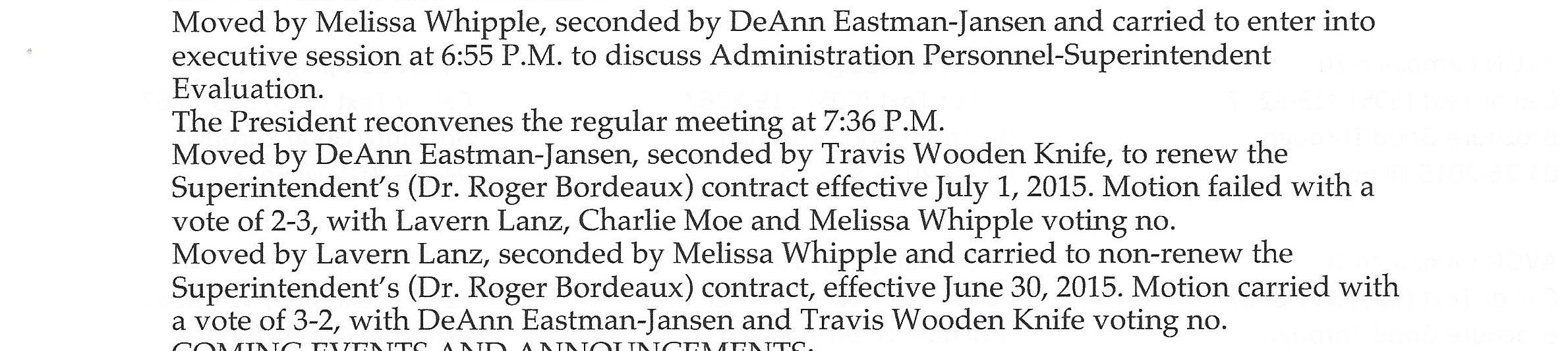
The following two paragraphs are excerpts from the January 12, 2015 Todd County School Board minutes: “Moved by DeAnn Eastman-Jansen, seconded by Travis Wooden Knife, to renew the Superintendent’s (Dr. Roger Bordeaux) contract effective July 1, 2015. Motion failed with a vote of 2-3, with Lavern Lanz, Charlie Moe and Melissa Whipple voting no.”

“Moved by Lavern Lanz, seconded by Melissa Whipple and carried to non-renew the Superintendent’s (Dr. Roger Bordeaux) contract, effective June 30, 2015. Motion carried with a vote of 3-2, with DeAnn Eastman-Jansen and Travis Wooden Knife voting no.”

Todd County School District is a public school funded by the State of South Dakota. The school district is located on the Rosebud Reservation. The majority of the students enrolled in the TCSD are Sicangu Lakota. So, it’s a real slap in the face to all of us when a handful of school board members asserts a hidden agenda and votes to fire a highly qualified Sicangu Lakota educator.

I don’t think it is right that he didn’t have his contract renewed. But that’s what happens when people armed with a political education are voted into seats of power. They vote from ego. They have pushed out one of our most highly educated Sicangu Lakota people. Yet, that’s what happens when the people in charge are motivated by a political education rather than a college education. It’s a great example of personal ego in action.

Unfortunately, our children on the Rosebud have witnessed yet another real life example of why it doesn’t matter if you stay in school or not. The politically educated people in power will always vote their ego. They will always vote to pull you down, despite how hard you’ve worked to earn a college degree so you could come home and help your own children.

The Sicangu Lakota have lost Dr. Bordeaux’s skills as an Indian Educator. He has dedicated his life to improving educational systems for Indian children all across Indian Country. I join the Sicangu Lakota Oyate in wishing him well in his future endeavors.

Please be sure to vote for college educated people who have the best interest of our Sicangu Lakota students in mind during the next Todd County School Board election.

Autism Awareness Growing on Rosebud

Autism Awareness Growing on Rosebud

By Vi Waln

ROSEBUD, SD – Elementary students were accompanied by their family members and school staff on a walk to bring awareness to autism on the Rosebud Reservation.

Everyone who participated in the 5th Annual Autism Awareness Walk received a blue t-shirt, as well as an Autism Awareness Puzzle Ribbon to wear. This walk was just one of the events organized by Shelley Means, mother of twin boys who are affected by autism. Another awareness walk is scheduled for April 30 at 4pm in Mission, SD.

Other activities included a balloon launch at Rosebud Elementary on April 1. Several families also attended an Autism Family Night, which included a Resource Fair, on April 9. The Crazy Horse Monument in the Black Hills supported the Light it Up Blue awareness promotion on April 2 by featuring blue lights on the monument.

Rosebud Elementary Students were accompanied by family members and school staff on the 5th Annual Autism Awareness Walk held on April 24, 2015. Photo by Vi Waln
Rosebud Elementary Students were accompanied by family members and school staff on the 5th Annual Autism Awareness Walk held on April 24, 2015.

April is designated as National Autism Awareness Month. President Barack Obama issued a Proclamation declaring April 2, 2015 as World Autism Awareness Day. He encouraged citizens to learn more about autism and what we can do to support individuals and their families on the autism spectrum.

“Today, let us honor advocates, professionals, family members, and all who work to build brighter tomorrows alongside those with autism,” declared the President. “Together, we can create a world free of barriers to inclusion and full of understanding and acceptance of the differences that make us strong.”

Autism affects 1 in every 68 children throughout the world. Boys are nearly five times more likely than girls to have autism. Recent figures estimate that 1 in 42 boys and 1 in 189 girls are diagnosed with autism in the United States. Autism is the fastest growing developmental disorder in the United States. There is no medical detection or cure for autism.

If you suspect that your child is affected by autism, watch for these symptoms:

• No big smiles or other warm, joyful expressions by six months or thereafter.
• No back and forth sharing of sounds, smiles or other facial expressions by nine months.
• No babbling by 12 months.
• No back-and-forth gestures such as pointing, showing, reaching or waving by 12 months.
• No words by 16 months.
• No meaningful, two-word phrases (not including imitating or repeating) by 24 months.
• Any loss of speech, babbling or social skills at any age.

Last week’s walk was sponsored by the SD Council on Developmental Disabilities, Lakota Tiwahe Center, Todd County School District, Domestic Violence Prevention Initiative, Sicangu Oyate Land Office, All Stop, Rosebud Rentals, Tax Express, Cherry-Todd Electric Cooperative and Sinte Gleska University.

More information, including an online Modified Checklist for Autism in Toddlers, Revised (M-CHAT-RTM), can be viewed at http://www.autismspeaks.org

https://www.youtube.com/watch?v=ych7Laooslc


Our Children Deserve Better

Our Children are Sacred

I want to see justice done for the young Lakota students from American Horse who were the targets of the demented behavior of drunk white men at the Civic Center last month. Many people are justifiably angry over this incident. But what about the similar alcohol related incidents happening on every Rez?

Right now there are children living in homes with adults who put them at risk. I think it’s safe for me to say that we are all aware that alcoholism is a scourge our people have not been able to completely overcome. We all know about the homes where children are often in harm’s way because of adults who drink alcohol, use drugs or gamble. Many children do not have enough to eat because of the adult’s addictions. Where is our outrage about that?

I realize there was alleged racism tied to the incident that happened at the Rush hockey game. Personally, I’ve learned to accept that most racist people will likely never change. Also, most racist people will probably not admit to being racist. Alcohol generally lowers our inhibitions. So when those men had had too much to drink, it was easy for them to utter their racist taunts.

Racism aside, you and I both know of children who have had beer or other alcoholic drinks spilled on them in their own homes. We might know of children who live in homes where adults are smoking meth or snorting prescription pills. Many children grow up watching regular drinking parties in their own living rooms. Some children are the victims of crimes which happen while the adults they trust blacked out or passed out because they had too much to drink. Why isn’t the media all over these crimes?

So many people say the children are sacred. But I have learned that this phrase is largely lip service. If we really believe our children are sacred, we would be doing more to help them have a better life. Our Lakota children deserve a happy life, free of the stress of living in a home with alcohol or drug addicted parents. They deserve a life where they do not have to worry about what they are going to eat for supper (if anything) or if there are any clean clothes to wear to school tomorrow.

The same level of outrage—which is being expressed over the hockey game incident—could be expressed over the conditions some of our children are living in on our reservations. I wonder what the children who live in alcoholic homes (where beer might be spilled on them regularly) are thinking. They may be questioning why no one is addressing the alcohol parties happening in their own homes.

Sometimes alcohol isn’t a factor in the abuse our children suffer. Last evening I stopped at a local grocery store to pick up a few things. I noticed a man in the story who was not wearing a coat, even though it was very cold outside. This man seemed very friendly and was being very sociable with several other customers in the store. He seemed like an okay guy.

I often must remind myself to never judge a book by its cover.

When I paid for my groceries and went out the door, there were two small children standing outside the door. Neither one had coats on. I asked the little girl where her coat was and wasn’t she cold? She said no. Then the man with no coat on, who I initially thought was an okay guy, came out and started yelling the F word at those two little children.

All three of them got into a suburban to leave. I could still hear the man yelling obscenities at the two small children. Every other word seemed to be the F word. How much do you want to bet me that those little children will be using the F word regularly when they enter Head Start?

I could have confronted the man about his behavior but I didn’t. Too many times the bad behavior of adults is turned on someone who tries to intervene. He probably would have started yelling the F word at me. Maybe my behavior is just as bad as his because I chose not to say anything.

I wondered about that little boy and girl all night.

We have to do more to make sure our children are safe, both at home and while at public events. Our Lakota youth deserve to have a life free of intoxicated adults. They also deserve to have a life free of adults who regular yell the F word at them. I want you to be a sober role model for the children in your family. I also want you to think about the power of the words that spew from your mouth. The F word carries negative energy. We would do well to eliminate the F word from our vocabulary.

I pray for our children every single day. Last night I came home and burned cedar for those two little kids.

Elected Officials Push for KXL Pipeline Construction

By Vi Waln
Sicangu Scribe

January 10, 2015–The intent of elected officials to fast track the construction of the Keystone XL (KXL) Pipeline was made apparent this week after votes were cast in South Dakota, Nebraska and on Capitol Hill.

First, the South Dakota Public Utilities Commission (SD PUC) voted unanimously to deny a motion to dismiss filed against TransCanada by the Yankton Sioux Tribe. The SD PUC listened to oral testimony by several intervening parties regarding the motion to dismiss. Their final conclusion was TransCanada’s petition doesn’t “demonstrate that the Project no longer meets the permit conditions,” which was the basis for Yankton’s motion to dismiss.

Thomasina Real Bird, General Counsel representing Yankton, thanked the other Tribes and organizations for their support in the motion to dismiss. “We look forward to participating in this case as it moves forward with that unified approach,” she stated in a press release issued by the Tribe.

The Yankton Sioux Tribe initially filed for the dismissal of TransCanada’s motion to limit discovery in their application for re-certification of the expired permit for the KXL pipeline. Yankton was joined by the Rosebud, Cheyenne River and Standing Rock Sioux Tribes in the motion to dismiss. Dakota Rural Action, the Indigenous Environmental Network, Rosebud’s Tribal Utility Commission and the Intertribal Council on Utility Policy also joined Yankton in the action to dismiss.

“Ihanktonwan appreciated the powerful coalition that came together to stand against the human rights violations and the concocted processes. It is clear that the Commission is walking in unfamiliar territory,” stated Faith Spotted Eagle, Ihanktonwan Treaty Chair.

Then, in one of their first official actions of 2015, the US House of Representatives approved H.R. 3—Keystone XL Pipeline Act, by a vote of 266-153 late last week. The bill would fast-track the construction of controversial pipeline. The legislation now moves to the Senate for their approval.

“Why is this bill so urgent? The answer is money. Money and power,” stated Senator Elizabeth Warren (D-MA). “The pipeline might not do much for the American people, but it is worth a whole lot to the Canadian oil industry. Since 2009 TransCanada has spent almost seven million dollars in lobbying expenses related to Keystone. And now TransCanada wants what they paid for.”

“Who does this new Republican Congress work for, foreign oil companies or the American people?” Senator Warren asked. “Today, their first priority is to advance a pipeline that means a whole lot to an army of well-paid lobbyists and a whole lot to a giant foreign oil company. I didn’t come here to do favors for TransCanada. I’ll be voting no on this.”

The White House also issued a statement last week which read in part:

The Administration strongly opposes H.R. 3 [Keystone XL Pipeline Act], which would immediately authorize the construction, connection, operation, and maintenance of the Keystone XL pipeline . . . Because H.R. 3 conflicts with longstanding Executive branch procedures regarding the authority of the President and prevents the thorough consideration of complex issues that could bear on U.S. national interests (including serious security, safety, environment, and other ramifications), if presented to the President, his senior advisors would recommend that he veto this bill.

In addition, the Nebraska Supreme Court Justices allowed a ruling by the Lancaster County District Court to stand when they did not get a majority vote to overturn the lower Court’s decision. Four of the seven justices were in agreement with the argument posed by three landowners who contended that Legislative Bill 1161, which was passed in 2012 and gave the governor authority to approve a pipeline route through Nebraska, was unconstitutional. The ruling needed five votes in order to be overturned.

“While the outcome may not be what we had hoped for, I believe we have successfully sent the message that Nebraska citizens are willing to stand up and fight back against the politically corrupting influence of rich and powerful corporations,” stated landowner plaintiff Randy Thompson in a press release issued by Bold Nebraska. “Even if LB 1161 has been found to be technically legal, it still does not make it right, and the passage of this legislation represents a gross injustice to many hardworking Nebraska families.”

“Despite [the Nebraska Supreme Court] ruling, the Rosebud Sioux Tribe will maintain its steadfast commitment to opposing TransCanada, the Keystone XL Pipeline and the wholesale destruction of Unci Maka that the Alberta tar sands mining represents,” stated Rosebud Sioux Tribal President Cyril Scott in a press release. “We will continue to fight our case and make sure that our voices are heard in front of the [SD PUC], as TransCanada cannot start construction of this black snake that our ancestors warned us of so many years ago until the case before the [SD PUC] is resolved.”