Tribal Council Disregards Ordinance 2007-09

Young people are constantly told to pursue college degrees so they can work to improve tribal programs and services. Yet, our educated tribal citizens are consistently disregarded by those elected to our tribal council.

Consequently, Rosebud Sioux Tribe Ordinance 2007-09 was implemented as the Personnel Manuel to guarantee employment preference to qualified tribal citizens. Article III, Employment Conditions and Provisions, Section C. reads:

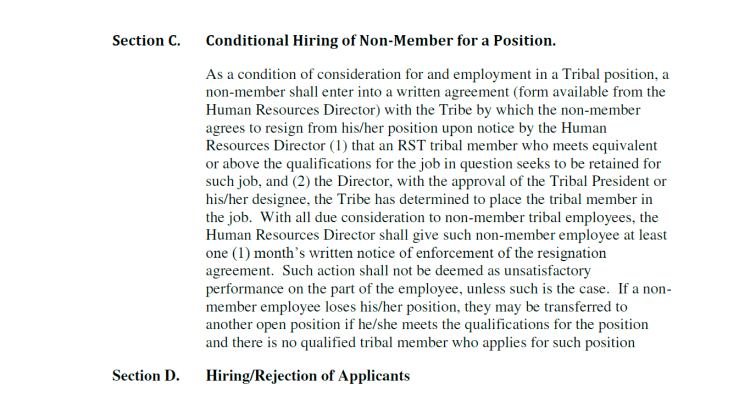
“As a condition of consideration for and employment in a Tribal position, a non-member shall enter into a written agreement (form available from the Human Resources Director) with the Tribe by which the non-member agrees to resign from his/her position upon notice by the Human Resources Director (1) that an RST tribal member who meets equivalent or above the qualifications for the job in question seeks to be retained for such job, and (2) the Director, with the approval of the Tribal President or his/her designee, the Tribe has determined to place the tribal member in the job. With all due consideration to non-member tribal employees, the Human Resources Director shall give such non-member employee at least one (1) month’s written notice of enforcement of the resignation agreement. Such action shall not be deemed as unsatisfactory performance on the part of the employee, unless such is the case. If a nonmember employee loses his/her position, they may be transferred to another open position if he/she meets the qualifications for the position and there is no qualified tribal member who applies for such position.”
non member

Last week, the tribal council disregarded law established by Ordinance 2007-09 with the following action: “Motion by Richard Smoke Whipple that we deny Ione Quigley’s challenge and Ben Rhodd stay in as the THPO Director. Seconded by Lenard Wright, question by Russell Eagle Bear. The vote: eight (8) in favor, zero (0) opposed and four (4) not voting. MOTION CARRIED.”

After this action was approved, President Bordeaux stated for the record that “Ione Quigley is a tribal member, met the qualifications [for the Director position at the Tribal Historical Preservation Office] and this is the law.” President Bordeaux reviewed the education and experience of both Rhodd and Quigley. Rhodd is not Sicangu Lakota.

Furthermore, the council tried to cover their blatant violation of tribal law by approving the following action: “Motion by Rita Means to find the resources to fund a position for Ione Quigley at THPO, Land Office or somewhere. Seconded by Lila Kills In Sight, question by Richard Whipple. The vote: eleven (11) in favor, zero opposed and two (2) not voting.”

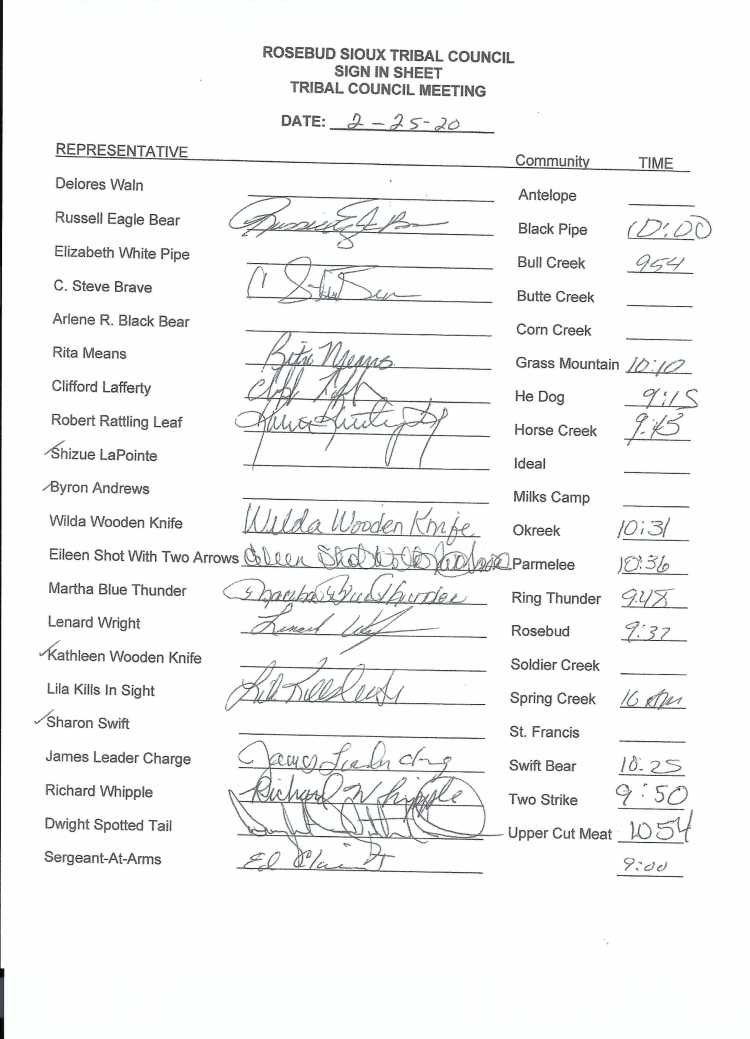
Other council representatives in attendance at the February 25 meeting were: C. Steve Brave, Clifford Lafferty, Robert Rattling Leaf, Wilda Wooden Knife, Eileen Shot With Two Arrows, Martha Blue Thunder, James Leader Charge and Dwight Spotted Tail.

RSTC Motion Excerpt 02-25-2020

RSTC Sign in 02-25-2020

Instances like these are very discouraging for all of us. Rosebud’s educated citizens obviously don’t have much to look forward too in terms of tribal employment. Tribal council representatives aren’t above the law. Tribal law is written for educated Sicangu people to have first preference at employment.

Rosebud’s Primary Election is scheduled for July 23, 2020. Ten council seats are up for election. I encourage all tribal citizens to register to vote and then support new candidates who will follow the law. Now is the time to recruit tribal candidates from Grass Mountain, Ideal, Spring Creek, Soldier Creek, Two Strike, Butte Creek, Parmelee, Black Pipe, Milks Camp and Okreek to run for office.

We will not more forward until new people committed to upholding Rosebud’s tribal laws are elected to office. Please support candidates who can read, understand and enforce tribal laws. Representatives without integrity will continue to trample over the policies and laws we all must follow.

Vi Waln is Lakota and an award-winning journalist. She can be reached at viwaln@gmail.com.
 

Adults are the worst bullies

Untitled

Bullying is still a problem in our schools. There are many intelligent students who refuse to attend school because they suffer verbal, mental, emotional and physical abuse while in class. The schools operating on my reservation will likely never improve. The majority of board members, administration, faculty and staff don’t seem to care about the real problems our young people face while attending school.

Recently, a young relative was bullied by two adult women. I have reached the age where I can be considered an elder in my tribe. The two adult women who bullied the young relative are both older than me. I once believed they were good people but their actions in the past month or so have proved otherwise. Consequently, I think I am fortunate that these two old women exposed their true nature for me to see. Their behavior is toxic and I work hard to stay away from their kind. Due to their age, I doubt they will ever change their behavior. I am extremely appalled at their actions.

Also, reservation gossip is a thriving activity that needs to be outlawed. Some organizations actually have written policy against gossip in the workplace but employees often won’t follow policy. Consequently, these two old ladies got together and talked horrid gossip about the young relative. The two adult women actually work in schools on the Rosebud reservation; they should be ashamed to gossip about any student.

These two adult women referred to the student in a very disparaging manner. We all grew up in our respective communities and watched one another. These two adult women shouldn’t be calling young relatives derogatory names, since they both have extremely colorful pasts of their own. In fact, the names they called the young relative are likely names they were both called when they were out and about laying down their colorful pasts.

Consequently, I’ve known these two old women most of my life. We all know that heavy alcohol abuse and promiscuous behavior are actions most reservation people never forget about anyone’s past. Each one of us has a past and it’s usually the first thing that’s brought up in gossip sessions. When I was a teenager, I remember my older relatives making remarks about these same two adult women and how they used to behave. We can all change our behavior but our past is still always there for someone to talk smack about.

Gossip and bullying are traits of sick people who are afflicted with the disease of the mind. When I encounter someone who acts like they are affected by a diseased mind, I wonder if they are suffering from mental illness. These two adult women behaved in a way which people with diseased minds tend to act. Emotional intelligence is the opposite of the disease of the mind; I remember one of my relatives telling me it took her four hot sweats before she could sincerely pray for someone who had hurt her family. Those who’ve healed their diseased minds will pray for people who’ve hurt them.

Both adult women should know better to than to talk about a young person in the way they do because suicide is always on some of our teenager’s minds. It doesn’t take many words to push a teenager over the edge. School employees/board members who regularly gossip about students or other staff should be barred from working in educational institutions. If this is the type of education the adults are providing to students, then the schools on Rosebud should be closed.

Remember to be careful what you say because the person you gossip about will likely hear it back. Words can’t be taken back.

Vi Waln (Lakota) is an award-winning Journalist. She can be reached through email viwaln@gmail.com

Decolonizing American Holidays

IMG_2253

February is a month with a free Monday. It’s free because people employed in full-time jobs are usually given the day off with holiday pay. We all love those paid days off. I wonder if those paid days off, like the Monday we just had for President’s Day, help our minds remain colonized.

Some of us have no clue why the post office, hospital, tribal offices, etc. are closed every third Monday in February. Some people who work full-time look forward to a paid day off as one of the fringe benefits of non-essential employees. Businesses, however, jump at the chance to sell us their products with their President’s Day sales, which actually run a whole week.

President’s Day is a federal holiday created to honor George Washington, whose birthday was this month. Later, Abraham Lincoln was added since he was also born in February. Even though it is a recognized holiday, some organizations don’t honor it as such and are open during regular business hours.

On a tribal level, there isn’t much fanfare about President’s Day in Indian Country. Some tribal colleges have classes as usual on President’s Day. Many federal and state government employees have a paid day off. Most of us will agree that the sitting President of the United States (POTUS) doesn’t give Lakota people much to celebrate about. There isn’t a lot for us to commemorate, unless we are one of the fortunate people with a full-time job who is getting paid to enjoy a day off from work.

In addition, the tribal government structure many of us know wasn’t created to align with traditional Lakota form of governance. The Indian Reorganization Act of 1934 forced a largely foreign way of governance down many Indigenous tribes’ throats. Still, it’s the governance structure we currently operate from. It’s up to our people to find creative ways to promote genuine, contemporary Lakota leadership.

Indian Country uses lots of American holidays as a time to celebrate culture. Today, many wacipis or other cultural celebrations are scheduled to coincide with the holidays we all see marked on the Gregorian calendar. New Year’s Day, Valentine’s day, Easter, Memorial Day, Independence Day, Labor Day, etc. are times when our people celebrate culture by participating in a wacipi or round dance.

Just like the dominant society taking what once was a time for ceremony – such as Winter Solstice and converting it into something Christian, like Christmas – our people can now choose to celebrate the dominant society’s observances with cultural gatherings. It’s another way to decolonize the wasicu holidays. Our children don’t have to see us blindly following holidays listed on the calendars we have in our homes. We can shift our focus from what everyone else in the country is doing to observe a certain “Day” by celebrating Lakota culture.

Traditional Lakota society never recognized any presidents or holidays in our government structure. The leaders were chosen for their ability to maintain camp order. There was shared leadership in our Tiospaye and it was respected by all. There was no such thing as popular vote in the Oceti Sakowin.

This President’s Day, many Lakota people choose to remember their own tribal leaders. These leaders include not only our tribal government elected officials, but also our traditional leaders who are fluent Lakota speakers working to keep our language and ways of life alive. We still have living Itancan in our communities and this is also a time to remember everything they’ve done for our families. We also have very special Lakota Itancan providing spiritual support in the form of Inipi and Lowanpi. There are many ways we can choose to celebrate our Lakota family, tribe, culture and ceremony.

Vi Waln (Lakota) is an award-winning Journalist. She can be reached through email viwaln@gmail.com


Did you like this post? Consider making a donation to help maintain this website. Wopila! 

Change is in Your Hands

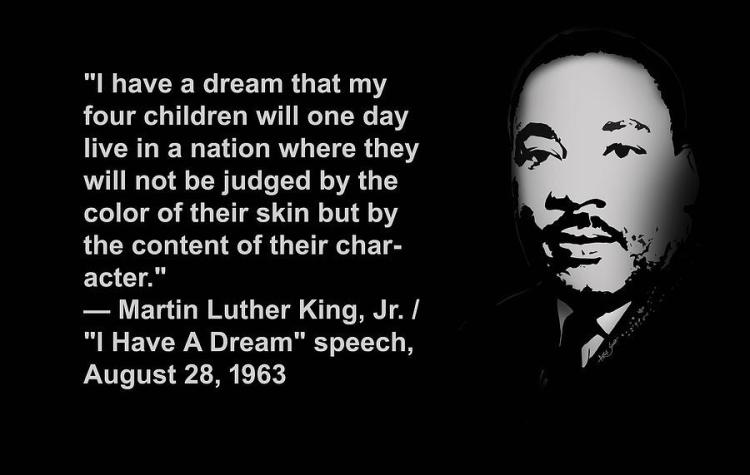
The Reverend Dr. Martin Luther King was only 39 years old when he was murdered in Memphis, Tennessee on April 4, 1968. If Dr. King were still alive, he would have celebrated his 91st birthday on January 15. Some of us have living parents or grandparents who are still living a full life, even though they have reached 90+ years of age. So, when I think of my elder Lakota relatives, I realize it wasn’t really that long ago when Dr. King was working for all of us to have the same opportunities as white people.

Dr. King was a clergyman and a civil rights advocate. He was hated vehemently by the wasicu who didn’t want people of color to have the same rights as white people. However, he didn’t let the hate from others stop his mission. He continued to forgive and pray for the best outcome for all people of color.

Dr. King was outspoken. Thanks to the internet, we are fortunate to be able to listen to the numerous public speeches he offered addressing the right of people of color to have the same opportunities as white people. Dr. King was disliked by many people all over the world who did not want to see any people of color advance. Nevertheless, every January we celebrate Dr. Martin Luther King, Jr.’s birthday as a federal holiday.

As a Lakota woman, I continue to experience racism due to the color of my skin. I’ve experienced racism from my own people because my government-imposed pedigree, also known as my Certificate of Indian Blood or tribal ID card, lists me as less than a full-blood. I also experience racism from people who are not tribal citizens. I don’t let it stop me. I don’t make eye contact with people when I am away from home unless they are people of color.

Before the civil rights movement, our people were viewed as second-class citizens. Our great-grandparents were targeted for blatant racial discrimination in many places of business across the country. Even though discrimination based on race is now against the law, we continue to experience prejudice as Indigenous people.

It doesn’t help that the 45th President of the United States (POTUS) encourages discrimination among his supporters. His attitude has emboldened many closet racists to come out publicly with how they really view Indigenous people. A lot of these now open racists are on school boards, county commissions or have served on either the state or national level legislatures.

People who hate anyone darker than themselves glare at me when I go shopping in Rapid City, Sioux Falls or Pierre, South Dakota. They commit on social media feeds, spewing their disgust for people of color any chance they get.

Dr. King wanted a better life for people of color and he stood up to advocate for it. So, even though we have a racist, homophobic POTUS – we still have the right to vote in local, state and national elections. We have the power to change the faces who represent us at all political levels.

But it’s up to you to help with this change. You can do this by registering to vote in your tribal, county, state and national elections. You can also bring more public funding to your area by making sure every member of your household is listed on the 2020 Census form. These may be small acts but they are a big way to prompt change.

Many of the opportunities now available to us as Indigenous people are a result of Dr. King’s work. Relatives, we cannot let racism win. Teach your children to be accepting of all people, no matter their color or disposition.

i-have-a-dream-martin-luther-king-jr-world-of-quotes-artist-singh


Vi Waln (Lakota) is an award-winning Journalist. She can be reached through email viwaln@gmail.com


Rosebud Amends Criminal Code to comply with VAWA, TLOA

ROSEBUD RESERVATION – The Rosebud Sioux Tribal Council approved legislation last week to amend their law and order code to comply with federal criminal laws.

In 2018, the tribal council approved Resolution 2018-95 to protect the women, men and children of the tribe against violence. The Resolution also adopted the Violence Against Women Reauthorization Act of 2013 (P.L. 113-4, Sec. 904, 905) to prosecute non-Indians under its inherent right to punish those who violate tribal laws within its territory.

Under the Violence Against Women Act (VAWA) and the Tribal Law and Order Act (TLOA) the tribe has the federal legal authority to exercise jurisdiction over non-Indians who reside, work, or who are a spouse, intimate or dating partner of an Indian residing with the Tribe’s territorial jurisdiction, and have subjected a victim to domestic violence, dating violence or criminal violation of a protection order.

Ordinance 2020-03 was adopted last week to clarify the area of jurisdiction the Rosebud Sioux Tribe has over crimes committed against tribal citizens. This legislation, adopted through Resolution 2020-03, reads in part: “The Rosebud Sioux Tribe’s criminal jurisdiction shall extend to the territory within the original confines of the Rosebud Reservation boundaries as established by the act of March 2, 1889, and to such other lands as may hereafter be added thereto under any laws of the United States, except as otherwise provided by law…The criminal jurisdiction of the Tribe shall extend to all Indians and all other persons whom the exercise of criminal jurisdiction by the Tribe is authorized or permitted by federal law.

“The Rosebud Sioux Tribe’s criminal jurisdiction shall extend to non-Indians who by federal law are subject to the Tribe’s special jurisdiction who commit violent crimes specifically domestic violence and dating violence against Indians within the Tribe’s jurisdiction. The Rosebud Sioux Tribe’s special criminal jurisdiction shall extend to criminal protection order violations under 5-44-7 [of the RST Law & Order Code]. The conditions for a non-Indian who violates the Tribes’ domestic violence and dating violence [laws] are: (1) reside within the territorial jurisdiction of the Rosebud Sioux Tribe; or (2) Is employed within the territorial jurisdiction of the Rosebud Sioux Tribe; or (3) Is a spouse, intimate partner, or dating partner of: a. a member of the Rosebud Sioux Tribe; or b. An Indian who resides within the territorial jurisdiction of the Rosebud Sioux Tribe.”

In addition, the Rosebud Sioux Tribe is committed to exercising special domestic and dating violence jurisdiction over non-Indians who abuse Indian people within its territorial boundaries and will enforce its inherent authority over protection order violations by adopting Title 5, Chapter 44, Domestic and Dating Violence code and repealing Title 5, Chapter 38 in its entirety, to protect the women and children. This legislation was adopted as Ordinance 2020-01.

The tribal council also adopted changes to the RST Law & Order Code by adding Title 5, Chapter 2, Section 5 (5-2-5) which identifies Class F crimes as felonies. A Class F crime carries a maximum term of confinement as three (3) years, a fine of $15,000 or both. In addition, a person who is found guilty of multiple Class F offenses under this Section can be sentenced to nine (9) years in the tribal jail, a fine of $15,000 or both, as well as court costs. This legislation was adopted as Ordinance 2020-02.

The tribal council conducted their first reading on the amendments to the Law & Order Code last week. All required readings at the tribal council level must be completed before these amendments are valid. Also, the RST Adult Correction Facility must obtain certification to house inmates who are sentenced for conviction of Class F felony crimes. Tribal officials are currently working to get that certification in place.

The Tribal Council also approved Resolution 2020-04 which states that all references to “children” in the RST Law & Order Code, Section 1. Code Interpretation, be changed to “wakanyeja.”

For more information, please call the Tribal Secretary’s Office at 605-747-2381.


REDCO Presents $388K Dividend Payment to Rosebud Sioux Tribe

REDCO Presents $388K Payment to Rosebud Sioux Tribe
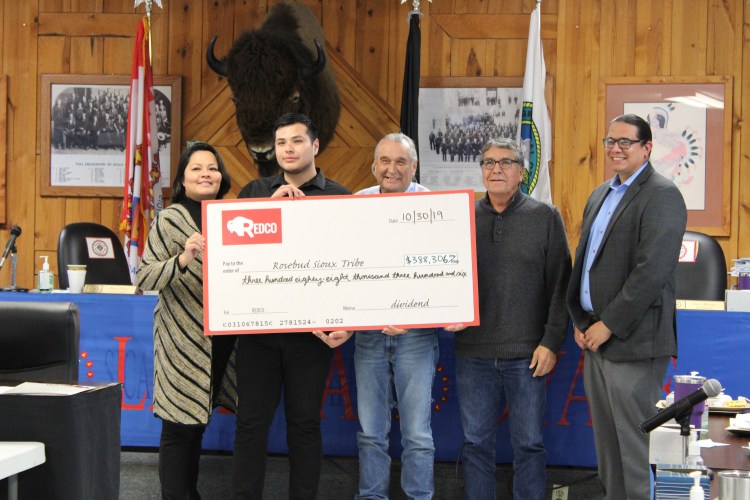
REDCO presented a $388K divident payment to the Rosebud Sioux Tribe recently. Pictured are (L-R) Lisa White Pipe, Stephan DeNoyer III, Wayne Boyd, Rodney M. Bordeaux and Wizipan Little Elk. Vi Waln photo.


ROSEBUD RESERVATION – The Rosebud Economic Development Corporation (REDCO) presented the Rosebud Sioux Tribe with a $388,306 dividend payment at a special tribal council meeting held recently.

“REDCO has grown from 1 employee to 57 employees in 7 years,” stated Wizipan Little Elk, REDCO CEO. “We want to find ways to help our people improve their quality of life.”

REDCO’s top accomplishments during the past year include bringing in revenue totaling $16,042,066. This amount resulted in a profit of $1,944,031 and provided the $388,306 dividend payment to the tribe. REDCO has had several accomplishments during the past year.

For example, REDCO has completed (1) 2018-2022 Comprehensive Economic Development Strategy (CEDS), (2) 2019 State of the Workforce Report, (3) 10+ government contracts and (4) construction of Indian Health Service staff apartments. REDCO has also implemented a Design-build to construction group, which will allow employees to oversee the entire construction project from initial design to final construction. Also, REDCO has implemented a healing informed workforce development strategy to help employees do the best job they can.

REDCO has several businesses, or subsidiaries, which they oversee. These include Rosebud Office Solutions (ROS), Rosebud Construction Inc. (RCI), Sicangu Propane, Arrow Financial Services (AFS), Sicangu Food Sovereignty Initiative, Sicangu Community Development Corporation and Tatanka Funds Community Development Financial Institution (CDFI).

Our ancestors worked hard to feed their families and knew certain strategies worked better than others. For instance, corn, beans and squash were planted in a mound for better growing results. These three staple vegetables were known as the Three Sisters. REDCO also believes in a Nation Building Approach using the Three Sisters technique because, as Lakota people, we believe we are all related and it is our duty to grow a better world for future generations.

REDCO, Sicangu CDC and Tatanka Funds are the Three Sisters of the corporation. REDCO will be charged with developing amazing leaders who will run great organizations to grow local economic development. Sicangu CDC will work to develop our overall community to empower all our people. Tatanka Funds CDFI will work on individual asset building through personal finance, business entrepreneurship and homeownership.

“It’s not important to tell you what I can do,” Little Elk told the tribal council. “What’s most important is for me to tell you what I can’t do. This is the reason why we build a team to carry out our plans.”

The 7Gen plan will work toward our people being healthy, helpful and safe. When we calculate 25 years for 1 generation, the plan must encompass the next 175 years. The 7Gen plan will develop strategies to work for improvement in 7 areas. These include Rosebud’s current (1) housing shortage, (2) low educational attainment, (3) poverty, (4) poor healthcare, (5) lack of jobs, (6) climate change and (7) food desert.

REDCO’s FY20 financial goals include increasing the corporation’s overall revenue to $21 million, which will increase profits to $2.7 million. Also, developments currently in motion for FY20 include (1) develop RST new tax strategy, (2) develop RST Hemp Code, (3) Amend Uniform Commercial Code, (4) Create the 7Gen Plan, (5) Support the Three Sister development: REDCO–Sicangu CDC–Tatanka Funds CDFI, (6) Start-up Rosebud Facilities Management and move into government contracting and (7) assess REDCO’s business cycle and scale-up plan to REDCO 3.0.

A six-member board is appointed by the tribal council to oversee REDCO. Board members are Wayne Boyd (Chairperson), Rodney M. Bordeaux (Vice-chairperson), Nora Antoine (at-large member), OJ Semans (at-large member) and Lisa White Pipe (RST Budget & Finance Committee Chair). The sixth board seat was held by the late Vernon Ike Schmidt and the tribal council is expected to appoint a replacement soon.

REDCO is preparing to roll-out an upgraded website in the coming weeks. You can visit them online at www.sicangucorp.com. Call 605-856-8400 for more information.


Vi Waln (Sicangu Lakota) can be reached through email at viwaln@gmail.com


Lakota Students Need Healing Spaces


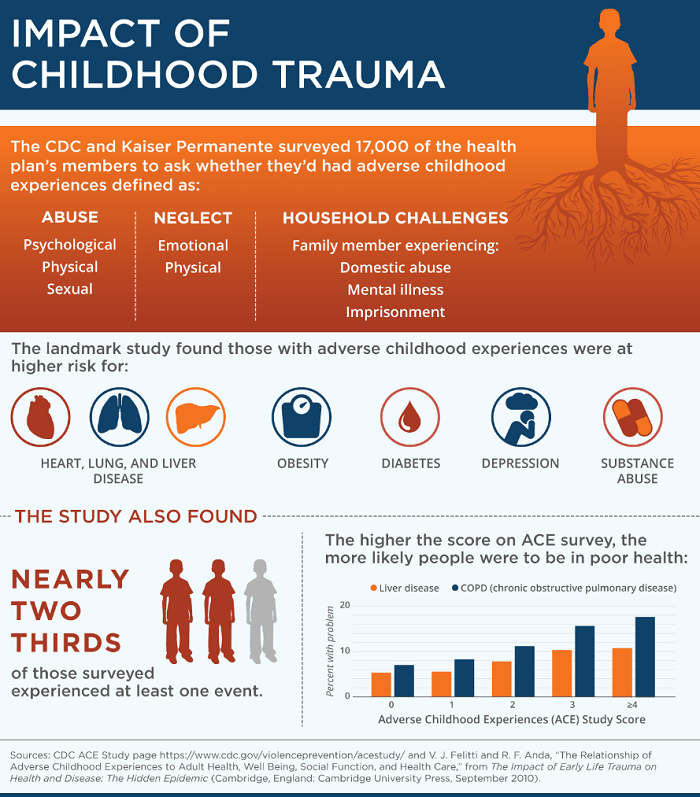
A majority of Lakota people raising children have a difficult time. The substance abuse epidemic continues to affect all of us, along with the school staff our young people encounter. Substance abuse drastically altered our lives. A majority of Lakota children are exposed to adverse childhood experiences (ACEs)

Our Takoja are required to attend school under tribal law. We try to follow the law by registering our children for school every year. But schools aren’t safe anymore. School statistics on incidents involving drugs, a bully/gang, firearms or violence prompting a call to 911, should be shared by administrators as soon as they occur. The rumor mill has us all confused.

We understand education begins in the home. Parents, along with extended family members, may or may not work to help their children succeed in school. What we do in our homes carries into our reservation schools.

childhood-trauma

Another thing to consider is the social environment in our local communities. Think about the community you live in and the effect it has on your family. There are communities whose residents fear leaving their homes for a number of reasons. Our communities grow more unsafe with every single day.

The health of our homes spills over into the school system. This week I read social media posts relating to incidents which allegedly happened at our reservation schools. A student said he received a 10-day suspension for being in the wrong place at the wrong time. There were some of our students who received two or more 3- to 10-day suspensions during the first quarter of the 2019-2020 school year.

I heard from two different tribal citizens about gun incidents in two of our local schools on Rosebud. Our K-12 students make many threats toward one another and sometimes police are involved. Most grandparents don’t have the answers but we understand the mental health of our young people is crucial to the survival of our Oyate.

A lot of our children grow up experiencing a maximum of adverse childhood experiences (ACEs).

When our children don’t experience a homelife which promotes healing, nothing will change. Disciplinary actions on our students are required by school policy, but they rarely help young person move any closer to healing from the experiences they lived through in childhood.

I am aware of several families who work hard to provide a safe and healthy environment for their young people. Yet, when our young relatives leave our homes, they must deal with their peers, school staff and others. Peers are the most difficult group to interact with. Middle and high school students with trauma-ridden childhoods need extra help in school; counselors are not equipped to deal with young people who are adversely affected by their environment.

I’ve learned it doesn’t do any good to visit with people working at the school. When dealing with school staff and administrators, our people often feel they are degraded. For instance, school staff will profess to be intimidated by the family of a student without a valid reason. Sometimes we are lied to when we visit our young people’s schools. Classroom management doesn’t seem to be very effective.

Some suggestions I’ve read on social media posts advocate for us to visit one another, that is, we are told to approach parents of students who continue to provoke incidents where police are summoned. It might or might not work. It could cause more problems for the people trying to resolve issues. For example, it’s a major challenge to be asked to reason with adults who perpetuate an environment which promotes adverse childhood experiences; or adults who are active alcohol or drug users.

We all must provide healing spaces for our children.

100_1264


Vi Waln (Lakota) is an award-winning Journalist. She can be reached through email vi@lakotatimes.com


Domestic Violence Awareness Walk on Rosebud

Domestic Violence Awareness Walk on Rosebud 2
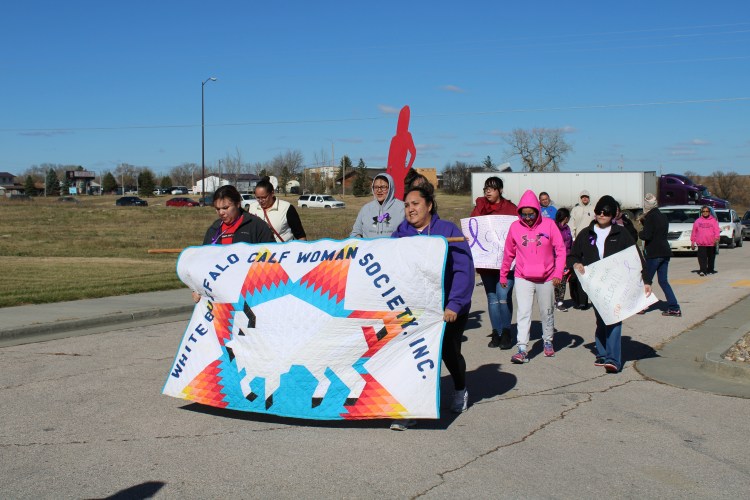
Participants carried the White Buffalo Calf Women’s Society banner on Oct. 26 in Antelope Community. A Domestic Violence Awareness walker carried a Silent Witness. (Vi Waln photo).

ROSEBUD RESERVATION – A small group of tribal citizens braved the chilly wind over the weekend and walked through town to bring awareness to the domestic violence epidemic plaguing the reservation.

A police escort led the walkers from the west end of town to the Sicangu Family and Child Services where refreshments were served. An open microphone was also available to participants.

One domestic violence (DV) survivor shared her story with the group as follows:

“I’d like to address a question that I hear often. Why does she stay? That disturbing question has an equally disturbing answer. Why would anyone stay with a partner who abuses them?

“In the beginning his drinking didn’t bother me. I knew he drank but I didn’t really see the extent of it until we moved in together. The abuse I endured usually happened when he got drunk. I knew once he was off to get his alcohol I was in for a rough night. Eventually I stopped going around my family. I stopped seeing my friends. Mostly because he would do things that made me feel so much shame and humiliation.

“My family would tell me that he wouldn’t stop hurting me and I needed to leave him. Did I listen? Nope! I thought that if I showed him how much I loved him he could change. He just needed a little love and understanding because he had been through so much. I hung in there because I loved him and he loved me too. He was just stressed out and it was an isolated incident and it was never going to happen again. Until it happened again. And again.

Why did I stay? I didn’t know he was abusing me, even though he held me hostage at knife point, tried to wreck the car we were in, stripped me naked and pushed me out of the house by jabbing me in the leg with his machete. Even though he killed my dog, smeared my make up when I tried to dress up, destroyed my pottery and paintings, I never thought of myself as a battered woman. Instead I was a very strong woman in love, who was in love with a deeply troubled man and I was the only person on this earth that could help him face his demons.

“Why didn’t I just walk out? To me that is the saddest and most painful question that people ask because we victims know something that the rest of you don’t. It’s incredibly dangerous to leave your abuser because the final step in the domestic violence pattern is to kill her. Over 70 percent of domestic violence murders happen after the victim ended the relationship.

“And still we ask why doesn’t she just leave. Well, I was able to leave after one final sadistic beating. I realized that the man I loved so much was going to kill me if I let him. So, I broke the silence. I told everyone. My family and friends, the police, my coworkers, total strangers. I am here today because they all listened and helped me.

“We tend to stereotype DV victims; as grizzly headlines, self-destructive women, damaged goods. The question ‘why does she stay’ is code for some people to think it’s her fault for staying. As if we choose to intentionally fall in love with men intent on destroying us.

“I am now married to a strong, kind, hardworking, gentle man. We live together with our fur baby and we have a happy, supportive and healthy relationship. What I will never have again is another knife held to my face, a chain wrapped around my neck, or cuts and bruises from a man who says he loves me.

“I promise you that you know someone currently being abused, who were abused as children or who are abusers. Abuse can be affecting your daughter, your sister, your best friend right now

“I was able to end my own crazy love story by breaking the silence. Talk about what you heard here. Abuse thrives only in silence. You have the power to end domestic violence simply by shining light on it. Show abuse the light of day by talking about it with your children, your coworkers, your friends and family. Recast survivors as wonderful loveable people with bright futures. Recognize the early warning signs and conscientiously intervene. Show our relatives a safe way out. Together we can make our homes, our communities, our nation the safe haven that it could be. Wopila!”

Domestic Violence Awareness Walk on Rosebud 1
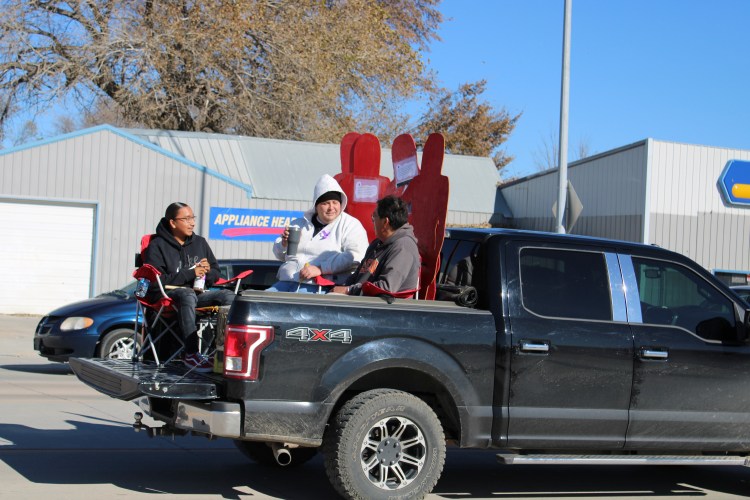
The Silent Witnesses rode in the back of the truck with the Red Leaf singers. These particular Red Ladies represent real Sicangu Lakota women from Rosebud who were murdered by their husband or boyfriend. (Vi Waln photo).


Vi Waln (Lakota) is an award-winning Journalist. She can be reached through email vi@lakotatimes.com


I don’t trust cops

Technology is a great tool for us to seek new information to improve our outlook on life. Yet, technology is also abused on a daily basis by unscrupulous users. Prior to the internet, computers, cell phones and social media – we had to rely on eye witness accounts or unreliable gossip to get our updates about what was going on around us. Today, we can just open an online news website or log into our social media account and watch a video filmed on someone’s cell phone. It’s both a blessing and a curse.

It’s a blessing because there’s a ton of information available right at our fingertips. For example, today’s students are especially fortunate because researching a topic for a class assignment is much easier when you have a computer or other device to access the internet.

However, technology is also a curse because it’s a way for people to bully one another from an internet connected device. And there is a whole lot of bullying going on through social media sites, email accounts and text messages. Sadly, young people have committed suicide after being viciously bullied through a computer, electronic tablet or cell phone.

Another advantage of technology is impromptu video. We can now watch videos uploaded to the internet by amateur recorders using just a cell phone. We can also watch videos depicting police brutality. Police can no longer deny they’ve used excessive force to subdue someone or even killed a person running in the opposite direction, as there is always a camera nearby. All of us, including the police, are under constant surveillance.

In light of numerous written reports and online video depicting police brutality, along with the “justified homicide” of countless unarmed suspects, I’ve stopped calling the police to my home. I couldn’t live with myself if a relative was killed by a cop wielding a police-issued firearm after I’d called for help. Judge me as you will; I don’t trust cops.

Consequently, on Rosebud we’ve seen our share of “justified homicides” by tribal police. This country has also witnessed the brutal killing of unarmed brown or black people by police. It’s time to protect ourselves and our family from trigger happy cops.

Last week, two young girls got into a fist fight at a middle school in Rapid City, South Dakota. With today’s technology in everyone’s hands, the fight was captured on cell phone video and shared widely on social media. The video also captured the unnecessary assault by a Rapid City cop when he stepped in to stop the fight.

There is much division surrounding this incident. Some people believe the cop was justified in using force to stop the fight. Others are appalled that the cop would use such force on middle school girls. One photo circulating on Facebook shows the girl with her neck twisted at an unnatural angle. Would it have been a “justified homicide/injury” if the girl’s neck was broken? Many of us hope there is no permanent damage to the girls. I believe the cop used unnecessary excessive force.

There’s a ton of parent shaming also going on through social media posts. It’s really easy to be the judge and jury when you are posting from a cell phone or from behind a computer screen. I urge you to think about how you would respond if it were your child pictured with a twisted neck in that photo.

The black and brown people living in this country are all too familiar with police brutality. When a brown or black child is killed by a Rapid City cop, will the investigation lead to a final written report which clears the police officer of “justified homicide?”


Vi Waln (Lakota) is an award-winning Journalist. She can be reached through email vi@lakotatimes.com